


 Francais
 Deutsch
 Italiano
Refine Your Search
Takhli Thailand 1966 stock footage and images
- Showing 295 to 300 of 1203 results more
more Hide
Hide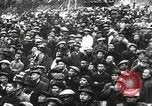
U.S. Army Air Forces employ air power in the India-Burma theater during World War II. Chinese troops are equipped and trained by U.S. soldiers.
Camera pans across scenes showing masses of Chinese. Narrator cites their large population as a war asset. Lt Gen. Daniel Sultan Commander of US Forces, India–Burma Theater (USFIBT) describes the Allied mission as simply "placing guns in the hands of men in order that they can kill our common enemy." He describes Japan's 1942 strategy of completely isolating China from outside help. Animated map shows Japanese forces attacking China from bases in Thailand and advancing north, driving British forces into India, and leaving Burma in Japanese hands.Glimpse of Japanese troops occupying Burma. Views of American troops evacuated to India. View of Chinese soldiers boarding U.S. Air Transport Command C-46 transport planes for flights from Kunming to Dinjan and Chabua, India. Closeup of some troops inside the cabin of a plane. Chinese soldiers await transport as a C-47 aircraft takes off in the background. Aerial view of two C-47 planes in formation. View from the air of high cloud covered mountains. Storm clouds over the mountains. Downward view from an aircraft flying over the Himalayan Mountains (called flying the "hump" by U.S. pilots). View of Chinese soldiers inside a transport plane. View out the window of a transport plane landing in India. A C-46 airplane taking off. A large formation of Chinese troops seen after more were brought from China to India, later in the war. American soldiers training troops of the Chinese 38th and 22nd Divisions. General Sultan speaks of the need to build up the U.S.Air Transport Command. Two C-47 airplanes on the ground. One named "The Joker." View of sky filled with B-24 Liberator bombers. Sky filled with C-47 transport planes. Chinese soldiers training in Kunming, climbing out of trench in live fire exercise with machine guns firing over their heads and explosive charges detonating near them. Air frame of a P-47 aircraft being loaded and several of Bell P-39 Airacobra aircraft being loaded aboard ship bound to strengthen the U.S. Army 10th and 14th Air Forces in Burma, in 1944. Covered P-47 aircraft without engines being towed by jeeps along a street in Burma. A large airfield with many U.S. fighter planes parked on its ramps. Engines being installed on P-39 aircraft. A flight line filled with P-40 aircraft displaying Chinese roundels. Some fly over a flight line of U.S. Army Air Forces P-39 aircraft. Glimpse of a fighter plane escorting a transport aircraft. A formation of B-24 Liberator bombers dropping bombs and exploding on Japanese ground targets. Workers are seen unloading large amounts of cargo from a B-24 bomber. Workers rolling a large bomb from the plane onto the tailgate of a truck.
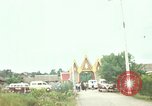
Houses, hotels, and the vegetable market in Nha Trang, Vietnam.
The city of Nha Trang in Vietnam. View of the city. Vehicles parked outside a temple entrance. A van leaves the area. Modern buildings in the commercial district. Elaborate houses and hotels. The Nana Hotel in Bangkok, Thailand. A swimming pool in a hotel. Other buildings and shacks. A local marketplace. Locals in conical hats sell fruits and vegetables such as bananas and durians. Men and women in shacks and stalls in the market. A young boy stands on a rock structure.
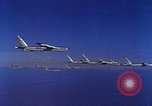
Cold War weaponry and NATO and American readiness for strike; Polaris Submarine and its features.
Aerial side view of formation of USAF B-52 Stratofortress bombers in flight in a blue sky. Dusk or dawn view of the White House in Washington DC and trees bare of leaves. Closer view of a single light on in one window of the White House while all else is dark. President Johnson seated at his desk reviewing paperwork. Close side view of President Johnson at work. American children spin on a playground carousel ride. Views from an outdoor market in Latin America or South America. Scenes of Bangkok, Thailand, boats with wares for sale seen in river, Wat Arun Temple. Low aerial views of a Polaris Submarine cruising at water surface. Crew of U.S. Navy Polaris submarine seen inside the submarine, including crew working in control room, and crew relaxing in a galley while one crew member plays a guitar. Crewman reading in his bunk while others play a game of chess. A line of submarine bunks. Crewman in engine room of Polaris submarine, passing by tubes of Polaris Missiles. Narrator indicates there will be 41 such submarines carrying over 600 such missiles, in movement at all times. (Mutual Assured Destruction). Sunset over waters of ocean. Children in Honduras walking to school. Honduran children in a classroom while teacher speaks. The Honduran children read books and listen to the teacher's instruction.
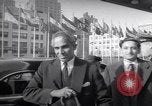
Representatives of various countries at the United Nations meeting in New York
V K Krishna Menon arrives by car for United Nations meeting in New York City. Ride escalator in building.Representatives of Finland, Thailand, England, Egypt and Israel during meeting. Dignitaries seated
Meeting of United Nations General Assembly in New York.
Representative of various countries go into building for meeting of United Nations General Assembly in New York. Ride escalator in building. Representatives from Thailand. A man talks to representatives from Greece. Secretary General Dag Hammarskjold and others greet a speaker on the podium. Representatives seated.
U.S. Rangers and Filipino guerrillas rescue Allied prisoners from Japanese prison camp in Philippines during World War II.
On January 30, 1945, 121 members of the 6th Ranger Battalion and 286 Filipino guerrillas are seen setting out on a 30 mile trek behind Japanese lines, to free Allied prisoners of war (POWs) and civilians from a Japanese camp near Cabanatuan City, in the Philippines, during World War 2. They stretch out in a long, informal column as they traverse low flat lands and ford a wide shallow river. The men carry weapons and supplies (some on their heads) as they move along, almost like a Safari. Scene shifts to rescued prisoner, Major Emil P. Reed, U.s. Army Medical Corps,26th Cavalry. He was the senior officer among prisoners at the Cabanatuan prison camp number 1. He recounts being told by the Japanese Commandant that commencing January 7th, they were free at their own risk, but also assured them they would not be molested by the Japanese if they stayed within their regular camp area. Sergeant Samuel E. Goldy, Signal Corps, also speaks a few words about that period when Japanese were departing. Next the camera records the Rangers and Filipino guerillas returning with the approximately 500 freed POWs. Some Filipino women and children watch them return. At one point, the cadre climb aboard army trucks and continue their journey in a convoy. The POWs climb down from their trucks at the 92nd Evacuation Hospital, in Guimba, Luzon. Some take pleasure is simply lying down on the grass at the site. Many gather around hospital staff handing out packages of treats, including cigarettes, candy and the like. A couple of them express pleasure as they smoke cigarettes. Two frail and injured are seen hobbling with canes. Some appear seriously malnourished. A group are seen trying on new clothes. A British prisoner, Sergeant Robert Bell, Manchester Regiment, British Army, speaks of his experience. He was taken prisoner in Singapore and sent to Thailand where he worked to build a railway for the Japanese. Many prisoners died there from disease and malnutrition. He was one of a small number who survived after being on a Japanese ship with other prisoners when it was sunk by American dive bombers. Sergeant Walter Ring, of San Roque, Luzon, is seated, relaxed on a chair, as he recounts his experiences. Two young Filipino boys sit on the grass at his feet. He reaches to one, whom he says is his son Louis and to the other, his son Sam. His captivity began on Bataan in 1942. Finally, after rest and rehabilitation, the former POWs are seen heading away from the battle fronts to be transported back to the U.S.A.