


 Francais
 Deutsch
 Italiano

Refine Your Search
Takhli Thailand 1966 stock footage and images
- Showing 541 to 546 of 1203 results more
 Hide
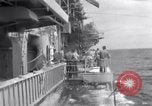
Crew of Aircraft Carrier USS Oriskany (CVA-34) successfully extinguishes fire aboard the ship, while deployed off Vietnam
Aircraft Carrier, USS Oriskany (CVA-34) extinguishing of fire resulting from accidental igniting of flares below the flight deck. Sailors on sponson deck begin recovery and cleanup after extinguishing the fire. Water from fire hose is discharging overboard. Sailors begin retrieving fire hoses. View of fire-damaged areas. Sailors begin cleanup of hangar space beneath the flight deck. Above, cleanup begins. Sailors move bombs on wheeled cradles
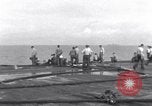
Firefighters prepare to enter area still burning on USS Oriskany (CVA-34) in South China Sea, off Vietnam
Fire aboard the aircraft carrier, USS Oriskany (CVA-34) from accident with flares. Latter stages of fire, with smoke still rising slightly on flight deck and from forward area starboard, below the flight deck. Sailors standing on flight deck with fire hoses laying all over the deck area. Man looks down the edge of the deck area. Firefighters donning Oxygen Breathing Apparatus (OBA) standing in the Sponson deck. They check each others equipment and prepare to enter the area of lingering fire. Smoke emerging from that area below the flight deck.

USS Oriskany (CVA-34) begins recovery and cleanup following fire aboard the ship
Crew of the aircraft carrier USS Oriskany (CVA-34) begins recovery and cleanup actions following an accidental fire from flares aboard the ship. Activity on the hangar deck. Four crewmen carry the body of a fire victim on a stretcher. Officers and men assess the damaged areas. Sailors holding hose lines. A rescue team runs across hangar deck carrying injured sailor on a stretcher. Sailors carry body of a fire victim across the flight deck. A SH-3A helicopter parked behind them. Hoses seen all about on flight deck.
Story of Manhattan Project. Plutonium generated and separated at University of California. Manhattan project undertaken.
Story Camp Hanford during the Manhattan Project in World War II. Scenes of Dr. Glenn Seaborg and colleagues: Arthur Wall, Edward McMillan, and Emilio Segre, who generated and isolated Plutonium at University of California in 1941 A sign on a container reads 'First Pure 94 (239) isolated from chain reaction source'. A model of the atomic pile under the stadium at the University of Chicago, where Enrico Fermi, an Italian physicist, demonstrated controlled nuclear fission, on December 2, 1942. A map shows various sites chosen for Manhattan Engineer's District. Views of desert in Southeast Washington State. The Columbia River, for cooling. Electrical towers for power supply. An aerial view of project buildings in Hanford. Construction workers selected for the project in Hanford. Construction sites. Trailer houses for the workers. An aerial view of the plant ready for operation. Inserted view of Camp Hanford abandoned, in later years.

The Manhattan Project. The Hanford camp and reactor plants for the production of plutonium in Richland, Washington.
'The Story of Hanford' about the activities of the Atomic Energy Commission and parts of the atomic bomb Manhattan Project conducted at Camp Hanford in Richland, Washington. Houses of the workers construction buildings for the project. Trucks are driven on a highway. Railroad carries material to the Hanford site. An aerial view of the plant with three nuclear reactors. Reactor for the production of plutonium. A plant for the separation of pure metal. Workers work at the plant to convert uranium into plutonium. The workers wear protective gear work. A worker opens the door of the area where plutonium is stored. Two workers bring air tight containers of plutonium on a trolley. A worker makes a note of it and places the containers in a lock. The energy of plutonium is compared with other fuels. The plant for the separation of plutonium from uranium. A map shows different places from which fissionable uranium and plutonium for the production of bombs can be obtained. People read newspapers.

Contractors work on nuclear reactor and a plant for processing nuclear waste in Richland, Washington.
Activities of the Atomic Energy Commission on the Hanford Project in Richland, Washington. The Atomic Energy Commission at the Richland Headquarters for the Hanford work. A General Electric company worker works at machines and equipment. An aerial view of the Hanford plant shows nuclear reactors and separation plants. Workers work at the separation machinery to separate plutonium from uranium. Uranium rods in a wooden box are carried. An animation of a uranium rod shows fissionable uranium content and the process of conversion of non fissionable uranium to plutonium. Workers in an elevator are lowered. Workers at the reactor load the reactor with fuel. Water being used as a coolant in the reactor. A water purification plant. Other workers remove the used up uranium from the rear end of the reactor. The used up fuel is disposed in water tanks. More radioactive materials are carried in a railroad. Materials are taken to another plant. A worker operates a crane. The aluminum cladding is removed. The crane lowers the fuel. The fuel is changed to three useful products inside the plant. Workers at the plant process uranium for further use. Solid uranium is placed in a cylindrical containers. A machine lifts the containers and places it on a flat car. A chart shows injury free days in various plants.