


 Francais
 Deutsch
 Italiano
Refine Your Search
Tangermunde Germany 1945 stock footage and images
- Showing 271 to 276 of 10471 results more
more Hide
Hide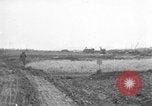
77th Infantry Division soldier looks at sign board at the commemorating spot in the Pacific Theater during Ryukyu Campaign.
U.S. Army 77th Infantry Division soldier looks at sign board in the Pacific Theater during Ryukyu Campaign of World War II. Soldier walks on field towards the commemorating spot. He looks at sign board which reads 'at this spot the 77th Infantry Division lost a buddy,Ernie Pyle,18 April 1945'.
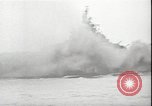
Aircraft Carrier, USS Hancock, struck by a Japanese Kamikaze in World War II
A series of views filmed from the USS Essex (CV-9) of the USS Hancock (CV-19) after she was struck by a Japanese Kamikaze aircraft on April 7, 1945, off the coast of Okinawa, during World War 2. Opening scene shows the Hancock almost completely enveloped by smoke. Camera pans across the ship. Subsequent scenes show smoke abating somewhat. View from flight deck of the Essex, of the Hancock steaming away, from the Essex. Brief view of four Japanese aircraft in flight, low overhead, and seven more at high altitude. Sailors line edge of the Essex flight deck looking at black objects in the water. Scene shifts to earlier sight of the Hancock burning., as viewed from a position on the island of the Essex, occupied by an officer and some sailors, wearing headsets. It shows heavy black smoke rising from the Hancock. The Battleship, USS North Carolina (BB-55) appears briefly in the background, upwind of the Hancock. Another view shows the Essex flight deck where sailors watch as the Hancock maneuvers. More scenes fairly closeup of smoke enveloping the Hancock.
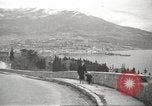
Russian woman and a child walk along mountain road leading to Lavidia Palace, Yalta during World War II.
Views of Yalta city, Ukrainian Soviet Socialist Republic during World War II. Russian woman and a child walk along mountain road to Lavidia Palace where Yalta Conference will take place. They stop at Russian pipe soda fountain for drink. A Russian man points to Russian signs, one sign indicates the advance of Nazi German forces into Soviet Union in 1941, the other dated 1945 shows their retreat.
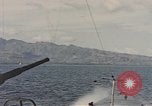
The submarine USS Bowfin engaged in surface gunnery practice off Guam in World War II
Near the end of World War 2, U.S. submarines were being refitted with extra guns and undertook more surface combat operations. Here, the USS Bowfin (SS-287) is seen in surface training activities off Guam, during May,1945. Its armament now includes (in addition to its original 4-inch/50 caliber deck gun) a Bofors 40mm aft of the conning tower and an Oerlikon 20mm cannon forward of it. As the Bowfin heads out, its deck gun is seen. Next, in a view from the conning tower fairwater, looking aft, the Bofors 40mm autocannon can be seen below. Scene shifts forward and then to side, where deck gun barrel is seen at extreme right of image. It fires at distant target boat. More views of targets being fired upon by autocannons and deck gun. Smoke rising from struck target. Sequence ends with the Bowfin firing a few rounds on its way back to Apra Harbor.
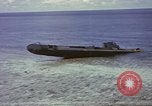
The Dutch submarine O 19 stranded on Ladd Reef in the South China Sea, near the end of World War II
Low altitude aerial views from an aircraft circling the Dutch submarine, O 19, stranded on Ladd Reef, in the South China Sea, with bow raised high above water and stern submerged. Note: According to Klaas van der Veen,of the Netherlands, whose father was second in command on the O 19, the boat went aground while on the way to Subic Bay, Phillipines, on July 8, 1945 (July 7th East of the International Date Line). After three days trying to free the O 19 using full reverse power at high tide, blowing air, firing torpedoes, and jettisoning ballast, the crew was rescued by the U.S. submarine, USS Cod, which torpedoed the O 19, after all critical equipment had been removed.
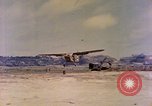
Wounded U.S. Marine being loaded aboard Stinson L-5B aircraft in Okinawa, Japan during World War II.
Air evacuation of wounded United States Marines on Okinawa in June, 1945. U.S. Army Air Forces Stinson L-5B Sentinel ambulance aircraft of the 163rd Liaison Squadron landing in front of camera as signalman waves flags. Identifiable aircraft serial numbers are: 44-17001, 44-17308, 44-17005. An ambulance pulls up on the field in front of a Red Cross tent and men carry a woundedsoldier on a stretcher towards L-5B aircraft. Another Marine on litter being loaded aboard an aircraft. More L-5B's taxi into position and take off. Identifiable tail numbers 44-17320, 44-16938. One aircraft, only identifiable with the number '80' on the tail is a Marine Corps OY-1 (L-5B).
CRITICALPAST.COM: About Us | Contact Us | FAQs - How to Order | License Agreement | My Account | My Lightboxes | Shopping Cart | Advanced Search | Featured Collections | Website Terms & Conditions | Privacy Policy ©2026 CriticalPast LLC.
License Agreement |
Terms & Conditions |
Privacy Policy
©2026 CriticalPast LLC.