


 Francais
 Deutsch
 Italiano
Refine Your Search
Tangermunde Germany 1945 stock footage and images
- Showing 379 to 384 of 10471 results more
more Hide
Hide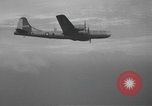
A WB-29A Hurricane Hunter aircraft returns and lands at Kindley Air Force Base, Bermuda
WB-29A of the 53rd Weather Reconnaissance Squadron (Hurricane Hunters) returning from a mission. The aircraft seen flying between smooth cloud layers. It banks to the left and descends. View of the WB-29 flying over part of Bermuda. Inside the aircraft, crew member fastens down equipment in preparation for landing. View from the ground as the WB-29 passes overhead. Another from the ground, of the aircraft touching down, bouncing up gently, and then staying down on the Kindley Air Force Base runway. (Note: During World War II, this B-29, tail number 42-94047, named the City of Jamestown, belonged to the 330th Bombardment Group, 459th Bomb Squadron stationed on Guam. On April 24, 1945,it was ditched near the shore of Japan, while returning from a bombing mission against the Hitachi aircraft factory in Tachikawa, Japan. Obviously, it was recovered and placed back in service after the war ended.)
USAF Lieutenant General Ira Eaker speaks about his experiences in the U.S. Air Force in the United States.
An interview of United States Air Force Lieutenant General Ira Eaker conducted by Dr. Maurer in the United States. Dr Maurer and General Eaker seated at a desk. Dr Maurer talks about the work and the contribution of General Eaker in the U.S. Air Force. He says that General Eaker was the Commander of the 8th Air Force. In 1944, he became the Commander in Chief of the Mediterranean Allied Air Force. Then from 1945 until his retirement in 1947, he was the deputy commander of the Army Air Forces and chief of the Air Staff. General Eaker talks about his experiences. He talks about the first airplane flight he saw. He further speaks that he was sent to a training camp in 1917. A man came in the camp looking for some fliers. He was already selected for an examination of regular army. He says that in November 1917, he was on a parade grounds. An airplane was in flight overhead. The aircraft landed and he looked at the engine of the aircraft.
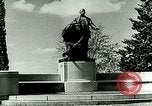
Contributions of African Americans in various fields in the United States.
(See also clip 65675078146 from different film transfer). Famous African American men and women citizens in the United States. Clip opens with of Booker T. Washington at Tuskegee University. Scene in a laboratory with African American scientist and inventor George Washington Carver, as an elderly man, working with another scientist in the laboratory. African American judge of New York city court. African American explorer Matthew Henson is seen looking at a globe (he was with Admiral Peary planting the American flag at the North Pole in 1909), and an unnamed African American surgeon at work in an operating room in New York. Next scene shows famous "father of the blues" musician and composer W.C. Handy (William Christoper Handy) smiling. Next is seen the financier and publisher of the Amsterdam News, Dr. C.B. Powell (Clilan Powell) greeting three uniformed African American women during a World War 2 war bond drive, and handing them a check (close up is shown) for 25,000 dollars, dated January 4, 1942, for the war bond drive. It is from the account of the Victory Mutual Life Insurance Company which Dr. Powell also owned. The check is signed by C.B Powell and Philip M.H. Savory (Dr. Savory was co-owner of the New York Amsterdam News). The next scene shows Elise Johnson McDougald, better known as Gertrude Elise Ayer, who was the first black full-time public school principal after the consolidation of New York City schools in 1898. She was also a noted woman writer during the Harlem Renaissance. She is seated in her office at her desk, likely in P.S. 119 in Harlem, since this is approximately year 1945 and she was at P.S 119 at that time. Her name plaque is visible on the front center of the desk. Principal Ayer smiles as a woman delivers a document to her. Next is seen the African American historian, author, and professor, Lawrence D. Reddick, serving in his role as the curator of the Schomburg Collection of African American Literature. In an art studio is seen the famous African American sculptor and painter Charles Alston, at work on a sculpture. Next scene shows the famous African American contralto singer, Marian Anderson, receiving a bouquet of flowers and smiling after a performance. This transitions to a view of African American orchestra conductor Dean Dixon leading an orchestra in a performance of Beethoven's 9th Symphony. Several views of different sections of the orchestra performing under Dixon's direction. Clip closes with brief shots of campuses of several historically black colleges and universities in the United States like Howard University, Hampton, Tuskegee, Fisk, Prairie View. An American college football game underway at the stadium of one of the colleges.

The outgoing President Harry S Truman and the President-elect Dwight D Eisenhower.
President Harry S Truman holds his last official cabinet meeting in Washington DC. The President with his cabinet team seated around a table. He is presented with a chair at the head of the table. Plate on chair reads 'The President April 1945.' New York: President-elect Dwight D Eisenhower with his future official family poses for pictures. The future President with his cabinet seated and standing.
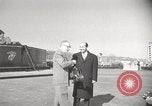
President Eisenhower and Vice President Nixon at the dedication ceremony of the Iwo Jima Memorial in Virginia, United States.
Dedication ceremony of the U.S. Marine Corps War Memorial (The Iwo Jima Memorial) in Arlington, Virginia, United States. Sculptor Felix de Weldon and photographer Joe Rosenthal shake hands with the statue of flag raising in the background. Chaplain says a prayer at a ceremony. Spectators seated with their hats off. President's car comes own the drive way followed by others. U.S. President Dwight D. Eisenhower walks with Navy personnel. Vice President Richard Nixon talks to a Marine who raised the flag at Iwo Jima. Nixon poses with the three survivors of the original flag raising at Iwo Jima. Statue of the flag raising at Iwo Jima. A sign at the base of the statue reads 'Felix de Weldon 1945-1954'.
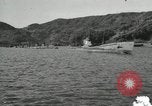
Operation "Road's End" and preparations for destruction of the Japanese submarine fleet moored in Sasebo Bay, Japan
Views from U.S. boat moving among Japanese submarines in Sasebo Bay, Japan, during Operation Road's End, involving the scuttling of the Japanese submarine fleet. Seen are submarines: I-47; I-162; I-156l;n-203;I-158;I-103;107;I-58. An American launch pulls up to I-58 (the sub that sank the USs Indianapolis on July 31, 1945, in the Philippine Sea).Vice-Admiral Robert M. Griffin, Commander of U.S. Naval Forces, Japan, climbs aboard the sub, followed by other members of his party. Admiral Griffin walks the deck of the submarine, followed by a Rear Admiral, who points out some features of the boat to Admiral Griffith. View of the group standing on the deck of the I-58.
CRITICALPAST.COM: About Us | Contact Us | FAQs - How to Order | License Agreement | My Account | My Lightboxes | Shopping Cart | Advanced Search | Featured Collections | Website Terms & Conditions | Privacy Policy ©2026 CriticalPast LLC.
License Agreement |
Terms & Conditions |
Privacy Policy
©2026 CriticalPast LLC.