


 Francais
 Deutsch
 Italiano
Refine Your Search
Tangermunde Germany 1945 stock footage and images
- Showing 3853 to 3858 of 10461 results more
more Hide
Hide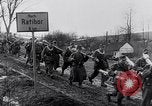
Germans defend against advancing Soviet forces in Silesia during World War II
Germany defending against Soviet offensives along the Oder River in in Silesia, during World War 2. German infantry slogging through mud, past sign pointing back 6 Km to Ratibor,Germany, (present-day Racibórz, Poland) during World War 2. They are proceeding to reinforce defenses at Breslau. They carry many panzerfaust antitank weapons. Scene shifts to German officers conversing with General Hermann Niehoff, Commander of Breslau defenses. German gunners firing a Heavy 21 cm Mörser 18 gun at near-zero elevation. (General Niehoff holds his ears as it fires.) Shell explodes with large fireball in distance. Niehoff speaks with a smiling German officer and pats him on the shoulder, at an informal award ceremony on a street in outlying area of Breslau. German soldiers riding atop an Auto Union Kätzchen (armored personnel carrier) .It is towing a conveyance in which two soldiers ride.
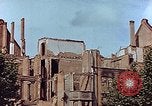
Damaged and ruined buildings are demolished in Leipzig after Allied forces take control at close of World War 2
Germany after Allied military forces takeover at close of World War II. Bomb damaged buildings in Leipzig in Germany. Ruins of buildings with walls shattered, windows burnt by bombing. Demolition charges go off in buildings and smoke rises from various buildings of the street. Demolition charge goes off with a puff of dust and smoke.
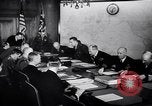
Bombing of Berlin by United States and British bomber aircraft during World War 2
American and British military officers of United States and United Kingdom discuss strategy for bombing Berlin, Germany, while gathered at a conference. Royal Air Force heavy bombers night raid German capital of Berlin to disrupt transportation system and war industry. Aerial views of night bombing raids and explosions over Berlin Germany. These were followed by British Mosquito aircraft raids. Aerial views and ground level views of wrecked buildings, destroyed railroad stations and tracks, and displaced German citizens and refugees are seen in daylight ground level views of Berlin after bombing.
The Brandenburg Gate and bomb damaged buildings on side of Unter den Linden, Berlin.
Bomb damage in Berlin after World War II. The Brandenburg Gate or Brandenburger Tor (Pariser Platz, 10117 Berlin, Germany). Buildings near the Brandenburg Gate suffered heavy damage (Unter den Linden 74, 10117 Berlin, Germany). A large portrait of Soviet Leader Joseph Stalin stands in the middle of Unter den Linden. Red Soviet flags fly. Bomb damaged buildings on side of Unter den Linden. Wreckage of vehicles are also seen in the middle of the boulevard.
Aerial views of Dachau Concentration Camp soon after liberation; emaciated survivors and dead bodies of camp victims.
Scenes at the recently liberated Nazi German Concentration Camp in Dachau, Germany, near the end of World War II in Europe. Aerial views of the Dachau Concentration Camp showing barracks, grounds, perimeter fencing, and various buildings. The main entrance gate of the camp. Views of some of the surviving liberated inmates from Germany, Poland, Czechoslovakia, France and Holland. Many of the survivors are starved and emaciated. View of a railroad train car that had arrived at the camp, carrying prisoner victims, with more of them dead than alive in the packed train car. Corpses lie inside an open door of a prison train box car. Bodies of victims under a blanket of snow in an open top train car. Some surviving liberated prisoners move piled bodies of dead victims from carts to prepare them for burial.
Soviet leader Joseph Stalin, UK Prime Minister Clement Attlee and U.S. President Harry Truman attend the Potsdam Conference.
The Potsdam Conference in Germany towards the end of World War II. U.S. President Harry Truman joins Supreme Allied Commander Dwight Eisenhower in a review of American troops in Frankfurt am Main city along the Main River in Germany. Exterior of the Cecilienhof in Potsdam. The Prime Minister of the United Kingdom Clement Attlee and his Foreign Secretary Ernest Bevin return to the Potsdam Conference. Soviet Communist Party General Secretary Joseph Stalin, Attlee, Truman and others seated around a round table.
CRITICALPAST.COM: About Us | Contact Us | FAQs - How to Order | License Agreement | My Account | My Lightboxes | Shopping Cart | Advanced Search | Featured Collections | Website Terms & Conditions | Privacy Policy ©2026 CriticalPast LLC.
License Agreement |
Terms & Conditions |
Privacy Policy
©2026 CriticalPast LLC.