


 Francais
 Deutsch
 Italiano

Refine Your Search
Tangermunde Germany 1945 stock footage and images
- Showing 4141 to 4146 of 10471 results more
 Hide
Color Sound
Junkers F 13 passenger aircraft takes off from Berlin Tempelhof Airport
Animation depicts an airplane flying to cities such as Danzig (Gdańsk, Poland), Königsberg (Kaliningrad, Russia), Memel (Klaipėda, Lithuania), Riga (Latvia), and Reval (Tallinn, Estonia). Civilian travelers board a Junkers F 13 passenger plane at Tempelhof Airport (Platz d. Luftbrücke 5, 12101 Berlin, Germany) in Berlin, Germany. Men and women peer from the door and window of the aircraft before departure. A man opens the back of an Ullstein cargo truck. Men unload cargo from truck in front of the Junkers hangar. Cargo handlers load packages into the aircraft. The aircraft takes off from Tempelhof aerodrome.

Aerial view of Munich, men push out a Junkers F 13 from the hangar of Schleissheim airfield
A Junkers F 13 plane in flight. Aerial view of Munich, Germany. The Frauenkirche, the Justizpalast, Bayerische Staatsoper, and other landmarks are seen from the aircraft in flight. The Nymphenburg Palace (Schloß Nymphenburg 1, 80638 München, Germany) as seen from a flying aircraft. Plane approach Schleissheim airfield, near Munich. Trans-Europe Union Lines Junkers F 13 passenger planes parked in the hangar of Schleissheim airfield. A group of men push a Junkers F 13 aircraft out of the hangar.
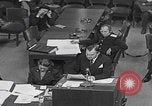
Chief Prosecutor Robert H. Jackson speaks about Nazi organizations during Nuremberg trials
United States Chief Prosecutor Robert H. Jackson continues his speech on the Criminality of Organizations during Day 70 of the Nuremberg Trials. Robert H. Jackson speaks to the tribunal at the Nuremberg Palace of Justice (Fürther Str. 110, 90429 Nürnberg, Germany). Female personnel take down notes beside him. A few guests seated near Jackson listens to his speech. Camera moves to Nazi defendants Hermann Göring, Rudolf Hess, Joachim von Ribbentrop, Wilhelm Keitel, Karl Dönitz, Erich Raeder, Baldur von Schirach, and Fritz Sauckel are sitting in the prisoner’s dock. Military Police personnel surround the defendants. Camera moves back to Jackson speaking to the tribunal. Jackson gives his documents to the secretary beside him before leaving the podium. Jackson speaks about certain Nazi organizations- the paramilitaries SA (Sturmabteilung) and the SS (Schutzstaffel)- were not selected without considerable study by the prosecution and that they were the most vicious in Germany.
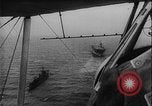
Crew of German submarine U-29 awarded Iron Cross after sinking British HMS Courageous aircraft carrier in 1939, during World War 2
Aerial view of British aircraft carrier HMS Courageous and a destroyer nearby, which was sunk by German submarine (type VIIA U-boat) of Nazi Germany's Kriegsmarine, on September 17, 1939. Scene changes and German submarine U-29 emerges from the water. Submarine cruises surfaced above water, German soldiers stand on the deck. The victorious submarine comes into port in Wilhelmshaven, Germany, on September 26, 1939. Soldiers standing on deck saluting. Nazi flag flies. Crew of the U-boat walk across plank to dock and assemble. The crew, standing in a line, shake hands and greet other German officers. The commander and crew are decorated with the Iron Cross award. Close ups of smiling crew. Nazi flag flying. Taken from a Spanish newsreel.
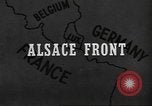
U.S. troops of the 79th Infantry Division engage German forces in the Alsace Front during World War II
Opening shows animated map of Alsace front at junction of Belgium, Germany, and France, in World War 2. Allied forces are schematically shown sweeping toward Wissembourg, Haguenau, and Strasbourg. Next, several U.S. Army M4A3(75) medium tanks are seen driving toward the camera on a rural road, during a pull back by the 7th Army in the first week of January, 1944, from advanced positions at the front. Some are filled with infantry riding atop them. The last of them is seen crossing a bridge 13 miles Northeast of Haguenau. The engineers of the 79th Division place demolition charges to destroy the bridge. Closeup of them placing and then remotely igniting the charge. A huge explosion ensues that completely destroys the bridge. Scene shifts to several U.S. soldiers of an engineer combat battalion preparing 100 pound of TNT in a captured blockhouse at Lauterbach, Alsace. Closeup of engineer carrying the explosives into the blockhouse and preparing the remote detonation device. The engineers string wire in the snow and setup their remote detonation device. One depresses a plunger to ignite the charge and blow up the blockhouse, which explodes in a huge cloud of black smoke. Next, elements of the 79th Infantry Division supported by tanks, are seen moving forward to counter German gains Southeast of Haguenau. (On January 5th the German forces had established a bridgehead across the Rhein (Rhine) river near Gansheim, Germany.) Scene shifts to Drusenheim, Germany where U.S. forces are engaging a Battalion of occupying German forces. Machine gun fire is heard constantly, as American infantry battle the hidden German defenders and tanks drive them from defensive positions near a bridge at the far end of town. Infantry move from behind tanks toward the bridge and are seen crossing it. An M4A3(75) medium tank risks crossing the narrow bridge and is immediately followed by many 79th Infantry troops. The battle continues on the other side of the bridge.
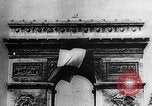
Montage of scenes illustrating the final stages of World War II in Europe
Liberation of Paris August 22, 1944. Tricolor flying from Arc de Triomphe. Crowds celebrate. Young people dance in street. Tanks firing guns. Bombs dropping on Germany. American tanks firing in Cologne, Germany. Spires of Cologne Cathedral loom above destruction and rubble in streets of Cologne. German civilian refugees on the streets. Germans in front of air raid shelters. Animated map showing Soviet advance from East.Formation of Ilyushin Il-2 aircraft. Soviet tanks in farm field. Silhouetted German soldiers surrendering. Wounded and dead German soldiers. Destroyed German military equipment. A long line of surrendered German soldiers. Allied forces driving into Germany beyond the Rhine River. Suffering German civilians and refugees including men, women, and children in desperate circumstances after the devastation of war. German refugees walking on roads, including babies in carriages or prams.
CRITICALPAST.COM: About Us | Contact Us | FAQs - How to Order | License Agreement | My Account | My Lightboxes | Shopping Cart | Advanced Search | Featured Collections | Website Terms & Conditions | Privacy Policy ©2026 CriticalPast LLC.
License Agreement |
Terms & Conditions |
Privacy Policy
©2026 CriticalPast LLC.