


 Francais
 Deutsch
 Italiano
Refine Your Search
Tangermunde Germany 1945 stock footage and images
- Showing 4219 to 4224 of 10461 results more
more Hide
Hide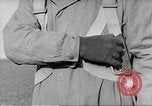
German paratrooper soldiers learn parachute landing techniques during training in Germany.
Parachute training in the German army early during World War II. A German soldier stands wearing a parachute. An airplane parked on a field. They are taught proper landing techniques by the instructors. Soldiers lying on the ground wearing parachutes. Men packing the parachutes. Other men learn the parachute packing techniques. An airplane in flight. A soldiers jumps and lands with the help of a parachute. Via loudspeaker, the instructor tells him not to wriggle while descending. A German airplane parked on the airfield.
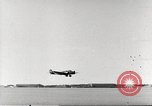
German paratrooper soldiers jump out of the airplane and descend with parachutes in Germany during World War II.
Parachute training in the German army during World War II. An airplane in flight. Newly trained German paratrooper soldiers jump out of the airplane. Close up views of German soldiers as they jump from aircraft. They descend towards the ground. Many parachutes open in the air as paratroopers descen. The parachute troops insignia. A German officer explains a model of an enemy town to the soldiers and a target demolition area. He explains a diagram on the board. They discuss a document.
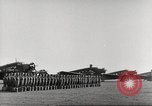
German paratrooper soldiers board Ju 52 airplanes for parachute jumping exercises in Germany during World War II.
Parachute training in the German army during World War II. Junkers Ju-52 airplanes parked on an airfield. Soldiers stand near the planes. A soldier salutes an officer. Paratroops board the aircraft. The Ju 52 airplanes take off from the airfield. The planes in flight. They fly in formation overhead. The soldiers jump out of the planes with parachutes. Close up views of them jumping from open door of aircraft, and aerial views of German paratroopers jumping. Aerial view of the soldiers descending. They land and quickly take off their parachute gear. They race to a gear parachute and open it to get rifles.
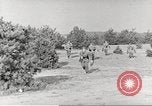
German paratrooper soldiers fire MG 34 machine gun during training in Germany in World War II.
Paratrooper training in the German army during World War II. Paratrooper soldiers advance on a field. They lie in prone position. A soldier looks through binoculars. Other soldiers come forward and take a prone position with a MG 34 machine gun. One soldier loads a cartridge belt in the MG-34 and the other soldier fires it. Smoke in the foreground due to firing. Soldiers advance on the field amid smoke and explosions. View of machine gun being fired at dusk or near night, as seen from just behind the gunman, almost machine gun operator point of view.
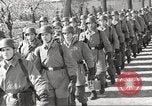
German paratrooper infantry soldiers march on a street in Germany during World War II.
German army paratroop soldiers during World War II. The German soldiers march on a street in formation while singing a song. Buildings in the far background. Trees along a side of the street.
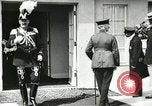
Kaiser Wilhelm II dedicates Germany's new Olympic Stadium on the 25th Anniversary of his Coronation
On June 8, 1913, the 25th anniversary of his coronation, Kaiser Wilhelm II presided over the inauguration of the new stadium (Deutsches Stadion) built near Berlin, to host the 1916 Olympics. These scenes were recorded immediately after the ceremonies. A German Admiral exits from a stadium building in Deutsches Stadion (Deutsches Stadion, Olympischer Platz 3, 14053 Berlin). Soon after, Kaiser Wilhelm II, exits, conversing with German Chancellor, Theobald von Bethmann-Hollweg. The Kaiser is attired in Hussar full dress uniform with fur busby. A German officer salutes and directs the Kaiser to athletes (German Olympic hopefuls) standing to the side, whom he introduces to the Kaiser. The Chancellor turns back into the building, and Empress Augusta Viktoria emerges and stands nearby, as the Kaiser speaks with the athletes and shakes hands with several of them. He chats amicably with the introducing officer, who smiles and salutes. The Kaiser then climbs into a waiting carriage in which the Empress is already seated. She holds a booklet or program in her hand. Attendants place a carriage robe over the Royal Couple and the carriage departs. Spectators watching the Royals are seen behind a railing at the Grunewald Racecourse track (part of the complex). The broad expanse of athletic grounds is behind them. Final scenes show many youths, walking along at the end of the ceremonies. in various uniforms (representing schools or clubs). some carry programs. some wear sashes on their outfits. Family groups are also seen. Stadium seats are seen briefly in the background to the left. A group of girls wearing dark skirts and white blouses with dark ties, are among the various small groups of youth walking together. (Note: The Deutsches Stadion was located in an area reserved as a Peoples' Park, by the Kaiser, in 1904. The property was leased for 30 years, in 1907, by the Union-Klub for the Grunewald Racecourse. But it also continued to serve general sports activities. The stadium was built on the racecourse grounds.)
CRITICALPAST.COM: About Us | Contact Us | FAQs - How to Order | License Agreement | My Account | My Lightboxes | Shopping Cart | Advanced Search | Featured Collections | Website Terms & Conditions | Privacy Policy ©2026 CriticalPast LLC.
License Agreement |
Terms & Conditions |
Privacy Policy
©2026 CriticalPast LLC.