


 Francais
 Deutsch
 Italiano

Refine Your Search
Tangermunde Germany 1945 stock footage and images
- Showing 4579 to 4584 of 10470 results more
 Hide
Color Sound

Anti-Nazi protesters parade carrying picket signs, along a sidewalk in New York City, prior to World War II.
Protest against Nazi Germany held in New York City in the weeks after the Kristallnacht attacks on Jews in Germany. A sign reads "German Exposition Christmas Market Now Open." Anti-Nazi protesters march carrying picket signs along a sidewalk in front of the exposition of German goods. One of the signs reads "Boycott Nazi Goods." Another sign reads "German Exposition Christmas Market Dec 16-24". American and Nazi flags fly from the building.
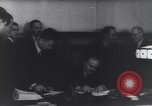
Signing of the German-Soviet Border and Commercial Agreement, by German Friedrich Werner von Schulenberg and Soviet Vyacheslav Molotov.
German diplomat Friedrich Werner von Schulenberg, of Nazi Germany, and Vyacheslav Molotov, of the Soviet Union meet together in Moscow, Russia, to sign the German-Soviet Border and Commercial Agreement. View of the two men and other representatives from each country at the signing ceremony. Narrator indicates that the agreement document covers expanded trade and commerce between the countries, establishes the northern border, and covers repatriation of Germans from republics including Lithuania and Estonia. View of the German and Soviet leaders each signing the document. Wax seals are added and a close-up of the signature page of the agreement is shown. (The Agreement also included the third set of secret protocols of the Hitler-Stalin Act or German-Soviet Treaty of Nonaggression. It followed the German-Soviet Frontier Treaty, which was the second secret protocol. Despite the pact, Germany attacked the Soviet Union 6 months later.) (World War II period).
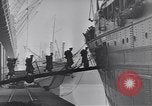
U.S. Army Service Forces transporting troops and supplies worldwide during World War II.
U.S. troops board a large troop transport ship via a gangplank. Troops on an intermediate deck of the ship. Some are sprawled out relaxing. View from above of more troops boarding a ship. Men and equipment on the pier below. American forces at various far flung places where the U.S. Army Services Forces facilitated their transport and logistic support. Fleeting glimpses of troops in: Ireland; Alaska; Trinidad; and South America. Troops jam the upper deck of a transport ship. Army Service Forces officers in a planning meeting. Naval officers on deck of a ship look through binoculars as U.S. Naval ships bombard the coast of Solomon Islands and landing craft carry marines in an amphibious assault. Next, a man is seen annotating a map of North Africa. Secret maps pertaining to Allied landings in Tunisia and Algeria. Animated map illustrates amphibious landings on North African coast, highlighting Casablanca, Oran, and Algeria. Landing craft carry troops and supplies that are piled up in the sand beach. Soldiers moving military supplies ashore, in fire brigade fashion. Soldiers working at desks in Offices of the Army Service Forces. Filing cabinet in background. Trucks on the move in remote locations. Supply ship being loaded at a terminal. Fuel drums and army vehicles a being loaded aboard ships. Officers seated at a conference table. Ordinary American enlisted soldiers in a griping session at an Army post in the United States. Camera pans over large formation of soldiers. Animated chart shows more than half of servicemen who are part of Army Service Forces (ASF), are unaware of that. Troops marching in review at a tropical location, where reviewing officers wear pith helmets. Chart illustrates lack of unit pride in ASF. Images of various ASF logos. Chart shows results of polling data from soldiers and service members. Signal Corps and Engineers elements of ASF have the greatest unit pride. But most think better of other branches of the Army. More troops marching, in steel helmets and carrying rifles with bayonets affixed. Troops marching overlaid by "50%" indicating that half don't believe their contributions to the war effort are significant. Troops lined up (for pay?). More charts expressing concern about low morale. A heavy gun firing. German paratroopers jumping from a formation of Junkers Ju 52 aircraft. Charts expressing prevailing U.S. troops view that Germany wouldn't be too hard to defeat. Chart showing lack of understanding about why the U.S. is fighting Germany. Image of President Franklin D. Roosevelt and Prime Minister Churchill seated in front of their key military officers at Casablanca Conference in World War 2. Chart shows U.S. soldiers believe that the greatest war effort is expended by the U.S. followed by Russia, with China and Britain providing little. Chart illustrates that only half U.S. troops want to get overseas and fight. Chart shows U.S. War Department films can correct this problem.
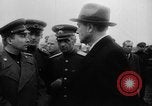
8th Air Force and 15th Air Force personnel are briefed in the European Theater for their first shuttle bombing run.
A film on U.S. shuttle bombing operations 'Operation Titanic' over Germany from bases in Great Britain, Italy and Russia during World War II. Personnel of the U.S. 8th Air Force in Great Britain. The U.S. 15th Air Force personnel in Italy. The are briefed about the first shuttle bombing run to new Russian airfields. United States Army Air Force General Nathan Farragut Twining addresses the personnel and bids them farewell. United States Army Air Force B-17 Flying Fortresses led by General Ira Clarence Eaker take off. USAAF B-24 Liberators take off from Great Britain. P-51 Mustangs and P-38 Lightning fighter airplanes escort the bombers on their way. The bombing forces bomb the targets in Germany. They return after their mission. Crew and officers look at the aircraft as they fly overhead. The officers look through binoculars. The crew waves towards the aircraft.
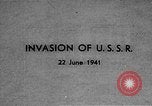
German troops invade Russia and Joseph Goebbels announces it on radio during World War 2.
German invasion of Russia, Soviet Union (Operation Barbarossa). Early morning in Berlin with quiet street scenes during World War II. Hands of a clock in view. A man unloads milk cans from a truck. German radio broadcasting studios. A man operates controls. View of radio tower and buildings. Men enter an office. A sign announces broadcast in progress and requests quiet and no entry. Propaganda Minister Dr Joseph Goebbels enters the room and sits on a sofa. He announces Germany has launched an offensive on the Eastern Front as Germany's actions represent declaration of war against the Soviet Union. Officers stand in the background. Several men seated in cars, listen to radio broadcast. German Foreign Minister Joachim von Ribbentrop makes the announcement to journalists at a crowded news conference. Newspapers carry the story. Cameramen take photographs. Animated map depicts the Eastern front extending more than 5 thousand kilometers from Finland in the North to Romania in the South. This is Operation Barbarossa. German troops invade Russia. A ship underway and a bridge in view. Heavy German guns bombard targets. Smoke rises up. Street signs such as "Eydtkau" are shown as evidence of advances. German troops dismantle border barriers. German tanks and artillery advancing Eastward, encountering resistance. They blow up a building.

Britons gather around the Houses of Parliament as the British Government makes decisions on the eve of Britain's entry into World War II
In the tense two weeks before Britain's declaration of war against Germany in World War 2, (occuring on September 3, 1939) the Evening Standard Newspaper of August 21, 1939 reports that the Premier sees the King; the Cabinet is to meet; Members of Parliament assemble to hear Chamberlain speak; and the Pope will broadcast peace pleas. Londoners are seen gathered in the areas around the Houses of Parliament. A woman carries a placard reading "Churchill." (She pushes it in front of the camera.) Rolls Royce limousines carrying cabinet ministers enter gates at Parliament courtyard. Bobbies contain peaceful crowds without difficulty. Occupants of one limousine are dressed in Arabian garb. Newspaper vendor displays headlines of Evening Standard reading: "Britons told to leave Germany." Cars carrying dignitaries continue into the Parliament courtyard. Several photographers snap photos as the cars pass them. A shot of the Elizabeth Tower at the north end of the Houses of Parliament, with the Great Clock clearly visible. The tower, clock and great bell (Big Ben) are often collectively referred to as"Big Ben." Routine busy commercial traffic moving on the street past Parliament. View from a high vantage point of double-decker buses moving past the Parliament courtyard, where crowd stands by the fence. Another official car enters the courtyard.
CRITICALPAST.COM: About Us | Contact Us | FAQs - How to Order | License Agreement | My Account | My Lightboxes | Shopping Cart | Advanced Search | Featured Collections | Website Terms & Conditions | Privacy Policy ©2026 CriticalPast LLC.
License Agreement |
Terms & Conditions |
Privacy Policy
©2026 CriticalPast LLC.