


 Francais
 Deutsch
 Italiano
Refine Your Search
Tehran Iran 1943 stock footage and images
- Showing 91 to 96 of 3276 results more
more Hide
Hide
Tehran Conference and successive preparations for D-Day attack on Nazi regions in France by Allied forces (WW2)
World War II Documentary entitled "D-Day Convoy." Leaders and military Generals of the Allied nations at the Tehran Conference. U.S. President Roosevelt, British Prime Minister Churchill, Soviet General Stalin, General George Marshall of U.S. Army, General Eisenhower. Map showing the targets of raid in France under German occupation. Immense military ammunition, artillery, tanks, weapons and infantry troops amassed in England and readied for military raids. American infantry troops being trained to raid the Peninsula of Normandy. Troops advance between bomb blasts and gun fire during training. Allied air force bombers bombing their targets in France. Formation of Martin B-26 bomber aircraft flying overhead. Point of view shot from inside aircraft, seen through rain spotted plexiglass gun canopy, flying very low over a French village, on the way to bombing target. Aerial view of U.S. Army Air Force B-17 Flying Fortress bomber dropping bombs over enemy target in Europe. View of bombs falling away from aircraft toward targets during a day time bombing raid. Explosions and smoke on the ground as targets are hit. Aerial fights between German and Allied air forces. Gun camera footage scenes as seen from Allied aircraft as they shoot at German airplanes. Several scenes of German aircraft exploding in flight. Airplane blasts in sky. U.S. army troops with ammunition moving toward camps in southern England. At the marshaling area soldiers receiving and trying on gas masks. They also receive inflatable life belts, food rations, cigarettes, candy including Hershey's chocolate, and French money as invasion currency. Briefing of the troops by the commanders.
A 1942-1943 film report to the American public about the progress of World War II in Europe and the Pacific.
Opening slate at start of film reads: "1942--1943 The Turn of the Tide." A column of British armor enters Bengazi, Libya, led by several troops in tankettes. Next seen are a Lee Medium Tank, M3 followed by an infantry tank, a jeep, another infantry tank and another Lee M3 Medium tank. Closeup of local people greeting the troops with upraised hands giving the "V" for victory sign. Another Lee M3 tank passes close by the camera. Black smoke is rising in the background. Scene changes to a half sunken ship near another burning in the harbor. Another view of this from further away above port buildings. Closeup of three smiling British soldiers leaning over a cartoon on a tank, of Winston Churchill (As a bulldog smoking a cigar and wearing a cap with the word "Victory" written on it). A crumpled captured flag with swastika on it. British Field Marshal Bernard Montgomery stands atop a vehicle (unseen) and looks through binoculars. Below, a column of British supply vehicles is making its way along a path in the desert. Two tanks coming toward the camera through sand. Animated map shows Nazi territory being threatened by the Allies from the Mediterranean, the USSR, and the English Channel. Views of Soviet infantry advancing against German forces in the snow of winter on the eastern front. Soviet troops firing updated 76-mm divisional gun model 1902 hidden in woods. Shells exploding in snow-covered field as Soviet BT series tanks advance. Various Soviet artillery firing from fixed gun batteries and from woods. A shell striking in distance. Fallen German soldiers lying on snowy field. Makeshift battlefield crosses marking graves of fallen German soldiers. German steel helmets lined up in the snow. A sign, posted on a birch tree, lists the names and birth dates of 16 German soldiers from the 3rd Panzer Division (3Pz-Pi-BH.39) buried at this site on November 28, 1941. Scene shifts to Joseph Stalin addressing Soviet troops in Red Square, Moscow, Russia. All the soldiers in formation seem to be singing (unheard). Film switches to animated map again. This time delineating the Eastern front being pressed by the USSR, and showing area of the 2nd Soviet winter offensive in 1943. Change of scene from Europe to the War in Asia, against Japan, shows General Douglas MacArthur after arriving by a B-17 bomber at a Pacific island American base. He ascends a steep hill in a jungle area, accompanied by other officers. Closeup of MacArthur. American infantry moving in single file in New Guinea, as a field piece fires a round in the direction they are headed. U.S. artillerymen load shells into a 105mm howitzer gun. A fire burns as mop-up operations begin on New Guinea. An Australian soldier is seen firing a Bren gun in jungles. Other Australian soldiers fire a mortar that explodes, raising earth and dust. More views of shells exploding near Allied soldier advancing. A soldier with fixed bayonet makes a fake charge toward the camera. Views of Japanese prisoners of war guarded in an outdoor compound. Japanese dead soldiers on Guadalcanal. An animated map shows new battle lines in the Pacific, closing in on Japan, with pressure from China, the USSR, and the Pacific islands being captured by the U.S. Arrows are added showing new pressure from American naval fleets and from British and American bombers out of Australia and captured islands.
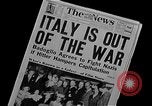
Allied pre-invasion base and activities in Scotland,1941. Allies in Algeria preparing for invasion of Sicily,1943
Activities of the Seabees in Scotland in 1941 and in Algeria in 1943, during World War II. News headlines in 1943 read : ' Italy is out of war' and '17 more Italian towns taken'. An animated map. The Clyde valley in Scotland showing a base built by the U.S. Navy Seabees, in 1941. Numerous quonset huts and vehicles are seen. View of the River Clyde, where 2400 feet of oceangoing dock are being assembled. A ship anchored at a harbor displaying U.S. flag. Allied troops board a landing ship with their belongings. An animated map tracing travel of Allied invasion forces from Scotland to Oran, Algeria, where Seabees are seen testing a floating causway that would be used for invasion of Sicily. Scuttled axis ships and other obstacles and damage that Seabees must repair in occupied ports. Allied ships and troops proceeding for invasion of Sicily. Allied warships bombarding Sicilian coast.

Baseball players train in northern U.S. states during World War II, 1943
Newsreel clip entitled "Ball Players Train in North" shows major league baseball teams holding spring training in 1943. Teams were not allowed to travel south to Florida because of World War 2 travel restrictions. First part of clip shows men (presumably baseball players) riding in a horse and buggy along a tree-lined road. Giants seen running on field and meeting with manager and Hall of Fame outfielder Mel Ott. Players pose for camera, all wearing long sleeves. Closeup of Giants Hall of Fame pitcher Carl Hubbell. Giants players seen throwing at posters of Benito Mussolini, Adolf Hitler and Hideki Tojo -- Leaders of the Axis powers during the war. Players look at the posters after throwing; note patriotic war patch on Giant player's sleeve. Clip shifts to Washington Senators training camp the same year. Coach and renowned baseball clown Nick Altrock leads players in warmup drills. Players warm up in outfield, near what looks like a heating plant. Closeup of Senators pitcher Dutch Leonard throwing. Closeup of Senators owner Clark Griffith (in overcoat) talking with manager Ossie Bluege. Closeup of Bluege. Players marvel over of 7-foot player Richard Ahrens, who was signed by the Senators that spring as a possible publicity stunt; he never appeared in a minor or major league game. Washington players pretend to warm themselves up by small campfire on the field. Another shot of Altrock. (Note: There is no indication where these clips were taken but the Giants trained in Lakewood, New Jersey that spring and the Senators trained in College Park, Maryland. )
The bombing of Rekata bay, near Munda in the South Pacific,on August 24th 1943.
Bombing of Rekata bay (near Munda and Guadalcanal in the South Pacific) during August 24th 1943. U.S. B-24 Liberator bombers of the 13th Army Air Forces in flight at a high altitude over the bay. Bombers drop bombs on Japanese targets at Rekata bay. (World War II period).
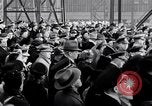
Launching of USS Wisconsin (BB-64). Philadelphia Navy Yard, December 7, 1943. Governor and Mrs. Goodland of Wisconsin.
Rear Admiral, M.F. Draemel, Commandant of the Philadelphia Navy Yard, introduces Assistant Secretary of the Navy, Ralph, A. Bard, who speaks to large group of Navy Yard personnel and visitors and spectators. The occasion is the launching of the second USS Wisconsin (BB-64) on December 7, 1943. Governor of Wisconsin, Walter S. Goodland and his wife are present. Mrs. Goodland is the official sponsor.