


 Francais
 Deutsch
 Italiano
Refine Your Search
Tehran Iran 1943 stock footage and images
- Showing 961 to 966 of 3272 results more
more Hide
Hide
WAVES arrive for Frank Sinatra's performance at Walton Auditorium in the Bronx, New York Cuty.
Women military WAVES (Women Accepted for Volunteer Emergency Service) seated in the Walton High School Auditorium in the Bronx, New York City. The Women's military reserve units await a performance by Frank Sinatra. WAVES applaud and cheer. A WAVES stands next to a board stating the night's performance by Frank Sinatra as well as the Station Military and Dance Band. WAVES seated inside the auditorium. They applaud.
Preliminary steps in manufacturing steel during World War 2 for the war effort
"Making Steel for War" shows powered shovel digging iron ore out of an open pit mine. After obtaining the Iron Ore ,it is crushed and shipped to steel mills. Countless open railroad cars filled with iron ore in a marshalling yard. Iron ore being loaded into an ore carrier ship. The ship carrying the Iron Ore reaches its destination, where huge cranes with claw buckets reach in and remove the iron ore from the ship. View of steel mill complex including rail yard, furnaces, and numerous structures. Powered shovel digging limestone out of open pit mine and loading it on to conveyer. Coal being discharged from coking ovens and bursting into flames when it contacts the open air. .
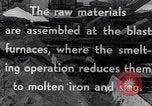
Charging and tapping a blast furnace for making steel during World War II (WWII)
The raw materials used in manufacturing of steel are carried by ore cranes and transfer cars, into a blast furnace, to be smelted. Steel workers drill out the clay tap plug, tapping the blast furnace, and molten iron runs out into runners in floor, amidst flame, smoke and fumes. A technician reads the temperature of the pour using an optical pyrometer.The molten iron creates flames, smoke and fumes as it progresses to empty into a large specially designed rail car, pulled by a locomotive.
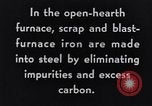
Recycling scrap in the process of steel making during WWII. Tapping open hearth furnace
Adding scrap to the charge of an open hearth furnace during steel making. Steel Workers use crane to pick up scrap for adding to the charge of an open hearth furnace. Workers sort scrap by noting the kinds of sparks produced as it is touched to a grinding wheel. Scrap is charged into the furnace by means of machines on rails. Operator seen at controls of charging machine. Under control of operator seen in booth above, molten iron is poured into the furnace from a huge Ladle. . Workers manually shovel Ferro manganese into the furnace, in measured quantity, to control the oxygen content. Furnace is tapped by burning and ramming a plug and molten steel flows in ladle. Molten steel is 'teemed' into ingot molds. Technician checks temperature of the steel with an optical pyrometer.
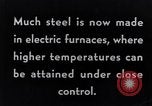
Using electric furnace for steel making during World War 2
Steel is manufactured in sufficient quantities in electric furnaces where higher temperatures are attained under close control in a manufacturing plant. Two workers inspect the furnace. Another worker manipulates electrical switches and controls on a panel. Molten iron seen splashing through open furnace door. Workers wearing protective glasses manually shovel measured quantities of alloying elements into the hot furnace at the factory.
Manufacturing steel using the Bessemer process (WW2)
Manufacture of Steel during World War II in United States. Bessemer converter seen in tilted position being charged with molten iron from a ladle, under control of crane operator. Bessemer converter operator manipulates lever to cause converter to tilt up and air to blast through the molten iron. This burns excess carbon, silicon and manganese and converts the iron into steel. Molten steel is poured into molds. which are removed after steel solidifies. Hot ingots are moved on rail cars to a place, where they attain a uniform temperature and are ready for rolling. Ingots stored in pit.
CRITICALPAST.COM: About Us | Contact Us | FAQs - How to Order | License Agreement | My Account | My Lightboxes | Shopping Cart | Advanced Search | Featured Collections | Website Terms & Conditions | Privacy Policy ©2026 CriticalPast LLC.
License Agreement |
Terms & Conditions |
Privacy Policy
©2026 CriticalPast LLC.