


 Francais
 Deutsch
 Italiano
Refine Your Search
Tehran Iran 1943 stock footage and images
- Showing 1897 to 1902 of 3272 results more
more Hide
Hide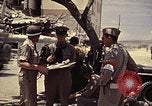
Operation Avalanche. American troops, in Tunisia, North Africa, board ships to Italy in World War II
As film begins, a U.S. Navy officer and Army officer coordinate a list of soldiers to board a Landing Craft Infantry (LCI) in the port of Tunis, North Africa. Rubble of damaged and destroyed building is behind them. U.S. Army troops are next seen on the waterfront. They begin moving along the docks where LCIs are tied up. Other troops are assembled on the wharf waiting to enter the docks. Extended series of views showing closeups of soldier's combat boots stepping along the gangplank to an LCI. Next, is view from a dock as column of soldiers walk slowly past the camera toward their LSIs. Another view of troops and LSIs from further away. Broad view of the waterfront with docked LCIs and war ships in the distance. Closer view of docks, troops, and LCIs, and warships in the harbor.
Schizophrenic U.S. Marine Corps private is given electro-shock treatment at the St. Elizabeths Hospital in Washington DC.
Clip opens with on screen text giving information on administration of electric shock therapy, and on the patient about to be shown. Scene shows a young schizophrenic United States Marine Corps private, sitting in a wheel chair at the St. Elizabeths Hospital in Washington DC. The 19 year old man was brought to the hospital after a experiencing a mental breakdown on his way to military basic training (during World War 2). A doctor (psychiatrist) examines him. The patient gives no response to the doctor's questions and has no reaction to pin pricks. The doctor's assistants transfer the patient to a gatch bed. The bed is lifted to produce a moderate hyper extension in the patient's spine. The doctor spreads electro-jelly on both sides of the mental patient's forehead and applies electrodes. The electro-shock apparatus is connected to a 110 Volt AC outlet. Electro-shock (shock therapy) is administered to the patient in a 0.3-0.5 second's time interval. Mouth gag is placed in the patient's mouth during shock administration.
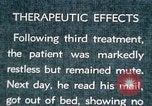
A psychiatrist examines a schizophrenic U.S. Marine Corps private at the St. Elizabeth Hospital in Washington DC.
Shows a schizophrenic United States Marine Corps (USMC) private, sitting on a chair at the St. Elizabeth Hospital in Washington DC the day after a round of electric shock therapy. He talks to his doctor (psychiatrist). The doctor examines him. The patient moves back and forth in the hospital room normally. Patient poses before the camera.
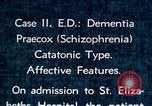
Schizophrenic woman is given electro-shock treatment at the St. Elizabeth Hospital in Washington DC.
Woman suffering from Dementia Praecox (Schizophrenia) is examined by a psychiatrist at the St Elizabeth Hospital in Washington DC. Nurses assist in shifting the patient to a bed. The doctor spreads electro-jelly on both sides of the patient's forehead and applies electrodes. Electro-shock or shock therapy is given to the patient. Mouth gag is placed in the patient's mouth. Nurses exert pressure on the patient's shoulders, arms and knees during convulsion, to moderate her bodily movements.
Schizophrenic woman talks with doctor after receiving electro shock treatment at the St Elizabeths Hospital in Washington DC.
Shows a woman suffering from Dementia Praecox (Schizophrenia) talking to a psychiatrist at the St Elizabeth Hospital mental care facility in Washington DC. She explains to the doctor about her improved state of health after undergoing electro-shock treatment (or shock therapy).
Woman suffering from Melancholia is given electro-shock treatment at the St Elizabeth's Hospital in Washington DC.
A 54 year old woman suffering from Involutional Psychosis (Melancholia) is examined by a psychiatrist at the St Elizabeths mental hospital in Washington DC. Nurses assist in shifting the patient to a bed. The patient is really agitated and restless. The doctor spreads electro-jelly on both sides of the patient's forehead and applies electrodes. Electro-shock, or shock therapy, is given to the patient. Mouth gag is placed in the patient's mouth. Nurses exert pressure on the patient's shoulders, arms and knees during the convulsion to moderate her body's movements. The patient becomes stable after the treatment.
CRITICALPAST.COM: About Us | Contact Us | FAQs - How to Order | License Agreement | My Account | My Lightboxes | Shopping Cart | Advanced Search | Featured Collections | Website Terms & Conditions | Privacy Policy ©2026 CriticalPast LLC.
License Agreement |
Terms & Conditions |
Privacy Policy
©2026 CriticalPast LLC.