


 Francais
 Deutsch
 Italiano
Refine Your Search
Tehran Iran 1943 stock footage and images
- Showing 2683 to 2688 of 3272 results more
more Hide
Hide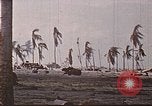
U.S. 2nd Marine Division begins mopping up operations during amphibious assault at Betio, Tarawa, during World War II
Marines of U.S. 2nd Marine Division moving toward the airfield on Betio, Tarawa atoll, during their amphibious assault against Japanese forces during World War 2. A Stuart M3 light tank driving rapidly at the edge of the field. A wounded marine is brought back in a jeep, under enemy fire. Back at the beachhead, a landing vehicle tracked (LVT) is seen towing several floating packages of supplies to the shore. Chaplain's assistants tend to U.S. marine dead lying on a beach. They remove on dog tag from each for registering while leaving the other for identification. Marine General Holland M.Smith, Commander of V Amphibious Corps, and Major General Julian C. Smith, Commander. 2nd Marine Division, are seen walking together and then consulting with Rear Admiral Harry W. Hill, Commander Amphibious Group Two, Fifth Amphibious Force. Marines using a bulldozer to dig Japanese defenders out of a pill box. This yields a half dozen Japanese prisoners, the first to be taken. Wounded American marines are given first aid and then seen being lowered in steel litters into landing craft and then being transferred to a transport ship, offshore.
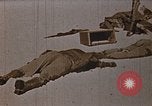
U.S. marines where they fell in combat during battle of Tarawa in World War II. Funeral and burial at sea for a marine.
Fallen U.S. marines lying on the beach and floating in the waters of Betio, Tarawa atoll, after the amphibious assault by 2nd Marine Division during World War 2. Flag draped coffin of a marine carried on deck of a transport ship where chaplains conduct funeral service for burial at sea. Marine honor guard fires salute as others salute.
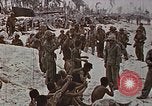
U.S. marines process Japanese prisoners on Betio, Tarawa, during World War II. Seabees begin restoring the airfield
U.S. 2nd Division Marines process about 10 Japanese soldiers taken prisoner on Betio, Tarawa atoll, during the battle there in World War 2. They cut away the prisoners' clothing to assure they don't carry weapons or explosives. (Narrator states they were later given replacement clothing from captured supplies.) Marines tend to a wounded Japanese prisoner. Japanese prisoners carrying their own wounded to a pier for evacuation. Marines cleaning up using water from captured Japanese steel barrels. Marines stand on fortifcations containing British Vickers BL 15 inch Mark I coastal defense guns captured by the Japanese in Singapore. These were knocked out by U.S. naval gunfire during the pre-assault bombardment. Closeup of one breech of a gun. A knocked out Japanese light tank at the South side of Japanese Rear Admiral Shibasaki's headquarters on Betio. (Shibasaki, commander of the Japanese forces there, was reportedly killed by U.S. Naval gunfire early in the assault.) Panning view of the remains of the reinforced concrete Japanese headquarters structure. U.S. Seabees using power shovel, dump trucks, graders, and heavy rollers, to restore the airfield for U.S. operations.
U.S. aircraft begin flight operations on Betio airfield in World War II. Navy F6F aircraft land at airfield. Marines leave to embark on troop ships
U.S. Marines complete capture of Tarawa from Japanese defenders in World War 2. U.S. Navy F6F aircraft are seen landing on the Betio airfield, Tarawa atoll, 24 hours after Seabees began to restore it to operation. One of the pilots poses with marines after landing. Marines of the 2nd Battalion, 6th Marine Regiment, wade ashore to relieve the others, provide protection for Seabees, and clean up ordnance in and around the airfield. Formal flag-raising ceremony officially establishing Tarawa under American control. The flag is raised as marines salute. The American flag flying high over the atoll. Battle-weary marines leaving Tarawa to embark on their transport ships, as members of the 2nd Battalion, 6th Marines, bid them farewell.
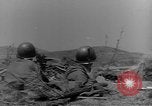
British and U.S. soldiers advance and construct a bridge over the Volturno River in Italy during the Italian Campaign.
A documentary television program titled 'The Big Picture' depicts the role of U.S. soldiers in the Italian Campaign during World War II. U.S. soldiers advance on tanks. The soldiers climb up a snowy area and get off a landing craft. Sergeant James Mansfield speaks about the story of U.S. soldiers wearing a Blue Badge and the Italian Campaign fought by U.S. soldiers. The sergeant holds a Combat Infantryman Badge. Colonel William W. Quinn talks about the role of Combat Engineers and Blue Badge Infantryman in the Italian Campaign. Animated map of Italy shows British 8th Army capturing Foggia and U.S. 5th Army capturing Naples in Italy. The Volturno River and mountains in the background. A damaged bridge. Troops near the river. Animated map shows location of Allied troops. Engineers construct a bridge over the river. Allied troops cross the river with necessary supplies and artillery.
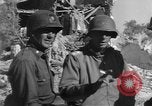
U.S. soldiers carry injured on stretchers and advance on Dragoni Italy during the Italian Campaign in World War 2.
Depicts activities of U.S. soldiers in the Italian Campaign during World War II. Major General Rider of U.S. 34th Infantry Division speaks to Colonel Butler Commander of 168th Infantry Division at Alvignano, Italy. U.S. troops advance towards Dragoni. U.S. Army 36th Artillery soldiers fire artillery, supporting the 45th Division, in an assault on the last line of hills leading to the Volturno Valley. A soldier gives water to an injured soldier on a stretcher. Soldiers carry injured on a stretcher. Japanese-American soldiers of the United States Army 100th Infantry Division arrive. They stand in a line and are served food. The troops eat their food. View of a dead German soldier, and of other German soldiers as they surrender to U.S. Army forces. U.S. 3rd Division troops fire artillery at Dragoni. Smoke rises in the foreground. A map of Italy showing Dragoni. The troops advance and the 168th Division is seen occupying Dragoni on the next day, without opposition. U.S. soldiers escort some German soldier prisoners of war from the German 3rd Panzer Grenadier and the 26th Panzer Divisions. A German soldier treats an injured fellow prisoner. Italian civilian refugee men and women walk in a roadway and are evacuated to the rear.