


 Francais
 Deutsch
 Italiano
Refine Your Search
Tehran Iran 1943 stock footage and images
- Showing 355 to 360 of 3276 results more
more Hide
Hide
British Prime Minister Winston Churchill in many meetings before and after America's entry into World War II
Opening slate reads: "Quebec Conference August 1943." The English battleship, Prince of Wales, is seen in fog off the Coast of Newfoundland, in August 1941. View of sailor on fore-deck of the British ship. View inside engine room of the ship where sailor manipulates her power. Closeup of engine crankshaft stopping as she drops anchor in Placentia Bay. View of Prime Minister Winston Churchill, greeting U.S. President Franklin D. Roosevelt aboard the Prince of Wales. He proffers a letter to the President, from the King of England. View of Roosevelt and Churchill seated on deck with their respective military leaders standing behind them. Admiral Ernest King, U.S. Chief of Naval Operations converses with U.S. Army Chief of Staff, George Marshall, as they stand behind Churchill and Roosevelt. Wider camera view shows the larger military entourage accompanying the Prime Minister and the President. Glimpse of prisoners and enslaved workers taken by Nazi Germans in Europe. Glimpse of bombs falling from an airplane. Classic film views of the Japanese attack on Pearl Harbor in December 7, 1941. Bombs exploding along "Battleship Row." Heavy smoke rising from the bombed ships. The USS Arizona tilted heavily and burning. Camera pans along the path of destruction, as the voice of President Roosevelt is heard in the background, asking the Congress to declare that the Japanese attack created a state of War between the United States and the Japanese Empire. View of President Roosevelt speaking to the U.S. Congress. Seated behind him are Vice-President Henry Wallace and Speaker of the House, Sam Rayburn. Glimpse of Congress members applauding. Change of scene shows President Roosevelt and Winston Churchill meeting in Washington, DC, in December of 1941, during World War 2. Views of war preparations in the United States, including the building of new war production plants and facilities. A large steel ingot being forged into an artillery gun barrel. Machinist at work turning a gun barrel on a lathe in a munitions factory. Views of manufacturing plants in operation and steel being made. A railroad train carrying new Army trucks. Another meeting of Churchill and Roosevelt in Washington, D.C. June, 1942. Standing behind them is President Roosevelt's special assistant, Harry Hopkins, a British naval officer, and an American navy Captain. American soldiers boarding a troop ship, and closeups of them as they enter the ship, looking out of portholes, and waving from the ship's deck. Glimpse of Washington Monument and its image in the reflecting pool in Washington DC. Closeup of a book entitled, "Time Table for Invasion." General George Marshall with several of his generals doing preliminary planning. Series of scenes involving senior military officers engaged in war planning. A convoy of warships is seen at sea during the Operation Torch Allied invasion of French North Africa during 8–16 November, 1942. Views of Allied Navy ship guns firing. Allied troops riding in landing craft, and advancing from beached craft on shore of Algiers. Aerial view of a flight of Douglas Dauntless bombers in formation. "Bombs away" view from Allied airplane dropping bombs. Allied troops firing camouflaged antiaircraft guns from sandy positions near shore. Enemy shells or bombs exploding nearby. Two U.S. Army soldiers holding a document in French entitled, "Message from the President of the United States.
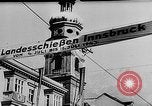
Austrians carry banners in a parade during Innsbruck Shooting Festival, Austria (WW2)
Innsbruck Shooting Festival in Innsbruck during July, 1943, announced by banner stretched across a road. Buildings and Nazi banners in view. Closeups of Austrian men and women in colorful costumes. Closeup glimpse of the flag of a World War II Austrian State. A parade of Austrians carrying various Austrian State flags and others carrying unidentified flags. The parade viewed from above, and then from within the ranks of marching participants in traditional uniforms and carrying rifles. A huge crowd of spectators gathered on the sidewalks. A brass band playing for the marchers, from the sidelines. Shots of marcher's feet and then of them from waist up. German soldiers in uniform, recovering from war wounds, have front row seats. An antique cannon is fired. Then the street becomes completely filled with participants and spectators.
Colonel Oveta Culp Hobby is the first commanding officer of Women's Army Corps in the United States.
Women's Army Corps in the United States. Women's Army Auxiliary Corps, created in 1942 is converted to WAC (Women's Army Corps) in 1943. A WAC carries a cake. 'WAAC' written on the cake. A WAC walks outside a building. Several men stand and talk. The WACs parade on a field. A United States flag. Duties performed by WACs. Women work as mechanics and handle complicated equipment. They take photographs through cameras. The U.S. Capitol building in view. U.S. Army General George Marshall and U.S. Secretary of State Henry Stimson. Colonel Oveta Culp Hobby is the first commanding officer of WAC. A dramatization depicts recruitment and induction of WAACs. A sign reads 'WAAC, information and recruiting'. A woman appears in an interview. The women undergo physical examination and are then recruited. WAACs undergo a training. They perform physical exercises and swim. Several WACs go to specialization classes. WACs cook food. A woman receives an award for her husband's bravery during World War II.
U.S. Army IX Corps soldiers, trucks and half tanks advance in California.
U.S. Army IX Corps soldiers during a simulated attack on 03 July 1943. Soldiers lie in rutted desert terrain behind smoke screen and barbed wired barricades. 0630: Men and equipment moving towards action. Half track tanks, trucks and troops proceeding through valley. Soldier sitting on ground and shaving. (World War II period).
American offensive campaigns in Europe and Pacific Theater during World War 2
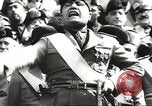
Fall of Benito Mussolini in Italy. Mussolini seen speaking to a crowd and shaking his fist. Sicily surrenders to Allied troops during World War II. German soldiers holding white surrender flags march forward. Civilians in Italy cheer the arrival of smiling American soldiers. Scene changes to American B-25 bomber aircraft dropping bombs over Japanese positions in Pacific Theater. Close view of bombardier calibrating position and bombs away from bomb bay doors toward Japanese-held targets. Gun camera footage of Allied aircraft attacking Nazi German Wolfpack submarines in the Atlantic Ocean. Allied aircraft, including B-25 bombers, bombing German industry and cities during a night raid. In England, United Kingdom, church service is held open to the sky in the ruins of bombed out Coventry Cathedral, which had been destroyed by German Luftwaffe blitz bombing of Britain. Clergy, robed choir members, and British parishioners seen at the enthronement service of Bishop of Coventry Neville Gorton in 1943, enclosed only by the exterior walls of St. Michaels, Coventry Cathedral.
Amphibious operations in Italy, during Operations Husky and Avalanche. General hazards of wartime amphibious assaults including those in the Pacific Theater in World War II.
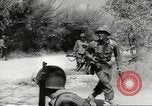
American soldiers in Italy, during Allied Operation Husky, and Operation Avalanche in World War 2. In landings during invasion of Salerno, Italy, soldiers pause their movements while two use a detector to search for possible buried mines. They detect one and are seen carefully digging it up from the sandy soil. Soldiers unroll steel matting across an area of beach. Close-up of heavy trucks moving across the matting. A bulldozer uses a cable to pull a section of temporary docking out of an LST (Landing ship tank). Troops move across several sections of such docking as they make their way onto the shore. A sherman tank making its way toward the shore . More heavy equipment coming ashore from LSTs, including a US M1 155mm “Long Tom” Gun. The gun being towed on shore, as trucks and jeeps maneuver through shallow water nearby. A long line of jeeps and trucks moving inland. Military vehicles being offloaded from the British Landing Ship Tank (HM LST-200). U.S. troops moving on a beachhead, along with artillery pieces, and vehicles. Soldiers carrying boxes of supplies and ammunition and struggling with large wooden crates of such, in shallow surf, and using a roller conveyor to offload some heavy items from a ship. A landing craft suspended from a cable operated A-Frame on wheels (in the water). At this point the thrust of the film shifts to illustrate the hazards of amphibious operations, in general. Swamped vehicles and a landing craft in the surf. The beach littered with damaged and swamped landing craft and equipment, including, among others, a landing craft from the USS Samuel Chase (APA-26). A huge explosion in the water. Glimpse of a German Junkers Ju 87 (Stuka) dive bomber attacking while being shot down by a U.S. sailor firing an anti-aircraft gun . View from above of sailors firing twin bofors 40mm antiaircraft cannons from an emplacement on a ship. Several German Junkers Ju 87 planes maneuvering as they attack. Quad bofors antiaircraft guns firing from a ship. More attacking Ju-87 dive bombers on the attack. A dramatic explosion and smoke from the Liberty ship SS Robin Rowan after being hit by a German bomb off the coast of Gela, Sicily on July 11, 1943. A landing ship burning from German bombing, off Gela, Sicily, with its deck full of halftrack and personnel carrier vehicles. The film continues the theme of losses encountered in wartime amphibious assaults, by shifting to the Pacific theater of operation, where a Landing Ship Tank (LST) is seen ablaze, off Guadalcanal, after being hit by Japanese shelling. View from beach with barbed wire, ashore, of the burning LST. Sherman tanks lost in a conflagration aboard an LST. Sailors carry a casualty on a litter, and place it next to other fallen crew members, on deck.