


 Francais
 Deutsch
 Italiano
Refine Your Search
Tehran Iran 1943 stock footage and images
- Showing 385 to 390 of 3276 results more
more Hide
Hide
Red Cross nurses prepare gift parcels and airmen carve children's toys during Christmas preparation in Germany.
Christmas preparation in Germany in 1943 during World War 2. German Red Cross volunteers prepare gift parcels for German troops, away at war. They pack them in boxes with Merry Christmas messages written on them. One box is destined to soldiers on the Eastern Front. German Airmen make toys from wood for distribution to German children. Display of the prepared toys.
U.S. Navy PBY Catalina flying boat rescues downed U.S. Marine Corps pilot in Solomon Islands during World War II.
Rescue of Marine Corps pilot, Milton H. Vedder, who was shot down on April 25, 1943, in an aerial battle over Vangunu, New Georgia, Solomon Islands, during World War 2. View from a U.S. Navy PBY Catalina flying boat as it takes off and then flies low over islands and water. Two Marine F4U Corsairs are seen flying escort above the PBY. View from the PBY as it lands on the water and taxis past a native shack while approaching Segi Point shoreline. Crewman on PBY looks through binoculars. Native canoe approaches with Lieutenant Vedder. Native and beach observer in a boat. Man in hat is probably coast watcher Donald Kennedy. Rescued pilot Lieutenant Milton N. Vedder, in boat, smokes a cigarette. View from PBY as it takes off. Vedder and others conversing inside the PBY. Several views of the two U.S. Marine F4U Corsair fighter escort aircraft. Other F4Us are seen in distance. (Note: reportedly, the two escorting F4U Corsairs were flown, respectively, by Major Weissenberger, the Commanding Officer, and Major Leary, both from Lt. Vedder's squadron, VMF-213. )
The Director of the WAVES (Women Accepted for Volunteer Emergency Service) christens USS Franklin (CV-13) in Newport News.
U.S. Navy ships launched in the United States during World War II. Lieutenant Commander Mildred H. McAfee, USNR (US Navy Reserve), Director of the WAVES (Women Accepted for Volunteer Emergency Service) breaks a bottle of champagne on the bow of a carrier and christens USS Franklin (CV-13) in Newport News, Virginia on 14th October, 1943. A destroyer is launched at the Great Lakes. The destroyer is turned into an upright position. Shipyard workers cheer. A ship is launched sideways.
U.S. Army Air Forces B-17F Flying Fortresses bomb targets in Regensburg, Germany during 'Shuttle Mission' of World War II.
Strategic bombing attack 'Shuttle Mission' by B-17 Flying Fortresses of the U.S. Army Air Forces on August 17, 1943 over Germany during World War II. A formation of B-17Fs over Germany. Vapor trails left by the airplanes. Aerial view of a German city. Smoking targets. B-17Fs over the Alps. A B-17 aircraft with a damaged tail flies over Regensburg, Germany. A B-17 aircraft with a damaged nose. Aerial view of African coastline. Mountainous terrain of Algiers, Algeria. Aerial view of barracks in Algiers. B-17Fs land on a field.
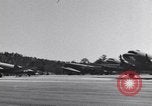
U.S. 801st Medical Air Evacuation Squadron tends wounded evacuated in C-47s from New Georgia Island, in World War II.
Sequence starts at Tontouta Air Base in New Caledonia, on the near left side of runway 2 in the area of the 13th Troop Carrier Squadron ( a.k.a. the Thirsty 13th) with their plane "Lady Eve" on the right. (The 801st Medical Air Evacuation Squadron was assigned to the 13th TCS on January 9, 1943, and remained with it until the end of the war. But they also flew on planes of the 63rd and 64th TCSs, and with the Marines.) Takeoff is on runway 11 at Tontouta Air Base. A pilot and a co-pilot at the controls in the cockpit of a C-47. A navigator at work. C-47s in flight west over New Georgia, 10 miles southeast of Munda, near Eghelo. The plane landing at Munda has no tail number and is probably a U.S. Marine Corps plane. They evacuate wounded soldiers from Munda airstrip on New Georgia Island in the Solomon Islands during World War 2. Doors of the aircraft are opened. An ambulance backs to the door of the aircraft. Litter patients are removed from the ambulance and loaded aboard the C-47.

U.S. recruits being classified for assignments and being informed about the progress of World War II and why they fight.
New U.S. army recruits seated at benches in the classification center, taking notes, as an instructor at a blackboard tells them how to fill out their classification questionnaires, during World War 2. View of machines processing the questionnaires. Hollerith 88 column punch cards being sorted by machine. Newspaper article about the Air Force efforts to improve classification and assignments of new airmen. A recruit being counseled. An Airmen in barracks, filling out a post card form to complain about his assignment. Servicemen working with sewing machines and at long cobbler's benches repairing shoes. U.S. soldiers in pith helmets, laying communications cable from a truck. A soldier recording information about a shipment of supplies. Soldiers filling 5-gallon "jerry cans" with fuel from a hose. Others serving at a communications center in woods. A soldier fastening a cable to a tank. Soldier standing on a truck. Large group of soldiers gathered to listen to a lecture about explosives. Army draftsmen at their work tables. Soldiers using information and training materials.(Narrator states these materials are often ignored.) An army newsmap for Monday, August 31, 1942 posted on an Army office wall. A sergeant points to July, 1943, on a current calendar next to it, illustrating that the newsmap is long out-of-date. View of another news map and narrator notes they are produced weekly. An officer speaking to an auditorium of soldiers. A soldier arranging his personal gear. Infantry on field maneuvers, firing rifles as they advance across a field. Soldiers firing a Browning water-cooled machine gun; a mortar; and a 105mm M101A1 howitzer. The sergeant using a newsmap to brief his staff about the progress of the war. Opening frames of a War Department Film Bulletin, and soldiers in a theater, watching the film. Opening frames of the film,"Why We Fight," that goes on to show animated map of the German advance across Europe in World War 2. Scenes of German forces on the move, towing artillery, riding on tanks, and entering towns as they invade countries of Europe. Women and children running in streets under bombardment, and civilians fleeing from their homes during aerial bombing. A Bombed out city and civilian corpses lying on the ground. Women in Poland, identifying their dead and grieving over them. German Heinkel He 111 aircraft dropping bombs. Norwegians evacuating the city in trucks, and other vehicles and on foot, during the German invasion. A squadron of German Messerschmitt Bf-109 aircraft in flight. German Ju-87, Stuka dive bombers diving on targets. Civilians rushing to a bomb shelter, and other refugees boarding a truck to evacuate. More He-111 bombers dropping bombs. A Ju-52 trimotor transport (type used to transport German paratroopers). Buildings ablaze in a town. Large formations of German aircraft of various types flying overhead. Building destroyed and burning from bombing. Ju-87s flying close past the camera.