


 Francais
 Deutsch
 Italiano
Refine Your Search
Tehran Iran 1943 stock footage and images
- Showing 427 to 432 of 3276 results more
more Hide
Hide
Destroyer Escort USS Frament, DE 677, is built and launched. Destroyer Escorts fitted out, readied for shakedown cruise
U.S. Destroyer Escort USS Brennan, DE-13,underway. U.S. navy crew aboard the ship. View at shipbuilding area of Bethlehem Steel in Quincy, Massachusetts. Keel is laid and shipbuilders busy on day 60 of construction of DE-677, the USS Frament. Scenes of construction. Welding steel plate. DE-677 is christened USS Frament and launched on June 28, 1943. Destroyer Escorts at pier, being fitted out. New ship's crew assembled on pier and boards for shakedown cruise. Supplies and munitions loaded on board the ship, including ammunition, depth charges, and torpedoes ("tin fish").
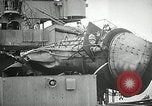
Damaged USS Louisville and men overhaul it in Okinawa, Japan.
Damaged USS Louisville (CA-28) hit by Japanese Kamikase in World War 2. Damaged forward stack of the ship. Float of its scout plane left on catapult, is jettisoned. Large stack of the USS Louisville knocked down. Engine of seaplane blown up by explosion on the signal bridge. Man welds in superstructure. View of other men working to repair damage to the Cruiser.. [Note: The following eyewitness account of the kamikaze attack was recorded by Seamen 1st Class, Enrico Trotta, who was a crew member on the USS Louisville (CA-28) from 1943 to 1946, "At 1923 (hours) two planes which were identified as friendly flew around and one kamikaze dove onto the battleship USS Mississippi BB 41. The other kamikaze plane turned to the Louisville and started to make a run on us. I was on No. #4 - 20 mm AA gun mount on the port side below #2 main battery and I fired 58 rounds to set the kamikaze plane on fire prior to hitting the Louisville’s front smoke stack bending and twisting it and killing 9 men on the 40 mm gun mount mounting on the forward superstructure tripod about 140 feet from our gun mount. The kamikaze also cut our sea plane off and left only the pontoon on the catapult. Three other 20 AA mm gun crews opened up firing 4, 11, and 20 rounds as well. We were not told to fire for we did it on our own. We were only manning the guns at the time and were not on general quarters. Later, the officers came by and said good job."]
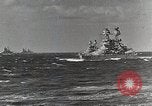
Montage of scenes related to the China-India-Burma theater during World War II
Two U.S. Pennsylvania class battleships underway at sea, with other warships in background, during World War 2. One fires to starboard with her 14-inch guns from the forward triple turrets. U.S. Army Air Forces B-24 Liberator bombers flying in formation over mountains. Glimpse of General Douglas MacArthur with General Joseph (Vinegar Joe) Stilwell in gunner's station of a bomber. Montage of brief glimpses showing U.S. forces engaging Japanese forces in: amphibious assaults; firing weapons in New Guinea and other Pacific islands. U.S. warship firing naval guns. U.S. ship firing at attacking Japanese aircraft, with sky full of black flak clouds. Admiral William (Bull) Halsey. Mitsubishi A6M Zero kamikaze aircraft blown up close to flight deck of U.S. aircraft carrier. It misses the ship and crashes in flames, exploding in the water, astern. U.S. General Joseph Stilwell, Madame Chiang Kai-Shek, British Allied commander Lord Louis Mountbatten, and Chinese Generalissimo Chiang Kai-Shek, photographed together in India. Chinese Generalissimo Chiang Kai-Shek seated for a picture with U.S. President Franklin D. Roosevelt. Camera moves back revealing British Prime Minister Winston Churchill, and Madame Chiang Kai-Shek, also seated. Behind them stand key allied military leaders, including (from the right) Field Marshal Archibald Percival Wavell, Commander-in-chief in India; Admiral Louis Mountbatten, Supreme Allied Commander of South-East Asia forces; George Giffard — commander of Eleventh Army Group; U.S. General Daniel Isom Sultan, deputy to General Stilwell; General Joseph Stilwell, Commander China-Burma-India (CBI) Command; and General Albert Coady Wedemeyer, Chiang Kai-Shek's Chief of Staff. General Joseph Stillwell is seen stepping from a military cargo plane, and being greeted by another officer. Stilwell is wearing a campaign hat. He has the CBI patch on his jacket shouder. A B-24 Liberator bomber takes off from a Chinese base at Liuchow, or possibly, Luiliang, China. (ostensibly carrying Chinese soldiers to India for training). U.S. marked P-40 aircraft are parked beside the runway. They display the shark teeth nose art of the Flying Tiger All volunteer Group of Claire Chennault. But this is 1944 and the aircraft are from the U.S. 23rd Fighter Group. Chinese soldiers are seen being armed and trained in India, with modern small arms. They are also seen fording a river with military supplies and moving in jeeps through jungle-like settings. Various views of Ledo Road construction in Burma. bulldozers, trucks, caterpillar tractors, explosives and men are shown in construction work. A jeep rides along a muddy section of the new road while U.S. and Chinese soldiers patrol on either side to protect it. Allied soldiers firing a small field piece. A C-47 aircraft airdrops supplies to the road builders. General Stilwell, standing with a Chinese officer, looks skyward at the aircraft. A C-46 Commando plane taking off from a field in India carrying supplies. Men loading a jeep aboard a C-46, plus ammunition and other supplies. Rare sight of supplies being loaded into nose cargo compartment of the one-of-a-kind XC-108A transport plane (modified B-17 bomber, tail number 41-2593). A formation of USAAF C-45 transport aircraft flying "over the Hump." Chinese P-36 Hawk aircraft in formation demonstrate firepower. Newly trained Chinese pilots marching and walking on flightline where solid-nose B-25s and P-40s are parked. Chinese and American pilots wave to each other from their P-40 aircraft. A B-25 takes off flanked by two P-40s. Bombs being dropped by Chinese B-25s. Japanese ship being strafed by Chinese fighter plane. Chinese laborers at work building an airfield without machinery. A large group pull a paving roller by hand. Chinese troops in combat with Japanese forces. One firing a Czech ZB vz. 26 light machine gun. Madame Chiang Kai-Shek addressing the U.S. Congress, 18 February, 1943.
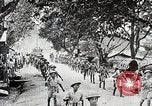
Chinese and American troops battle Japanese forces as they proceed along the Ledo road in the China-Burma-India theater of operations in World War II
On Christmas Eve, 1943,during World War 2, the Chinese 38th and 22nd Divisions are seen marching along a road toward North Burma. A regiment of Merrill's Marauders is seen joining the march from India through Burma. (Narrator says they will engage the Japanese 18th Division.) Along the line of march a road sign reads,"Shinbwiyang, Mile 110." Numerous views of troops struggling through jungles and natural obstacles. They employ pack animals that sometimes had difficulty in rough terrain. Animated map shows the route from Ledo, Assam, India, to the places of Chinese and American engagement with Japanese forces, in the Hukawng Valley. U.S. troops are seen moving under fire from Japanese enemy during active combat and returning fire with rifles, Browning M 1917, and M 1919 machine guns. Some of Merrill's Marauders wear standard M1 steel combat helmets, while others wear older M1917A1 "Kelly" helmets. One is seen firing a Bren gun with top-mounted curved box magazine. Others fire mortars. Chinese troops seen firing small artillery pieces. M3A3 Stuart light tanks of the joint Chinese-American 1st Provisional Tank Group (1st PTG) are seen with infantry walking behind them. Next, Allied casualties on litters are seen being placed in an ambulance. Numerous wounded are seen on the ground. Chinese troops carry a wounded on a litter. Views of Japanese soldiers being burned out of their hiding places by Chinese troops. Numerous views of dead Japanese soldiers. Scene shifts to air support by U.S. Army Air transport command providing aerial resupply from C-47 transport aircraft. C-47 aircraft seen flying over jungles. Monitors at a headquarters location are seen charting the changing positions of the Allied troops on the ground. View in a warehouse where air drop ready supplies are stored. Numerous views of supplies of all kinds being readied for air drop, including mail for the troops. Shipments being loaded aboard a transport airplane. C-47 airplane taxiing out after loading. Troops on the ground in radio contact with a transport plane. A long sequence ensues showing aerial resupply air drops from C-47 transport planes. After that, medical personnel are seen on the ground providing care to seriously wounded under difficult circumstances. Closeup of a surgeon tending to a patient. Many wounded seen on the ground awaiting attention and others in tents. A wounded on litters are transferred from an ambulance to an airplane. A woman nurse with other medics transferring patients. View inside an airplane set up for air evacuation. A nurse gives a wounded patient some water to drink. At a location unreachable by larger transport airplanes, a wounded soldier is placed aboard a single engine Stinson L-5 Sentinel liaison airplane which is then seen taking off and flying away. Animated map shows progress of Chinese troops on the Ledo road.
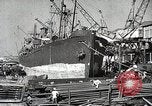
Construction of India-Burma-China Pipeline during World War II
Opening scene shows a large transport ship at a dock in Calcutta, India, during World War 2. It is surrounded by cranes unloading it. In the foreground, numerous sections of pipe are piled up on the dock. Closeup of group of pipe sections being lifted by crane from the ship's hold. Some individual pipes are seen moved by groups of Indian workers carrying them over their heads. Other Indian workers roll pipe sections onto barges that are seen clustered together near a steel bridge. A convoy of trucks is seen carrying the pipe sections along the Ledo road. Some bundles of pipe sections are carried on jeeps. View of an Army Air Forces C-47 transport plane taking off. Sections of pipe being offloaded from a C-47 plane. Numerous pipe sections in organized stacks near the airfield. Sections of pipe being fastened together. Engineers re-condition the road bed using construction equipment. Long connected pipe lines being pulled through water. Caterpillar tractors working on a muddy section of the road. Workers installing pipe near graves of workers who died from disease and other causes. Workers sending a bundle of pipe segments across a river by means of a Zip line. A worker's camp of tents in the background. Workers dressed in rain gear and boots carrying a pipe section through water during the Monsoon. Workers using machetes to chop their way through jungles. An open utility train moving Chinese troops along a single-track rail line, passes pipeline workers standing aside. Engineers and other pipeline workers distributing pipe sections along the rail line from railroad flatcars. Trucks driving the road, in Burma. Various views of the pipeline in including one showing lines of pipe forming a suspension bridge across a river. Other scenes show the pipeline crossing ravines, submerged under rivers, climbing vertical cliffs. Aerial views of the pipeline from low flying aircraft. A vehicle marshaling yard filled with army vehicles. M3A3 Stuart light tank moving past a yard filled with them. Army trucks moving out of their parking yard. Aerial view of large airfield with many parked Air Transport Command C-47 airplanes. B-29 bombers being refueled at an airfield. One is seen taking off. Lieutenant General Daniel Isom Sultan, Commander India-Burma theater, comments that the pipeline is a lifeline to our beleaguered ally and that the Chinese are in on this. Views of Chinese soldiers engaged against Japanese forces. They fire artillery pieces and heavy machine guns. British soldiers carrying Bren guns and struggling to move artillery pieces in the mud. They are seen firing artillery from under camouflage canopies and firing Vickers machine guns. Aerial view of the British controlled port in Calcutta, India, where war materiel is seen being unloaded. Tanks being transported on an Indian railroad. War supplies moving on a barge line and on roads. View of a British airfield in India. North Burma Chinese troops with their weapons and army vehicles. U.S. troops advancing on roads in the jungles. Chinese Marshal Chiang Kai-shek with U.S. President Franklin D. Roosevelt and British Prime Minister Winston Churchill, at the Cairo Conference of November 22–26, 1943. General Sultan concludes the film by reassuring American soldiers that they are in the China-Burma-India theater in the common allied effort to fight against Japan.
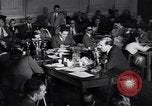
Journalist Howard Rushmore testifies before the House Committee on Un-American Activities in Washington DC.
The House Committee on Un-American Activities (HUAC or HCUA) an Investigating Committee of the United States House of Representatives, questions Hollywood personalities about communist influence. Journalist Howard Rushmore is asked questions. He is asked about Gerhart Eisler and whether he was "Jerome's "boss, and whether Eisler was a Communist. Witness answers that he is one of the major ones and that he is a representative of communist international in the United States. He mentions giving certain communists favorable press. Member of committee calls such communists 'Sacred Cows', witness call them 'Sacred Red Cows'. He takes name of Edward G Robinson and states that Jerome had instructed him to always defend Robinson, even if he gave a poor performance in a bad picture. . He talks to the committee about meeting of American committee, for the protection of foreign born, in Cleveland. Attorney General Biddle labeled it as a communist front in 1943. The committee asks him about League of American Writers and whether it is a Communist organization. Journalist also takes names of Earl Browder and Mike Gold, a writer for the Daily Worker newspaper.