


 Francais
 Deutsch
 Italiano
Refine Your Search
Tehran Iran 1943 stock footage and images
- Showing 463 to 468 of 3276 results more
more Hide
Hide
Launches of several U.S. Warships during World War II
Preparations for launch of the USS Hancock (CV-19) at Fore River Shipyard, Quincy, Massachusetts, on January 24, 1944. . Shipyard riggers removing supports from under the ship's hull. Platform at bow is decorated with bunting. Scene shifts to Brooklyn Navy Yard, New York, and the launching of the USS Missouri (BB-63), on January 29, 1944. Crowd gathered around the bow as the Missouri goes down the ways. Another change of scene to the Newport News Shipbuilding and Dry Dock Company of Newport News, Virginia. Here the ways are emptied following the launch of the Light Cruiser, USS Hancock (CL-81) on June 19, 1943. The Hancock can be seen in the water. Tugs attend to the newly launched Cruiser.
Mob uprisings against Fascists in Europe, during the end of World War II. The Third Moscow Conference of the Allied occupying powers. The Belsen trials.
A mob, seeking revenge against Fascist leaders, fills a city square. They pound on steel gates of a government building. Soldiers and police attempt to protect various persons from the mobs. Others are unprotected and suffer beatings and death. Bodies of Benito Mussolini and his Mistress Clara Petacci are seen hung upside down by Italian Partisans in Milan, Italy, on 28 April 1945. Scene shifts to image of postwar occupying powers, United States, Soviet Union, and Great Britain, whose flags are displayed in the center of a conference table during the Third Moscow Conference. Principals signing agreements, in November, 1943, providing, among other things, for lawful and orderly trials of war criminals, following World War 2. Seen signing are: Soviet Foreign Minister Vyacheslav Mikhailovich Molotov; U.S. Secretary of State, Cordell Hull; and British foreign Secretary, Sir Anthony Eden. View of General Dwight D. Eisenhower, leading a contingent of American wartime Generals on a mission to document Nazi atrocities at liberated German concentration camps. Closeup of a man directing local German citizens who were forced to observe the horrors of the camp. Closeup of an oven used to dispose of bodies of victims. Dead bodies of concentration camp victims strewn in a heap. A room filled with documentary evidence to be analyzed and used in war crimes trials. the body of German General Admiral Hans-Georg von Friedeburg , and of Heinrich Himmler, both of whom committed suicide. A hand holding cyanide capsules. Body of Leipzig City Council deputy mayor Dr. Ernst Kurt Lisso slumped over his desk, following suicide. Body of his daughter, Regina Lisso also a suicide victim. Nazi war criminals being rounded up by Allied military.One being carried on a stretcher. Another, a German officer, is taken into custody. Next, Josef Kramer, the Commandant of Bergen-Belsen concentration camp is seen under guard by a British soldier. British soldiers guarding the court room of the second Belsen trial, convened by the Allied occupational forces, in the Gymnasium building of Luneburg. View of the courtroom with defendants wearing numbers. Closeup of numbers 1 and 2, Josef Kramer, and Fritz Klein, respectively. View of Allied military officers sitting in judgment. Closeups of women defendants, including Irma Grese (number 9) and Elisabeth Volkenrath (number 11). Camera pans around the courtroom.
Numerous wrecked Allied warplanes. German ace Adolf Galland and other pilots. FW-190s and ME-109 airplanes in flight (WW2)
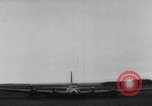
German soldiers climbing over a crash-landed B-17 bomber of the USAAF 96th Bomb Group, 337th Bomb Squadron, with tail number 42-3353. Its props are all bent and skin is peeled off its rudder and horizontal stabilizer. (This aircraft, named "Tar Fly," was hit by flak on September 9, 1943, and crash-landed west of Evreux, at Beamont-Le Roger, France. Two crew were killed and 8 taken as prisoners of war.) Smoking wreckage of an Allied aircraft in a field with two dead fliers lying on the ground about 50 yards away. Engines of a downed U.S. aircraft. Numerous views of wrecked American and British airplanes. Sign painted on one piece of wreckage reads: "When I go sightseeing in Tokyo, Tojo's gonna be my Ricksha Boy!" Piles of scrap alumunum from crashed airplanes piled up at a railroad siding, where German workers load it into rail freight cars. German army workers using tools to dismantle parts. Sequence shifts to a Messerschmitt Bf 109 that lands in a field. German airmen run to greet the pilot, who steps from the cockpit and describes some aerial maneuvers to a surrounding audience. Next, German ace, Adolf Galland is seen discussing tactics with other pilots. Several camouflaged Me Bf-109s lined up on a grass field, where ground crews are repairing and maintaining them. Closeups of German pilots climbing into cockpits of planes. Ground crews hand crank their starters. Next sequence shows Focke-Wulf FW-190 aircraft taxiing and then making a formation takeoff from grass field. Then an Me-Bf-109 is shown right after takeoff. FW-190s and Me-109s buzz the field. (World War II period)

United States Army Air Corps film "The Truth About Ploesti."
Formations of B-24 Liberator bombers are seen in flight, headed for Ploesti, Romania, on August 1, 1943, during World War 2. Next, vertical columns of bombs are seen falling from the planes. Animated map of Europe shows Romania and Ploesti. It show paths of oil from the Ploesti oil fields to Germany. (Narrator states Ploesti provides 30% of Axis oil.) Map show path of 9th Air Force bombers from Libya to the Ploesti oil fields. Scenes shift to captured German films from 1944, showing the fires and destruction resulting from the constant B-24 raids. Huge black clouds rise from the area. Firefighters rush to combat flames. They direct streams of water on the conflagrations. (Commenter states: "Delayed action bombs prevented firefighters from rushing in, until too late.") Nighttime views of large fires and heavy smoke from 6 of Ploesti's 7 refineries ripped wide open. Film advances to August, 1944, showing Ploesti with the fires out, following Rumania's capitulation. Next, with some fires still burning, King Michael I of Romania, tours the site with military officers. They walk amidst the debris. Smoke rising near a rail marshaling yard. Against a background of dense smoke rising, a Slate is displayed showing the cost to the United States of the Ploesti raids, as 300 bombers and 3000 American airmen were lost.
Trials of war criminals in Germany after World War Two. Belsen local trial.
"The Guilty." Animation depicts person being hanged. View of an angry crowd on a road. People beat captured German soldiers and collaborationists. Mob of Italian partisans in Italy raising dead bodies of Mussolini and others up to hang from their heels in public after their execution. Foreign Minister Vyacheslav Molotov and British Foreign Secretary Sir Anthony Eden signing the Moscow Declaration in November, 1943. The declaration is signed to preserve the authority of law in Europe and to ensure fair and orderly trials for war criminals. Next scene shows Allied soldiers at a liberated Concentration Camp near the end of World War 2 in Europe. Military jeeps in the background. Military photographer takes pictures as officials arrive to tour the concentration camp. Man opens a crematorium oven, revealing bones of a corpse inside. Pile of dead victims of a concentration camp. Elevated view of a room full of documents that are in review for war trials. Officials search documents to identify war criminal suspects. Nazi officers and officials who committed suicide are shown, including a German admiral, the body of Heinrich Himmler, and the bodies of the Mayor of Leipzig and his wife. War criminals being summoned for the various war crime trials. Scenes from the Belsen Trial in September 1945, held in a Lüneburg gymnasium, to decide the fate of German guards and SS officials from the Auschwitz and Bergen-Belsen concentration camps. A defendant being brought to trial on a stretcher. Soldiers guard the court room. View of defendants including many women SS-Gefolge members. German Commandant Josef Kramer during his trial, and German doctor Fritz Klein beside him. The court trial underway for the war criminals. Guilty war criminal brought to the gallows to be hanged, black cover placed over his head and he is hanged. View of dead bodies of concentration camp victims. View of a crowd amassed at a hanging execution of several German officers, possibly in the Soviet Union.
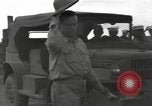
Bob Hope and his USO Troupe visit a U.S. Navy base on Mios Woendi island, Schouten Islands, Papua New Guinea, during World War II.
Bob Hope and members of his USO troupe ride on a PT boat during visit to entertain U.S. Navy personnel during World War 2. In opening scene, Bob Hope doffs his pith helmet as he strolls past the camera to climb aboard a PT boat (PT-331) of U.S. Navy Motor Torpedo Boat Squadron 21, where several naval officers greet him. Members of Hope's USO troupe, Patty Thomas, and Francis Langford, step from jeeps to board the PT boat. Next, the two are seen in the cockpit of the boat next to its captain, Lieutenant Kermit W. Montz, USNR, as the boat speeds along in the water. Among sailors occasionally glimpsed behind them is Radioman 1st Class bill Thielen. In change of scene, Bob Hope climbs out a hatch, holding onto his pith helmet to keep it from blowing off. The boat's number, 331 is clearly displayed on superstructure behind him. Various Navy sailors on deck. (Note: Squadron 21 received a Presidential Unit Citation for outstanding performance during the Huon Peninsula Campaign against Japanese forces from October 1943 to March 1944.)