


 Francais
 Deutsch
 Italiano
Refine Your Search
Tehran Iran 1943 stock footage and images
- Showing 559 to 564 of 3276 results more
more Hide
Hide
V-mail procedures including cutting, microfilming, transport, photographic enlargement, and processing during WWII.
The use of V-mail (Victory Mail) by the United States during World War II. V-mail procedures including cutting, microfilming, transport, photographic enlargement, and processing of V-mail letters and post. A poster promoting the use of V-mail. Women in a line at a post office. The post office staff at counter windows serves the customers. A woman collects a V-mail letter, writes her message and then addresses the letter. The preferred use of a softer pencil in V-mails. Cutting: Specially trained soldiers unpack the V-mails and use a cutting machine to open each mail. Processing: The experienced staff sorts mails into the respective destination groups at sorting tables. Soldiers open mails to photograph them. A soldier sorts mail that can't be photographed and are to be sent back. These mails include stamps, enclosures, snapshots and bad writing. The correct mails are then sorted into given numbers in bundles. Microfilming: Women use Airgraph machines to photograph each mail on 16mm films. 1600 mails on 100 feet of film. The complete reels are sent for developing. Women put in new reels of negatives into the cameras. Developers dry the film reels. Stacks of reels on a table containing images of thousands of letters. Soldiers packing and stacking many hundreds of sacks filled with V-mail letter microfilm images. A Boeing 314 Pan American Clipper flying boat sea plane (military designation C-98) is seen taking off to transport V-mail to major destination points. A bag of microfilm reels is delivered to an officer. He unpacks the reels and sends them to the printing room. Enlargement: Enlargement machines are used to enlarge the snapshots. Men and women operate the printing machines. Soldiers with the printed facsimiles on tables. Processing: Women slice the prints into separate letters. Machines used to insert facsimiles into V-mail envelopes and seal them. The mails are then sent to the exact destinations by ordinary post. Soldiers gather around as a comrade distributes mail at a U.S. military base in the combat area.
The Guadalcanal campaign in World War II
Major General Alexander Vandegrift, USMC, who, as Commanding General of the 1st Marine Division, also commanded other U.S. military units involved in the invasion of Guadalcanal in World War 2. He discusses those joint U.S. military operations. The U.S. Destroyer, USS Blue (DD-387) seen bombarding Guadalcanal.A B-17 bomber overhead. U.S. Marines decend rope net into landing craft of the attack transport, USS George Clymer (APA-27), later seen with the USS Harry Lee (APA-10) and numerous landing craft around them. A landing craft from the Harry Lee arriving and Marines jumping out. Many U.S. troops wading ashore from landing craft. Troops carrying supplies ashore. Officers salute as American flag is raised on rugged flag pole. Numerous Japanese prisoners of war marching and in outdoor confinement. Japanese prisoners being processed. Japanese soldier using shoe clamps to quickly climb a tall palm tree. Admiral William Frederick Halsey, Jr.decorating a flyer with the Distinguished Flying Cross. View of the medal.Halsey decorating marines, including Major General Alexander Vandegrift, USMC, seen wearing the Navy Cross. Sign on palm tree reading: "Hospital Station C-1-Med." Wounded inside hospital tent. Troops gathered for religious service. U.S. troops dug in and moving along jungle path. Fallen Japanese soldiers on shore of Guadalcanal.Smoke rising from Japanese bombing of Henderson Field and construction continuing with heavy equipment. A B-17 bomber landing on the field. Names on B-17s at the field, including: "Spook," "Leis-Lady,"and "Boomerang." A Douglas SBD Dauntless aircraft taking off from Henderson field. Film concludes with parade of warships and overflight of warplanes (including a biplane).
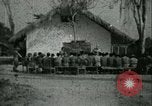
A U.S. OSS officer uses a black board to instruct Burmese students in Burma during World War if.
U.S. OSS (Office of Strategic Services) officers train Burmese recruits in Burma during World War II. An OSS officer instructs Burmese students on ambush and traps. Students seated on benches outside a hut. The instructor uses a black board. He explains the written matter and diagrams on the board. A Burmese instructor translates the information. A student stands up and asks a question. The instructor responds.
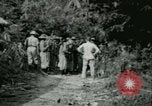
American and Burmese instructors train recruits in mine laying in Burma during World War II.
U.S. OSS (Office of Strategic Services) officers train Burmese recruits in Burma during World War II. American and Burmese instructors with the students on a path in the jungle. The instructor gives instructions and demonstrates mine laying near huts in a clearing. The students watch. The y mark positions on either side of the road and lay mines. The recruits in camouflaged hats. The instructors demonstrate and inspect. The students lay mines in the thick foliage. Dust flies on the jungle path.
OSS and Burmese officers train Burmese students in machine gun firing and grenade throwing in Burma during World War II.
U.S. OSS (Office of Strategic Services) officers train Burmese recruits in Burma during World War II. Instructors and Burmese students on tracks in a clearing. The students at attention. The U.S. and Burmese instructors talk to the students. The e students get into a truck. The officers in a military jeep and the students in a truck leave the ground. They reach the firing range, get off, get into formation and salute the officers. The officers give instructions and mark their positions. The recruits are trained in machine gun handling and firing as well as grenade throwing. The American instructor demonstrates the correct standing position and handling of a machine gun. The students watch, learn and follow the instructions. The instructors watch as the recruits hold machine guns, take aim and fire at targets on the range. The American instructor watches as students throw grenades on practice targets. They throw the grenade and fall into the prone position. Burmese soldiers smile and salute.
American and Burmese instructors train Burmese students in the uses of a compass and medical procedures during World War II.
U.S. OSS (Office of Strategic Services) officers train Burmese recruits in Burma during World War II. The students learn the uses of a compass and medical procedures for helping wounded comrades. A Burmese instructor shows them a compass and demonstrates its uses. The students listen as he gives instructions. The instructor demonstrates the uses of a compass on a map on the table. A Burmese recruit stands on a table as another wraps a bandage around his foot to demonstrate medical procedures. An American instructor and the other students observe. The American instructor then demonstrates tying of a bandage around the head. The Burmese instructor guides the students to follow the same steps. The American instructor looks on as the recruits demonstrate plastering a broken arm. He guides the students.