


 Francais
 Deutsch
 Italiano

Refine Your Search
Thionville France 1944 stock footage and images
- Showing 607 to 612 of 9965 results more
 Hide
Color Sound

The Philippines gains independence from the United States on July 4, 1946; also scenes from 1941 Japanese invasion WW2
The Philippines are established as an independent nation. Crowds of Filipinos gathered at Rizal Park (Luneta Park) in Manila on the July 4, 1946. View of Independence Grandstand (a temporary structure built in front of the Rizal Monument) with American flag and Philippine flags on tall flag poles.. View looking down on General Douglas MacArthur at a podium, speaking into microphones. Camera pans over various segments of the audience. A map shows the Philippine Islands in context of its neighbors in the Pacific Ocean. Camera pans closeup across faces of many Filipinos gathered at the independence event. View of the Jones Bridge over the Pasig River in downtown Manila. Heacock’s Department Store on the Escolta. The Legislative Building. (later the National Museum of the Philippines). Ocean going ships in a harbor. Cargo being offloaded from a ship onto smaller boat. An industrial complex with eight tall smoke stacks emitting smoke. Steel and petroleum plants. Filipino workers in an assembly plant. The Legislative building with people coming and going. Air raid sirens sounding and people running in streets of Manila at onset of Japanese invasion of the Philippines in December, 1941, at start of World War 2, in the Pacific. People running across the Jones Bridge, seeking shelter. Others boarding a bus. Smoke rising from Japanese bombing. Glimpse of Japanese tanks entering Manila during attack and invasion. Japanese infantry climbing a hill. Bodies of persons killed during the Japanese invasion. Glimpse of Japanese troops occupying Corregidor. U.S. General Wainwright negotiating the surrender of Corregidor with Japanese General Homma. View of an American warship firing during the U.S. campaign to defeat the Japanese on islands in the Pacific. An American landing ship carrying U.S. troops who storm ashore. General Douglas MacArthur striding ashore with a retinue of officers, at Leyte, Philippines, on October 20, 1944. as he keeps his promise to return to the Philippines. Views, back again, to MacArthur speaking at the Independence Day ceremony in Manila on July 4, 1946. Also seen at the ceremony are: U.S. Senator Millard Tydings, (co-sponsor of the 1934 Tydings–McDuffie Act, which provided independence to the Philippines after a 10-year transition under a limited autonomy), and Paul V. McNutt, U.S. High Commissioner of the Philippines, who read President Truman's proclamation of Philippine Independence to the assembly. Camera pans over the gathering which includes many U.S. Service personnel in uniform. The oath of office is administered to the elected President of the Philippines, Manuel Roxas. At the conclusion, the American flag is lowered by Paul McNutt, as President Roxas raises that of the Republic of the Philippines. A celebratory parade in Manila includes a float with signs reading: "Let's Produce and Rebuild," among other things. Other floats represent "Mountain Province," and "The City of Manila," "The University of the Philippines," and "The Division of City Schools." One float, sponsored by the Chamber of Commerce, contains a huge replica machine gear, and models of an aircraft and a ship. It's message is about turning the gear that helps make the nation great. American and Filipino soldiers march, carrying their respective national flags. A white-helmeted military band plays for the marchers. Final scene shows large loose formation of military aircraft in flight very high above the Independence Grandstand, at Rizal Park.
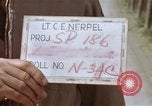
Liberated United States airmen prisoners at Stalag 7A in Moosburg, Germany (WW2)
Liberated United States prisoners (mostly military airmen) at POW camp called Kriegsgefangenen-Mannschafts-Stammlager (Stalag) VII A, located just North of Moosburg, Germany during World War II. The airmen cook food. Several are seen sunning themselves. Airmen seen shaving, shining shoes and cleaning clothes. A group of airmen around sign 'I Wanted Wings' and 'Luft 3'. These are some of the prisoners who were originally held at Stalag Luft III, in German Province of Lower Silesia, near the town of Sagan (now in Poland). (Note: Stalag Luft III is famous because the "Great Escape" took place there in March, 1944. Prisoners were forced to march from Sagan to Spremburg during the coldest winter in Germany in 50 years. There, they boarded a train of boxcars for a 3 day trip to Moosburg in January 1945, because the Russians were closing in. The addition of these prisoners to Stalag 7A, at Moosburg, led to serious overcrowding of the camp. On May 1, 1945, the New York Times reported that "The Fourteenth Armored Division liberated 110,000 Allied prisoners of war at Stalag 7A at Moosburg." This corrected an earlier report that 27,000 prisoners had been liberated.)
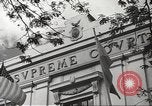
Courts and legislature in the Philippines shortly before World War 2, also President Quezon and Moro people
Scenes in the Philippines before World War II, from a 1944 film. Exterior of the Supreme Court of the Philippines. Judges and officials of the court seated in the court and trials being conducted. Exterior of House of Congress. Interior view with legislature in session. Filipino President Manuel Luis Quezon seen speaking to legislators and seated at a desk in discussion by telephone and with officials. View of his Vice Presiden, Sergio Osmeña, seated in an office. Filpino children pray in front of an altar with the figure of Jesus at a church. Women cross themselves in church. View of beaches on islands. Moro men on Mindanao. Moro man using a bolo (steel blade with handle akin to machete) to cut open a coconut and to cut down crops in field. Moro men gathered near docks at a beach area. Earlier views of U.S. Army General John J. Pershing between time of Spanish American War and World War I. Street views in city and town areas of Zamboanga, Mindanao, with businesses, rickshaws, commercial traffic. A monkey with a very short stub of a tail that is local to Mindanao (stump-tailed macaque). Moro women and men dancers perform a traditional dance and play music. A moro woman spinning a large clay vessel to husk rice. Moro woman walking with goods piled and balanced on her head. Moro men moving a small house using large poles. Moro man getting a haircut. Moro woman washing clothes. Moro fishing vessels with small sails heading out to sea.
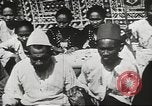
Culture and traditions of the tribal people in the Philippines before World War 2.
Activities of indigenous Filipinos in the Philippines shortly before World War II, from a 1944 film showing earlier scenes. Moro musicians sit beside gongs. Animated map of the Philippines showing the main islands of the archipelago such as Mindanao, Cebu, Mindoro, and Luzon. An American man compares his height to a Negrito man. Negrito men pose wearing loin cloths and running from a field. Negrito boy hugs a U.S. soldier. Igorot people gather near a house in the Cordillera region. Terraced rice fields and irrigation ditches made by the Igorots for thousands of years. View of the Banaue Rice Terraces. Mountains in the foreground. Young Igorot men and women in lowland attire such as Barong Tagalog and Terno perform a rice dance.
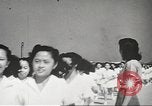
Filipino women work in houses and offices in the Philippines.
Lifestyle and activities of Filipino people in the Philippines shortly before World War II, from a 1944 film showing pre-war scenes. Filipino women in homes and offices. A Physical Education teacher watch a group of female Filipino students jogging in two straight lines. Faces of young Filipino women smiling. Pairs of dancers perform Filipino folk dance Cariñosa with handkerchiefs. Two women talk amongst themselves while shopping in a crockery shop. A woman stitches clothes using a sewing machine. Some of the women work in their houses. A woman practices archery. Women wearing various traditional Filipino dresses such as the Maria Clara dress of the Tagalogs and Batawi for Muslim Tausug women. Tagalog women wearing Terno dresses made of Piña or Pineapple cloth. A woman shows her Terno’s ‘Butterfly sleeves’. Filipino women working as soda fountain waitresses in the American tradition, and as Blues singers. Women doctors and nurses in a hospital. Young Filipino women and men dance the Jitterbug.
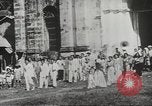
Filipino people at homes and market places in the Philippines before World War 2.
Activities of Filipino people in the Philippines before World War II (from a 1944 film showing earlier scenes). A wedding ceremony in a church in the Philippines. A Roman Catholic priest officiates a Filipino wedding. Children play with see-saw outside a traditional Bahay Kubo house. A man offers ‘ulam’ or dish to accompany with rice. Interior of a house. A Filipino woman cooks pochero, a stewpot dish. Men and women seated at a table eating food. A woman scoops rice to her plate. A man wearing a Barong Tagalog having dinner at home. Filipinos roasting ‘Lechon’ during an outdoor barbecue. Suckling pig cooked over charcoal. Filipinos enjoying barbecue dishes. People buying vegetables such as ampalaya (bitter melon) and jicamas at the wet market. Vegetable in baskets. Houses in the background. Narrator warning about food and water safety and risk of dysentery. Scene closes with wartime views in World War w of Japanese soldiers marching in the Philippines.
CRITICALPAST.COM: About Us | Contact Us | FAQs - How to Order | License Agreement | My Account | My Lightboxes | Shopping Cart | Advanced Search | Featured Collections | Website Terms & Conditions | Privacy Policy ©2026 CriticalPast LLC.
License Agreement |
Terms & Conditions |
Privacy Policy
©2026 CriticalPast LLC.