


 Francais
 Deutsch
 Italiano

Refine Your Search
Thionville France 1944 stock footage and images
- Showing 61 to 66 of 9965 results more
 Hide
Color Sound
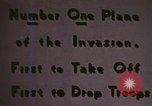
The first U.S. C-47 aircraft (and its crew) to drop Pathfinder Paratroopers on D-day eve in World War II.
U.S. Army Air Forces C-47aircraft , number 42-93098, of the 9th Troop Carrier Command Pathfinder Group, and its crew. This is the first aircraft and crew to drop American paratroopers (pathfinders) over France during the Allied invasion, in World War 2. The aircraft taxis on a British airfield. Crew of the aircraft are seen in front of it, including pilot, Lieutenant Colonel Joel Crouch, Copilot, Captain Vito Pedone, Navigator, Captain William Culp, Radio Operator, Harold Coonrod, along with two crew chiefs. Crew members shake hands and board the aircraft. Colonel Crouch waves from the cockpit of the C-47 (but has not started engines). Major J.L. Sweetman boards another aircraft. Colonel Crouche's C-47 taxis to where the Pathfinders will load up. View of Control Tower at RAF North Witham, with ambulance parked outside it. Three hours before takeoff.Colonel Crouch, is seen on a path near the airfield, with a Pathfinder Captain and Lieutenant, who will be aboard his aircraft and be the first to jump into France. They kid around. The Pathfinder officers note that Colonel Crouch wears paratroop wings. Later, two Pathfinders, of the 101st Airborne Division , with camouflaged faces and American flag insignia on their right shoulders, step from woods and pose momentarily. Pathfinder Paratroopers line up to board C-47 aircraft as Lt. Col. Crouch rides a scooter at the airfield. Aircrews and Pathfinders pose for photographs before taking off. The lead aircraft, number 42-93098, with Lieutenant Colonel Crouch at the controls, takes off from RAF Station North Witham at 9:54 PM, on June 5, 1944. to begin the invasion of France. (Note: This C-47 was shot down on September 18, 1944, during Operation Market Garden, and crash landed on Haamstede Airbase, Netherlands. Although shot at by German troops on the ground, pilot, Maj Joseph A. Beck, and Navigator Lt. Vincent J. Paterno, survived as prisoners of war. Copilot Capt Fred O. Lorimer and another crew member were fatally shot.)

Bomb damaged Place de la Concorde and unscathed Champs Elysees, Eiffel Tower, Arc de Triomphe, Notre Dame in Paris after WWII.
Results of selective strategic bombing by the British Royal and United States Eighth Air Forces in German-occupied Paris and surrounding areas during World War II. September 1944: Pont de Grenelle bridge over the Seine river. Eiffel Tower (Champ de Mars, 5 Avenue Anatole France, 75007 Paris, France) in the background. The Statue of Liberty replica on the Ile aux Cygnes Island (Pont de Grenelle, 75015 Paris, France). Shell blast damaged buildings and the Obelisk at Place de la Concorde (75008 Paris, France). Cyclists and motorists at the Place. Military cars pass the Arc de Triomphe (Place Charles de Gaulle, 75008 Paris, France) at Champs Elysees. Civilians around the Eiffel Tower. The French flag atop the undamaged tower. Unscathed Notre Dame de Paris (6 Parvis Notre-Dame - Pl. Jean-Paul II, 75004 Paris, France). United States military vehicles in the square before the cathedral. U.S. Army soldiers and French civilians crowding in front of the Cathedral. An FFI (French Forces of the Interior) flag at Notre Dame.
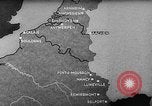
German forces defending against Allied advances toward Germany during WW2.
Map highlighting France, Belgium, and low countries, and German border city of Aachen during World War II. Soldiers riding on German Panther tanks camouflaged with foliage. They pass infantry walking along the side of the road. A Panzer IV with side track protectors. Commander of the German 5th Panzer Army, General Hasso von Manteuffel, conversing with officers of the 116th Panzer Division, September 1944. German tanks and infantry moving across a field. German soldier firing from prone position in a field. Knocked out American M3 halftracks. Captured American jeep and M3 halftrack. A very young German boy soldier escorting two ambulatory wounded American soldier prisoners of war. A small group of American prisoners of war. German field artillery firing and smoke rising from their shells exploding in distance. German troops entering town of Moncel-Les-Luneville, in Northeast France. Fire burning in the town. The Moncel-les-Luneville building after bombing in Luneville, France, at 15 Rue des Tuiliers, 54300 Moncel-lès-Lunéville, France. A Panzer tank enters Luneville. A huge smoke column rising in background.
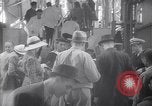
American passengers boarding U.S. Ocean Liner SS Washington shortly before fall of France to Nazi Germany in World War II.
A group of passengers waiting to go on board the American ocean liner SS Washington, standing at the port of Le Verdon Sur Mer, Bordeaux France. Passengers leaving France shortly before its fall to Nazi Germany are shown inspected for passport and searched before boarding. A car being hoisted onto the ship. View of the clock tower and loading areas at the port of Le Verdon Sur Mer (subsequently destroyed by Nazi Germany later in the war, in November 1944). Captain Manning standing on the bridge. View of ship SS Washington pulling away from dock. June 1940.
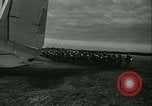
U.S. Signal Corps employ the Eureka/Rebecca transponder system during the American airborne landings in Normandy, France.
The role and contribution of the U.S. Army Signal Corps in combat and war. Parachute drop-markers with radio signals guide an airborne operation in the European Theater. U.S. airborne troops board a U.S. Army Air Forces Douglas C-47 Skytrain or Dakota transport aircraft. A woman soldier greets the paratroopers as they prepare to board the aircraft. The paratroopers jump out and descend towards the ground. The paratroopers are furnished with markers for every dropping point. A paratrooper with a radio beacon hooked onto his belt. The beacon is the ground section of the Eureka/Rebecca transponder system. The paratrooper fixes the Eureka extension including the cable and the receiver transmitter. Animation depicts the working of the Eureka-Rebeca system. An aircraft unloads paratroopers over Normandy in France during World War II. Allied troops, landing crafts, landing ships arrive at Normandy on D-Day (6 June 1944). Soldiers wade through the water towards the shore and advance inland across the beach during Allied invasion of France.

Allied troops aboard ships in England as they prepare for D-Day invasion of France during World War 2
Briefing about D-Day invasion of Normandy prepared by SHAEF Public Relations Division (SHAEF is Supreme Headquarters Allied Expeditionary Forces). With English narration. Allied troops on foot and in DUKWs, amphibious trucks move towards southern ports in England to launch D-Day attack in France during World War II. Allied soldiers board landing crafts and landing ships. Military vehicles being loaded in ships. Royal Air Force bomber aircraft attack German-held Normandy coast during night. Fire and explosions occur. A soldier talks to another soldier holding a bayonet. Allied soldiers aboard vessels move across the ocean as balloon barrages fly over head. British soldiers look at pamphlets on France. Soldiers read General Eisenhower's order. Footage shot between June 6 and June 9, 1944 (D-Day to D-Day plus 3)
CRITICALPAST.COM: About Us | Contact Us | FAQs - How to Order | License Agreement | My Account | My Lightboxes | Shopping Cart | Advanced Search | Featured Collections | Website Terms & Conditions | Privacy Policy ©2026 CriticalPast LLC.
License Agreement |
Terms & Conditions |
Privacy Policy
©2026 CriticalPast LLC.