


 Francais
 Deutsch
 Italiano

Refine Your Search
Thionville France 1944 stock footage and images
- Showing 763 to 768 of 9965 results more
 Hide
Color Sound
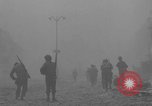
U.S. soldiers liberate Isigny, France and guard captured German soldiers during WW2
U.S. Army 29th Infantry Division soldiers stand in smoke-filled streets of Isigny-sur-Mer, France, during its liberation from Nazi German occupation, three days after the Allied invasion of France in World War 2. Two American soldiers stand at a stone monument in Place Gambetta, at Rue Émile Demagny. View of the damaged Hotel de France in the town, and U.S. soldiers crouched under its sign, looking upward and likely monitoring for German snipers. Next scene shows a U.S. Army soldier standing guard with his rifle pointed at four captured German soldiers and one German officer. The prisoners of war are a mix of young soldiers and old. With sullen, exhausted expressions the German soldiers lean and sit against the building of the Cafe du Port. A seated German soldier has a bandage wrapped around one foot. Close-up view of an old French sign above the head of the U.S. soldier, dated 1867, that warns residents not to throw garbage into the port waters. A French woman wrapped in a shawl leans close toward a seated U.S. soldier while she speaks to him and points. A very elderly French woman, using a cane, and wearing traditional clothing of the region, walks past a group of American soldiers over top of rubble from bombing. A group of U.S. soldiers on patrol walks away from camera position toward other streets of the town.
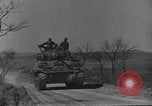
A tank battle between United States and German tanks in France (WW2)
A tank battle between United States and German tanks in France during World War II. Several U.S. Sherman tanks advance on a road. German Panther tanks advance on a nearly parallel road that eventually merges and tank battle ensues at the road junction. Wrecked early-war French and British tanks are seen. Mountains in the background. U. S. infantry move through woods behind Sherman flamethrower tank. Several German soldiers surrender to U.S. troops. Sherman tanks move through woods. A sherman dozer tank knocks down a tree. American Sherman tanks moving through a town or city as troops fan out.
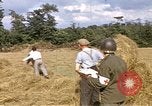
Farmers work in a field in France while U.S. artillery is fired at German positions during World War II
U.S. troops in France soon after the Allied Invasion of Europe, in World War 2. An American Army medic in a field. French Farmers stack hay with hay forks. Hay stacks on the field. Big U.S. artillery gun camouflaged in the same field. The artillery fires at German positions while the farmers continue moving hay, uninterrupted.
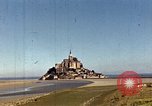
American troops and war correspondents at Mont Saint Michel and Saint Malo in France during World War II
American troops and war correspondents in France, during World War 2. They visit Mont Saint Michel, a small rocky island at the mouth of Couesnon River in Normandy, separating Normandy and Brittany. View of the island with a monastery at the top. War correspondent Robert Capa (of Life and of Time Magazines) looks on and takes pictures. Military jeeps leave the island. Madam Poulard stands under a sign at her Hotel Poulard. Sign for the Hotel and its reputed omelette. Soldiers on the street. Shops and French flags. GIs at the Benedictine Abbey and steepled church. An old French man points. U.S. Soldiers take a tour of the monastery with a woman guide. Steeples, towers, arches and other architectural features of the abbey and monastery. War correspondents including Charles Collingwood, Chicago Daily News' Helen Kirkpatrick, New Yorker Magazine's Joe Liebling (Abbot Joseph Liebling) and Warden Becker. Helen and Charles pose for the camera. Ernest Hemingway, covering for Colliers Magazine, drinks and talks to Bill Walton. War correspondents including Bill Stringer seated and walking on the street. They visit the monastery and take pictures. Civilians on the streets. Tall sticks in sand placed by German forces around the island to prevent Allied planes from landing at low tide. Three war orphan brothers whose parents were killed at the battle of St Lo, play on the beach as their grandmother looks on. Views of the island and patterns on the sand around the island from the receding waters of low tide. St. Malo, Brittany: Field near Saint Malo. American soldiers bathe and swim in a lake. They fool around in the water, taking a break from battle.
Damage caused during World War II and German prisoners at a prison camp in France.
Damage caused during the war between Allied forces and the German troops in France. Wrecked vehicles, artillery and other equipment. Wounded German soldiers. Soldiers carry wounded on a stretcher. German prisoners emerge single and then in small groups. German prisoners at a prison camp built by them for the French. The prisoners sit, stand and talk. A soldier talks to a man. Soldiers talk to a boy who was made a slave after his parents were killed by the Nazis in Ukraine. Prisoners eat and drink.
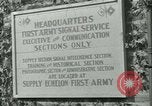
Messages are encoded and decoded at the First Army Signal Service Headquarters in France during World War II.
The First Army Signal Service Headquarters, Executive and Communication Section in France during World War 2. A soldier takes a message from the check post at the entrance. He delivers the dispatch message to the 'Master Message Center'. View of an American cipher machine ( SIGABA or Converter M-134 or ECM Mark II, akin to a German enigma machine) used to encipher or encrypt the message. Another soldier decodes the incoming messages and encodes the outgoing messages using an automatic code machine. Soldiers operate teletypes, wirelesses, telephones and radios at the Headquarters. Officers near telephone carrier equipment that provides 7 channels in all and has 2 ground simplex circuits. A messenger plane lands near the Headquarters. The pilot hands over a map to the messenger. The map is cleared through the Message Center, sent by facsimile to Intelligence. Officers then forward the information to the artillery. The designated target area on the map. Soldiers fire artillery and shell the target area.
CRITICALPAST.COM: About Us | Contact Us | FAQs - How to Order | License Agreement | My Account | My Lightboxes | Shopping Cart | Advanced Search | Featured Collections | Website Terms & Conditions | Privacy Policy ©2026 CriticalPast LLC.
License Agreement |
Terms & Conditions |
Privacy Policy
©2026 CriticalPast LLC.