


 Francais
 Deutsch
 Italiano

Refine Your Search
Thionville France 1944 stock footage and images
- Showing 205 to 210 of 9965 results more
 Hide
Color Sound
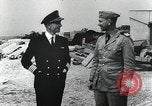
Seabees construct an artificial harbor during the Allied invasion of Normandy, France in World War II.
A film about the role of U.S. Navy Seabees in construction of artificial harbors in the English Channel during the Allied invasion of Normandy in World War II. U.S. Navy Captain Clark, in charge of artificial harbors and Commander Calair, in charge of installing Phoenixes and pier heads in the English Channel. Ships underway in the English channel. Tugs at a harbor. Beetles being pulled. A tug prepares to tow a Phoenix. Men work on lines. Whales spread across the channel. Pier head at sea. A dumb barge underway at sea. A captain looks at the towing operation from the bridge of a vessel. Aircraft in flight. Crew aboard a phoenix. Gliders in flight above the convoy. A signalman sends a blinker signal. Animated diagram depicts the creation of an artificial harbor. First tow arrives at Normandy on June 6, 1944. Landing crafts at the Normandy beach. Artificial harbor being constructed. A bridge being completed and pier head being attached to it. Seabees at work.
U.S. troops in Scotland rehearse for amphibious invasion of Normandy, France during World War II
Higgins Boats (landing craft) from the USS Bayfield (APA-33) are seen heading toward the shore on the River Clyde in Scotland, where they carried out amphibious landing exercises from 14 March, through 21 March,1944, in preparation for the Allied invasion of Normandy during World War 2.. Snow-covered mountains dominate the background. View of a U.S. Coast Guardsman standing in one of the boats. Several landing craft are seen near the shore in the background. Snow extends almost as low as the beach. Several landing craft moving in loose formation across the water, with rising moon low on horizon in background. View of one Higgins Boat plowing through the water, towards the camera. The moon is now higher in the sky. American troops wading ashore through surf, in the moonlight. Some stars are visible high in the background sky. Troops coming ashore along a wide stretch of beach. Clouds obscure the sky.
Allied invasion force departs England en route to France for invasion of Normandy, in World War II.
D-Day minus 1 (June 5, 1944) U.S. Invasion craft jammed into harbor at Weymouth, England, the day before D-day, during World War 2. Troops sitting on deck of LSI(L) 88, drinking coffee and playing dice game. One soldier looking through binoculars, at an English woman,in doorway of her flat, who is looking back through her binoculars. Several other women in the flat complex are hanging laundry out to dry.The American soldier cups his hands and tries to call out to the woman.One of his friends joins in the fun. Scene shifts to Formation of U.S. B-26 bombers in flight. A city is viewed from a bomber, with smoke rising from bomb bursts. Formation of U.S. B-17 bombers escorted by P-47 fighters. Scene shifts back to troops at port of embarkation, where large group is seen at a Catholic mass being held on a pier by U.S. chaplain.LCI(L)s numbers 49, 89, and 93, are seen tied up in background. A U.S.Coast Guard officer briefs his crewmen. Several of the invasion fleet ships begin moving out of the harbor. A U.S. Navy Captain, conversing with Major General Clarence R. Huebner, Commander, U.S. 1st Infantry Division, on deck of a ship. Buckley-Class Destroyer escort, in camouflage paint, is seen with other other escorting warships. Barrage Balloons fly aloft. View from LCI(L) departing pier in Weymouth. Several others preparing to depart as well. LCI(L) 498 is seen closeby. Columns of invasion craft underway. Captain Miles Imlay,USCG, deputy commander, Assault Group O-1, and Commander of Flotilla 10, on the bridge of his flagship, LCI(L) 87. The U.S. Attack transport USS Samuel Chase (APA-26) is seen. Soldiers loading rounds into an ammunition belt. Crew members on an invasion ship man an antiaircraft gun (as friendly aircraft fly overhead). An 83-ft Coast Guard rescue cutter. U.S. Battleships. Soldiers napping on deck of the USS Samuel Chase. Below decks, a Coast Guard Commander joins others being briefed with help of a mockup of the Normandy coastline.
U.S. engineers construct bridge on the Ledo Burma roads in South East Asia during Allied Invasion of France during World War 2
Bridge construction on the Ledo Burma roads in South East Asia during World War II on 5 August 1944. Aerial view of the flooded and damaged roads and bridges. United States engineers watch as the worker operates crane. They instruct the bridge building. Mountains in the background. Cable is pulled over tower by the block and tackle. Cable anchors are embedded in hillside caves. View of the completed suspension bridge. American and Chinese workers clear debris using bulldozer. Allied soldiers look at the map and discuss. Soldiers move with the horses loaded with their belongings. They cross flooded stream. Aircraft in flight. Supplies are dropped by parachutes on field.
Battle of the Ardennes and Battle of the Bulge, in World War II
Film starts showing silhouettes of British tanks on the move, including one with a bulldozer blade. View from Allied warplane as bombs explode on the ground below. In November, 1944, infantry of the First Canadian Army, with Polish and British units fire Bren guns as they advance in Belgium and secure the Scheldt Estuary, to open a shipping route to Antwerp for the Allies. They traverse a river and cross rail lines while advancing. View of destroyed steel bridge across the Maas (Meuse) river with several British troops wading in water nearby. Silhouettes of German prisoners of war marching single file. View from rear of German prisoners walking under guard with hands resting on their heads. British troops running beside the Scheldt river at Antwerp on September 4, 1944, as huge explosions occur in the river behind them. A column of British troops, marching on tree-lined road, enters outskirts of Antwerp, as local people cheer them. Views of the troops being greeted in the city itself. Columns of Belgian refugees are seen returning to their homes. One,injured, is carried by friends in a wooden cart. A contingent of British troops marching in the city. Glimpses of derricks in the Antwerp port and a ship under construction in a shipyard. An animated map shows German counter offensive through Belgium and Luxemburg on September 4, 1944. Refugees leaving again, ahead of the returning German forces. View of a road sign reading: "Bastogne." American military police checking credentials of some refugees as they leave. American soldiers jammed together atop a Sherman tank parked at a checkpoint. After delaying further German advance, through the Ardennes, on September 16th, American troops are forced back and seen leaving , in trucks and Sherman tanks, from Bastogne, past a road leading to Martelange. As weather cleared on September 22nd, a formation of British Hawker Typhoon ground attack aircraft are seen in flight and diving to attack lines of communication with machine gun fire and rockets. Several different views of the aircraft firing and smoke rising from the ground. Animated map of German advance depicts the so-called "Bulge" extending 60 miles into Allied territory. Captured German films show German troops,one carrying a rifle and another a Sig 44 machine gun, as they pass columns of burning Allied trucks, other vehicles and armor. Closeup of German soldier waving to others to follow him, as he runs ahead past burning Allied equipment. Several German soldiers hunker under a knocked out Allied tank, as a German Jagdpanzer 38(t) Hetzer light tank destroyer passes their position. Closeup of German soldier smoking captured American cigarette. German infantry, walk past barrel of destroyed Allied tank. Several gather and smoke American cigarettes. One of them, with a belt of ammunition around his neck, is Hans Tragarsky aka Walter Armbrusch, of German Kampfgruppe Hansen, a battle group formed during the Battle of the Bulge from SS-Panzergrenadierdivision Regiment 2, an infantry regiment of SS Pz Rgt 2 "Das Reich". (This image is well known but his identity is subject to debate.) Glimpse of German officer walking with a soldier at the front, with background engulfed in flames.. Scene shifts to a formation of U.S. Army Air Forces C-47 transport planes seen, in flight, dropping food and ammunition to beleaguered American troops caught in the Battle of the Bulge. Change of scene to German Jagdpanzer IV tank destroyer moving; Panzer IV tanks firing 7.5 cm KwK 37 L/24 guns; and troops riding on a Tiger tank ( Panzerkampfwagen Tiger Ausf. B). German soldiers riding in a streamlined Volkswagen Kübelwagen. German soldier in an open single seat courier car spattered with mud. Close-ups of him smoking a cigar. German soldiers looking at formation of American C-47 aircraft overhead. A U.S. Army Air Corps B-25 bomber in flight. View from Allied bomber dropping bombs that strike ground with many explosions. View from above of a B-24 Liberator bomber in flight. View on ground of shells and bombs exploding in wooded area and low level black flak clouds. Captured 88mm gun being fired by Allied forces. British soldiers in a Landing Vehicle Tracked, cross a stream and climb up a steep bank. View from British "Wasp" flame-throwing Bren-gun carrier, as it fires and resulting inferno of fires. Views from a long distance of other flame-throwers firing across the stream. Closeup view of one firing with fires burning on the opposite shore.
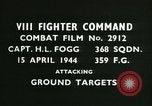
Gun camera views from P-47 flown by Captain HL Fogg of U.S. 8th AF, VIII Fighter Command, 359 FG, 368th Fighter Squadron
U.S. Army Air Forces Eighth Air Force, VIII Fighter Command operations in Germany during World War II. Gun camera views from 15 April 1944: Captain HL Fogg of the 359th Fighter Group 368th Squadron attacking ground targets, in one of their last combat missions in P-47s. (The unit converted to P-51s in April, 1944.) Captain Fogg strafes a train and an oil well. White smoke arises due to the firing and bombardment. An electric tower. The aircraft in flight over a field.
CRITICALPAST.COM: About Us | Contact Us | FAQs - How to Order | License Agreement | My Account | My Lightboxes | Shopping Cart | Advanced Search | Featured Collections | Website Terms & Conditions | Privacy Policy ©2026 CriticalPast LLC.
License Agreement |
Terms & Conditions |
Privacy Policy
©2026 CriticalPast LLC.