


 Francais
 Deutsch
 Italiano
Refine Your Search
Tontouta New Caledonia 1943 stock footage and images
- Showing 6241 to 6246 of 10520 results more
more Hide
Hide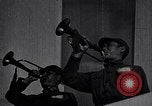
Chinese youth join the Army as Japan advances further in land and isolates China; Colonel Chennault and Flying Tigers.
Japanese invasion of China. Chinese soldiers blow the trumpet. Young men march in a field. Young men register in the Army. Millions of young people answer the call to fight for China. Volunteers from south, north, east and west China to form the people's army. Men and women with their children leave to join the forces. Drumming sound. New recruits train and perform a drill to drum beats. Soldiers practice martial arts, rifle handling, and shooting. Others train to care for the sick and wounded. Women soldiers in uniform. They learn to fire a gun. Pilots crowd around an officer. Planes in the background. Men from other countries prepare to fight for China. U.S. Colonel Claire Chennault of the American Volunteer Group Flying Tigers, talks to his men. The Curtiss P-40 Warhawks with the shark face emblems take off. Chinese soldiers march. Japan: Japanese officials in a meeting. Japanese troops penetrate China along the rivers. They rebuild destroyed rail roads using slave labor. A map depicts the Japanese strategy of cutting off Chinese supply lines. Japanese warships blockade the coast with the aim to isolate China. Japanese occupied ports in China. Japanese warships and boats in a Chinese port. Gas plants, gun factories and planes. Indochina map: The narrow gauge railway from sea to Kunming and a truck road to Chungking. The camel trail from Russia across the Gobi Desert. The railroad from Rangoon to Lashio in Burma. (World War II period).
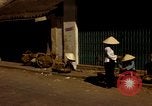
Streets of Nha Trang in Vietnam and ROK troops sightseeing in Bangkok, Thailand.
Places in Nha Trang and Bangkok. The street of Nha Trang, Vietnam. Local Vietnamese women wearing Non La conical hats with children. Women in coolie hats sell goods on the roadside. Vietnamese civilians shopping at a vegetable market. Pedestrians and cyclists on the street. Buildings and stores in the commercial district. ‘Universal Gems’ jewelry store building. Republic of Korea (ROK) troops' Rest and Relaxation (R&R) trip to Bangkok. The streets of Bangkok. A temple and ground in the city. Soldiers click pictures. A Thai guardian statue stands outside a temple. Shrines and statues in temples. New hotels including the Rajah Hotel (18 Soi Sukhumvit 2 & Sukhumvit 4 Sukhumvit Road Klongtoey Bangkok 10110, Thailand) and the Nana Hotel. Cars parked at the entrance to the hotels. (Vietnam War period).
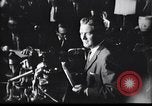
U.S. Vice President Lyndon Baines Johnson and Lady Bird Johnson visit Ling Temco Vought plant in Texas.
Governor Connolly of Texas gives a news conference. U.S. Vice President Lyndon Baines Johnson and Lady Bird Johnson arrive by helicopter to visit the Ling-Temco-Vought manufacturing plant in Grand Prairie, Texas. Cars and officials on the tarmac. Men take pictures. The Vice President and Mrs. Johnson are taken by car to a large aircraft hangar facility where they are greeted by managers and workers. President Johnson shakes hand with an official and workers as he enters the facility. He is escorted by the official. People holding posters welcome the Vice President. Johnson addresses the assembled employees. Lady Bird Johnson also addresses the workers. People applaud. Signs inside the facility read: VTOL mockup, and XC-142, AF Serial No. 5921 A. The aircraft is shown in the hangar. A sign reads 'No Admittance --Demonstration in Progress" Security men stand outside the door.
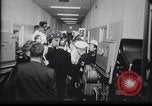
Lee Harvey Oswald speaks with press members during a press conference in Texas.
Prime suspect in President John F Kennedy's assassination Lee Harvey Oswald in Police Headquarters, Dallas,Texas. Police officials, news reporters, and photographers crowd the hallway as Oswald is escorted by detectives into a room where he speaks to the assembled reporters. This was after he was charged with the killing of Police officer Tibbet and before he was charged with the killing of President Kennedy..
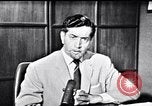
King Faisal entertains President Johnson and Washington officials at a reception in the Saudi Embassy, Washington DC.
King Faisal ibn Abdul Aziz Al Saud of Saudi Arabia during a visit to Washington DC. A Saudi broadcaster describes events in Arabic. United States President Lyndon B. Johnson and King Faisal with other dignitaries in a conference. King Faisal arrives at the Royal Embassy of Saudi Arabia, where Saudi and American flags fly. He is greeted by the Saudi Arabian Ambassador to the United States, Ambassador Ibrahim bin Abdullah bin Abdul Aziz bin Abdullah Al Suwaiyel, and the embassy staff. The King receives guests at the embassy, including William Averell Harriman, an American diplomat and 48th Governor of New York. Ambassador Al Suwaiyel accompanies King Faisal in greeting the guests. Guests are identified by narrator in Arabic. President Johnson arrives by car and is greeted and escorted into the embassy. Orchestra plays "Hail to the Chief." President Johnson mingles with guests, accompanied by King Faisal. The King greets succession of arriving guests, including Secretary of State Dean Rusk and Mrs. Rusk, and Vice President Hubert Humphrey. Guests enjoy a sumptuous buffet. A cake made in the shape of an Arab mosque. An Arabian golden bird ornament beside plates of canapé.

Montage of Wright brothers and their airplanes in France and at Ft. Myer, Arlington, Virginia.
As a contrast to the early pioneering airplanes, passengers are seen seated inside cabin of a "modern" airplane (Douglas DC-4E). View of the DC-4E in flight. A view of Orville Wright. Wilbur Wright gesturing as he talks with officials in France about an aerial course to be flown. Wilbur Wright placing wheels under a Wright Flyer before it is moved across a muddy field in France. A team of men pull a rope raising a catapult weight in a tower. The weight falls, catapulting the Wright Flyer airplane into the air. Soldiers remove a Wright Flyer airplane from a storage building onto the parade grounds at Ft. Myer, Virginia. The airplane is seen in flight with Orville Wright alone, at the controls, On July 30, 1909, soldiers are seen moving a Wright Flyer from its shed for its final acceptance test. President William Howard Taft, U.S. Army Major George Owen Squier, U.S. Army Major Charles E. Saltzman and Wilbur Wright are among those standing with the President, as the Wright Flyer is moved toward the parade ground. Views of the monorail and weight and catapult used for launching an airplane. Men turn the two propellers on a Wright Flyer, as Wilbur Wright stands at the rear of the aircraft engine and makes an adjustment. . On September 9, 1908. U.S. Army Lt. Frank P. Lanham, seen in uniform, seated on a Wright Flyer, is joined by Orville Wright. Wilbur. They take off and set a new airborne endurance record, and Lt. Lanham becomes the first Military officer to fly in an airplane. On July 30th, as part of the final acceptance test, Orville Wright takes Army Lt. Benjamin D. Foulois on a cross country flight to Alexandria, Virginia, and back again. They are seen aboard the Wright Flyer, and then high in the air on their way to Alexandria.
CRITICALPAST.COM: About Us | Contact Us | FAQs - How to Order | License Agreement | My Account | My Lightboxes | Shopping Cart | Advanced Search | Featured Collections | Website Terms & Conditions | Privacy Policy ©2026 CriticalPast LLC.
License Agreement |
Terms & Conditions |
Privacy Policy
©2026 CriticalPast LLC.