


 Francais
 Deutsch
 Italiano
Refine Your Search
Tontouta New Caledonia 1943 stock footage and images
- Showing 6787 to 6792 of 10521 results more
more Hide
Hide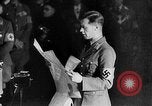
Remilitarized Germany crosses Rhine in violation of Treaty of Versailles; annexation of Austria and Czechoslovakia by Germany.
Scenes from Nuremberg Trials, including footage of prior events being discussed in the trials. Nazi officer reads an announcement to Hilter and Nazi leadership confirming the March 7, 1936 occupation and remilitarization of the Rhineland by the German Army, and the loyalty of the German Army. German Army rally and parade is held in Nuremberg. Soldiers march and goosestep, along with Nazi leadership such as Hermann Goering, while Hitler speaks assuring peaceful intentions by Germany. German officials Goering, Rader, and von Neurath arrive at special meeting with Hitler and Generals von Blomberg and von Fritsch in November 1937 to plan conquer of Czechoslovakia and Austria. Tall meeting chamber doors under armed guard. Scenes from February 1938 Berchtesgaden meeting arranged by von Papen with Austrian Chancellor Schuschnigg, Hitler, Keitel, and von Ribbentrop walking on grounds. Car approaches Berghof. Guido Schmidt, former foreign minister of Austria seen at the meeting, and then seen on stand testifying at Nuremberg trials concerning Hitler's decision to annex Austria. Scenes of German troops marching and a night-time rally parade in Austria. View of Schuschnigg on March 9, 1938 at podium during meeting announcing a plebiscite vote on Austrian independence. Views of German newspaper headlines denouncing the plebiscite and demanding Schuschnigg's resignation. Crowd surrounds new Chancellor Arthur von Seyss-Inquart with Nazi salutes following Schuschnigg's resignation. Next is scenes of March 12, 1938 German Anschluss annexation of Austria. Initial German forces seen meeting some resistance by Austrian citizens. Germany army rolling into Austria and dismantling border gates. Hitler memo announces intent to annex Czechoslovakia. Operation Green leader Konrad Henlein seen walking in parade with officials. Scenes of Munich Pact signing ceremony. Czech President Hacha walks with Nazi leaders and enters car for meeting to hear German ultimatum. Map shows lands grabbed by German
Preparing drilling bit and drilling for oil in the United States
Sharpening an oil drilling bit. A worker holds hot steel oil drill (bit) with tongs. Another worker pounds it with a sledge hammer. A fish tail is fashioned into the bit.The newly sharpened fishtail bit,now fastened to the end of a drill shaft, is lowered into the drill hole. Then a heavy steel pipe is forced down into the drill hole. Roughnecks fasten the new section of pipe to another above it and lower the pipes and drill into the hole. At a depth of 2300 feet, The well yields muddy water with traces of oil in it. Supervisors, in a group, check carefully for the presence of oil.
Busy city street with 1920's era automobiles; also Kerosene and by-products obtained from distillation of crude petroleum in US
Slate indicates that 200 million gallons of gasoline are used annually in the United States for power (in 1925). View of a busy city street, possibly New York City, circa 1925 with motor vehicle traffic, pedestrians and many tall buildings. Many early automobiles seen. A worker tests flash point of kerosene. Lighted candle in stuck block of paraffin (wax) showing wax or parrafin as a byproduct of petroleum. Slate indicates that petroleum provides motor fuel, common light, a lubricant for machinery and other important by-products.
An oil pumping station which serves important fields and a map shows important oil pipe line systems in the United States.
Pumping and transportation of crude oil drilled in the United States. A political map of the U.S. shows oil pipe line systems which are used to transport crude petroleum. The map shows main trunk pipe line systems including a new line under construction from Wyoming, connecting with the Great Lakes and the Gulf of Mexico. A pumping station which serves important fields in Texas, Oklahoma, Kansas and Wyoming with its chief terminals at East Chicago, Houston, Texas and Salt Creek, Wyoming. Internal combustion engines and machinery at the pumping station.

Oil drilling equipment is brought in and set up in a jungle in Mexico.
A documentry 'The Story of a Mexican Gusher' visualizes different stages in oil production in Mexico. A political map of Mexico shows Tampico and the distance between Tampico and New Orleans. Men cut through jungles, cross rivers and make roads to bring equipment into the Mexican oil region. Men cut trees in a jungle using machetes and axes. Men at work in an open area. Smoke rises in the background. A barge goes across a river. A jeep on a road built in a jungle. An oil company's railroad. Men work on the company pipeline near the railroad. A camp hospital in a jungle clearing to the south of the Panuco River. Cable tool method of drilling is practiced. Men do 'spudding in' by drilling a hole. Machinery in operation. After the spudding in a cable is 'hitched on' to a 'walking beam'. Men lower a casing at Ebano to drill out oil. A derrick. Oil is discovered at 800 feet and bubbles up from oil well. Two oil workers completely covered in oil work with the oil well equipment.

World War 2 battle scenes; wrecked buildings and masses of displaced persons in Europe after World War II.
'Problems of Peace in Europe' produced in 1948, depicts reconstruction problems in aftermath of World War II and includes footage from during the war and soon after the war. Scene of desperate and hungry civilian people (possibly in Germany but could be elsewhere in Europe) scrambling over each other and trying to find food on the ground among garbage or wreckage, circa 1945 or 1946. European peoples massing to reestablish political order and seek relief in post-war Europe. Montage of images of people from all walks of life. Reminders of war showing aircrews in bombers and bombs falling. Batteries of rockets being fired. A formation of U.S. B-17s and a B-26 aircraft with D-day stripes, in flight. Allied bombing of cities with devastating effect (likely 1944-1945). Aerial view of the Statue of Liberty in New York Harbor. Aerial view of a major U.S. industrial complex, with many smoke stacks and industrial pollution. Mass of workers leaving at end of shift at a U.S. manufacturing plant or factory. Views of two different streamlined locomotives pulling passenger trains at high speed, approaching camera position. Freight trains speeding on railroads. Farmers harvesting and baling hay by machine and cultivating fields with tractor. Multiple wide views of the K-25 building of the Oak Ridge Gaseous Diffusion Plant, in Oak Ridge Tennessee, the world's largest building in 1944 when it was built, and an instrumental part of the Manhattan Project effort to develop the atomic bomb in World War 2. Huge sprawling industrial sites in America. Map of Europe. Street scene in Germany with destroyed buildings and rubble cleaned from street, but still piled up in places. Desperate, hungry, and poverty stricken German citizens rummaging through garbage piles for anything to eat or anything of value. Two very young German boys standing together on a street, with one boy smoking a cigarette. Children scrambling over trash and rubbish heaps.
CRITICALPAST.COM: About Us | Contact Us | FAQs - How to Order | License Agreement | My Account | My Lightboxes | Shopping Cart | Advanced Search | Featured Collections | Website Terms & Conditions | Privacy Policy ©2026 CriticalPast LLC.
License Agreement |
Terms & Conditions |
Privacy Policy
©2026 CriticalPast LLC.