


 Francais
 Deutsch
 Italiano
Refine Your Search
Tontouta New Caledonia 1943 stock footage and images
- Showing 6931 to 6936 of 10521 results more
more Hide
Hide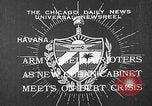
Cuban President Carlos Manuel de Cespedes y Quesada and cabinet meet at the Capitol to confer on debt crisis, in Havana, Cuba.
The members of the Cuban Cabinet at the Capitol building in Havana, Cuba. The Capitol building in Havana. A motorcade drives through an archway at the entrance to the Capitol building. A crowd gathered on the side of the road. Guards on the road. The members of the Cuban Cabinet climbs up the stairs and enters the Capitol. Guards on either side of the stairs. The officials inside the building, for the new Cabinet, formed by President Carlos Manuel de Cespedes y Quesada, meet on debt crisis. The officials on a large balcony on the Capitol. The crowd gathered outside the building wave to the officials. President Carlos Manuel de Cespedes y Quesada and other officials, seated and standing in two rows, pose for photograph. View at harbor with ship at dock and armed military or militia gathered at stern of ship. View from a moving boat of various ships anchored in Havana harbor including the U.S. Navy Destroyer USS Claxton (DD-140).
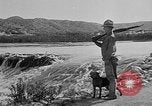
Scenes during Mexican revolution, in 1913, along the U.S. Mexican border
U.S. soldier with shouldered rifle stands guard beside the Rio Grande river, separating the United States from Mexico, in 1913. A dog stands next to him. The river is rushing in the background. View of extensive stakes and barbed wire lining the U.S.Mexico border. U.S. soldiers perform changing of the guard at a checkpoint on the U.S. side of the border between the U.S. and Mexico. Two new American sentries replace those being relieved. Signs on the fence identify the respective country boundaries. Mexican refugees (mostly women and children) flee the revolutionary combat taking place in Mexico. U.S. soldiers monitor as they cross into the United States, and direct some passing inside a trench manned by American soldiers along the border. Scene shifts to an official looking building guarded by U.S. soldiers. Several Mexican men, including Pancho Villa leave the building, accompanied by two or more Americans. (One American, wearing glasses , and carrying a cane. is dressed in a white suit, and wears a bow tie and Edwardian style summer straw hat. Next, Pancho Villa is seen with a number of his soldiers. A group of Mexican men relaxing at a shaded table near rustic structures. Large cacti frame the foreground, where a girl is walking toward them. Closeup of the men gathered around the table.
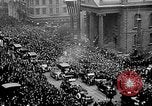
French General Joseph Joffre, Ford Company founder Henry Ford and Pacifist leader Rankin at the Capitol in the U.S.
The United States of America in 1917. A huge crowd on the streets of a city in the United States. A motorcade proceeds on a street, past official looking buildings. People on both sides of the street wave U.S. flags and cheer. French General Joseph Joffre, accompanied by officials, makes his way through a crowd (likely New York City on "Joffre Day," May 11, 1917). A large number of persons surrounding them, wave flags. Scene changes to the dome of the United States Capitol building in Washington DC. People outside the building. A Ford motor car arrives. Henry Ford, founder of the Ford Motor Company, with officials. Henry Ford and Speaker of the House, Congressman James Beauchamp Clark ("Champ") seen seated and talking on a balcony of the United States Capitol building. Officials and members of the Ford party come down the steps of the Capitol and pose for pictures. Among them is Thomas Edison who shakes hands with Congressman Clark. The dignitaries leave in an automobile. Next scene shows suffrage and pacifist leader Congresswoman Jeannette Rankin, (the first woman congressional representative in the United States) holding flowers, with other women suffragists (also called suffragettes) in a carriage. Policemen maintain order among a crowd of demonstrators outside the Capitol. Two mounted policemen begin to urge demonstrators away from the building.
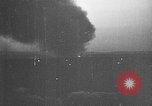
Views of ammunition depot allegedly sabotaged by Germans within the United States during World War I.
The United States of America in 1917. Scenes of Lyndhurst, New Jersey after January 11, 1917 explosion in the Canadian Car and Foundry Company in Kingsland. Suspected cause of explosion was sabotage, allegedly committed by Germans during World War I. Smoke from buildings on fire at night after an ammunition depot explodes. Flames rise high from the buildings. Widespread destruction. Debris on a railroad track the next day. People pick through devastated buildings and barren area flattened by blast. Views of crater filled with artillery shells after the explosion. Damaged window panes of buildings and a railroad car at D.L.&W (Delaware, Lackawanna & Western) Railroad Shops building at Kingsland (later Lyndhurst). DL&W railroad train car 605 parked. Railroad Shops with broken glass everywhere from explosions. Men point to shell that is embedded in the side of a railroad car. View of artillery shell lodged in a door. Next scene is from a different time and place, in Perth Amboy, in October of 1918 after an explosion at the T.A. Gillespie Shell Loading Plant made many families homeless. was called the Morgan Depot Explosion. Homeless women, children, and men sit in a town common area. The refugees eat. U.S. Army soldiers patrolling on Smith Street in Perth Amboy in front of stores damaged in the explosion. Entrance to Michaels & Co. shop among damaged stores on Smith Street.
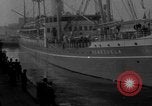
Re-named Steamship, Venezuela. sets off on its maiden voyage from a port in San Francisco, California.
Newly renamed steamer, Venezuela, on its maiden voyage across the Pacific. The new steamer Venezuela leaves the port for its maiden voyage. The steamer moves away from the port. People on the port watch the steamship. 'Venezuela' written on its hull. Equipment aboard the steamer in view. The steamer at sea. Smoke emitting from the smokestack.
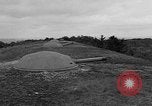
Americans capture Fort Obergentringen and turn its guns on Germans in Thionville, France, during World War II
American soldiers of the U.S. 90th Infantry Division, walking atop captured Fort Obergentringen, Near Thionville, on the west side of the Moselle River, in World War 2. Next, the Fort's German Krupp 105mm guns are seen firing numerous shells at German positions in Thionville, east of the river. American soldiers with binoculars observe the shell strikes from the fort. Smoke rising from the shelling. [Note: A September 17, 1944 wireless report about the fort's capture , to the New York Times, by Frederick Grahamby, stated that "The fort's name is Gingringen and from 1870 to 1919 it belonged to Germany." However, it is actually Fort Obergentringen (Fort Guentrange) on the hills of Guentrange, overlooking Thionville, and built in 1899.]
CRITICALPAST.COM: About Us | Contact Us | FAQs - How to Order | License Agreement | My Account | My Lightboxes | Shopping Cart | Advanced Search | Featured Collections | Website Terms & Conditions | Privacy Policy ©2026 CriticalPast LLC.
License Agreement |
Terms & Conditions |
Privacy Policy
©2026 CriticalPast LLC.