


 Francais
 Deutsch
 Italiano
Refine Your Search
Tontouta New Caledonia 1943 stock footage and images
- Showing 7657 to 7662 of 10520 results more
more Hide
Hide
General MacArthur speaks on Philippine Independence Day
Filipinos attend the proclamation of Philippine independence ceremony in Manila as the United States grants independence after World War 2. Smiling crowds of Filipinos in attendance. A Filipino boy watches the ceremony while holding a hotdog on a stick, a common snack brought under American influence in the Philippines. View of the Independence Grandstand (a temporary structure built in front of the Rizal Monument) in Manila with American flag and Philippine flags on tall flag poles. United States General of the Army Douglas MacArthur gives a speech during the Philippine Independence ceremony. “with this ceremony, a new nation is born. A nation conceived in the centuries-old struggles of people to attain the political liberty to embark upon its own national destiny.” Says General Douglas MacArthur. Filipino women with umbrellas watching MacArthur’s speech. Map of the Philippines. Filipinos smiling. View of Jones Bridge, on the riverbanks of the Pasig River, connecting to the Binondo Chinatown district in Manila. The Philippine National Bank (PNB) in Escolta Street, the historic financial district of Manila. Heacock’s Department Store, selling American appliances such as Remington, with various Manila billboards such as “ASIA LIFE”, “Elizade & Co Inc. Tanduay Distillery” and “Goodrich”. The old Legislative Building (now the National Museum of the Philippines). View of the Port of Manila. Men offloading crates of sugar and hemp to be exported to markets abroad, particularly in the United States. A ship sailing away from the Port of Manila. Factory smokestacks emitting smoke. Filipinos in steel and petroleum plants. Filipinos building a vehicle on an assembly plant. People at the Philippine Legislative Building entrance. Filipinos in panic, running for shelter, after air raid siren sounds. Evacuating people board a crowded bus. Japanese bombing of Manila. Japanese tanks with soldiers enter into Manila, prominently flying the Japanese flag. Japanese soldiers wade through water on a coast, climb a steep hill. Smoke in battlefield.
The Philippines under Japanese occupation, liberation by allied forces, Philippine Independence ceremony.
The Philippines under Japanese occupation, liberation, and subsequent granting of independence by the United States in World War 2. Bodies of Filipino and United States soldiers killed during the Japanese invasion of the Philippines. Captured American, Filipino, and Australian soldiers raise their hands after the Fall of Corregidor. United States General Jonathan M. Wainwright negotiating the surrender of The Phillipines with Japanese General Masaharu Homma in 1942. Brigadier General Lewis C. Beebe and Major Thomas Dooley are seen to Wainwright's left. An American warship firing during the United States Pacific campaign to defeat Japanese occupying forces in the Pacific. United States soldiers get off an amphibious landing craft during the U.S. retaking of the Philippines. United States General Douglas MacArthur arrival in Leyte Gulf with a retinue consisting of Philippine President-in-exile Sergio Osmeña, Lieutenant General Richard Sutherland, Philippine Brigadier General Carlos P. Romulo, Major General Courtney Whitney, Philippine Sergeant Francisco Salveron and CBS Radio correspondent William J. Dunn in Palo, Leyte, the Philippines- a fulfillment of his promise to return to the Philippines. General Douglas MacArthur speaking at the Independence Day ceremony in Manila on July 4, 1946. “America never wavered in that purpose. America today redeems that pledge.” Says General MacArthur. United States Senator Millard Tydings, the co-sponsor of the Tydings–McDuffie Act (a law that provides independence to the Philippines after a 10-year transition as a Commonwealth) attends the ceremony. Paul V. McNutt, the United States High Commissioner of the Philippine Commonwealth (later the first United States Ambassador to the Philippines), reads the United States President Harry Truman's official proclamation of Philippine Independence. Filipino elites and United States dignitaries watch the ceremony in the Independence Grandstand (a temporary structure built in front of the Rizal Monument). Manuel Roxas being sworn in as the first President of the Philippines after gaining independence from the United States. The Philippine national anthem, Lupang Hinirang, plays in the background. High Commissioner McNutt lowers the United States flag from the flagpole as President Manuel Roxas raises the flag of the new Republic of the Philippines. A celebratory parade following the Independence ceremony takes place, which includes floats from various provinces in the country. A float with signs reading: "Let's Produce and Rebuild,". "Mountain Province" float with women wearing formal Filipino Baro’t Saya gowns. "The City of Manila" float with soldiers. "The University of the Philippines" (UP) float featuring two women dressed as allegorical figures and sign saying, “The University of the Philippines At the Service of the State”. "The Division of City Schools" float features two Filipinos in traditional attire in front of a Statue of Liberty model. A float, likely belonging to the National Library of the Philippines, with children and a huge book model. The Chamber of Commerce Philippines float contains a machine gear model and small models of an aircraft and a ship. American soldiers marching, carrying the United States flag. A military marching band play. Filipino soldiers marching with the Philippine flag. Military aircraft in flight above the Independence Grandstand in Manila.
Yugoslav communist leader Josip Broz Tito, also known as Marshal Tito, talks with fellow officer at his mountain headquarters (WW2)
A female host wearing an U.S. army uniform, reads a letter from a sergeant asking to hear news about Marshal Tito, leader of the Yugoslav Partisan forces. Yugoslav communist revolutionary and President Josip Broz Tito, also known as Marshal Tito, with some of his fellow officers, meeting with Allied officers during World War II. Josip Broz Tito with his loyal partisans at his mountain headquarters in Yugoslavia. One of the few early footage segments of Josip Broz Tito. A cameraman walks away as Josip Tito talks with others.
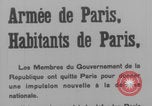
French performs reconnaissance and prepares Paris defense before Battle of Marne WWI
A proclamation issued on September 3, 1914 from General Joseph Simon Gallieni urging the defense of Paris in light of the French government’s evacuation for Bordeaux and the incoming Battle of Marne during World War 1. “MILITARY GOVERNMENT OF PARIS Army of Paris, Residents of Paris, The members of the Government of the Republic have left Paris to give a new impulse to the national defense. I have received the mandate to defend Paris against the invader. This mandate, I shall carry out to the end. Paris, 3 September 1914 The Military Governor of Paris, Commanding the Army of Paris, GALLIENI” translated in English. Workers using pickaxes to break stones at a park in Paris, France. Soldiers in position behind a trench made of tree branches. A soldier uses a telephone while hiding under a tent of twigs. A French military official answers call. French soldiers towing a reconnaissance aircraft. A French Blériot XI observation aircraft takes off from an airfield for a reconnaissance mission. Aerial view of countryside outside Paris and surrounding areas as seen from a Blériot XI’s , with the French Army incorporating cameras in reconnaissance planes from the beginning of World War 1. The Blériot XI aircraft lands back to the airbase. Reconnaissance pilot reports his findings, showing his logbook. French military official working at his desk. French officers consulting reports posted on a wall inside their office. Under a canopy of twigs, a military officer uses a telephone to receive orders.
Reaction to Jean Jaurès death, French reservists depart by train during WWI
Parisians react to the assassination of French Socialist leader and outspoken war critic Jean Jaurès by Raoul Villain in France at the onset of World War 1. Throngs of people grab newspapers from vendors in Paris. The Le Petit Parisien front page announcing the declaration of war by Germany against France and the French decree to mobilize troops, with the headline, "La France décrète la mobilisation...." Crowds in Paris reacting to news. Reservists in civilian clothing, one with a child on his back, and uniformed soldiers, holding Lebel Model 1886 rifles with small French flags sticking out of their muzzles, marching in Paris. Aerial view of crowds of military-age men march to the Bureau Militaire to report for mobilization. French Bureau Militaire signs directing inductees. French reservists depart Paris by train, possibly from Gare du Nord train station. Enlisted Frenchmen waving good-bye from a moving train.
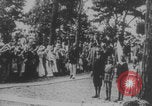
Kaiser Wilhelm II annual cruise aboard SMY Hohenzollern II and arrival in Berlin
Kaiser Wilhelm II of Germany on his annual Nordlandfahrt cruise sailing the North Sea in 1914. Kaiser Wilhelm II shakes hands with dignitaries before boarding a car. The Imperial yacht, SMY Hohenzollern II, departs from port, heading back to Germany. German crowds line shore to watch the arrival of the SMY Hohenzollern II. Kaiser Wilhelm II descends gangplank from ship and enters waiting car. Cavalry marshals control crowds in Berlin waiting for Kaiser Wilhelm II arrival. Kaiser Wilhelm II rides an open topped royal carriage to travel back to the New Palace (Neues Palais), in Potsdam. Crowds wave with their hats to Kaiser Wilhelm II.
CRITICALPAST.COM: About Us | Contact Us | FAQs - How to Order | License Agreement | My Account | My Lightboxes | Shopping Cart | Advanced Search | Featured Collections | Website Terms & Conditions | Privacy Policy ©2026 CriticalPast LLC.
License Agreement |
Terms & Conditions |
Privacy Policy
©2026 CriticalPast LLC.