


 Francais
 Deutsch
 Italiano
Refine Your Search
Tontouta New Caledonia 1943 stock footage and images
- Showing 8365 to 8370 of 10521 results more
more Hide
Hide
Australian soldiers trained in jungle warfare in Canungra, Australia
Australian soldiers trained in jungle warfare in Canungra, Australia. Soldiers march out toward work area and then perform exercises. They jump into a creek and swim. They undergo blindfolded exercises with Owen gun. Soldiers rush forward with fixed bayonets and jab at chalked figure on a tree. Soldiers undergo vigorous training as they climb trees, walk over logs of wood and so on. (World War II period).
Australian soldiers trained in jungle warfare use flying fox to cross a stream in Canungra, Australia
Australian soldiers trained in jungle warfare in Canungra, Australia. Soldier uses a flying fox to move across a stream. Men pack their clothing and equipment in a ground sheet and swim down the stream. They cross the stream on a wired cable bridge. (World War II period).
Australian soldiers cut and mark trails during jungle warfare training in Canungra, Australia
Australian soldiers trained in jungle warfare in Canungra, Australia. Soldiers make a jungle trail by cutting a narrow passage into thick foliage area. One of the soldiers marks trails to aid troops that will follow. Soldiers carrying Bren guns climb up and down the hills and advance into the jungle. (World War II period).
Australian soldiers charge through jungle and fire rifles during jungle warfare training in Canungra, Australia
Australian soldiers trained in jungle warfare in Canungra, Australia. Soldiers charge through woods. They lie on the ground and fire rifles and they move further. (World War II period).
American paratroops trained in United States
A film titled 'These are the parachutists' shows paratroops being trained for combat in United States. They blast obstacles, jump forward and backward from a training platform. They undergo physical training. They make practice jumps from towers and also learn to pack parachutes.
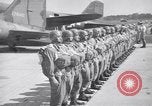
American paratroops make their first landing from a C-47 plane during training in the United States, during World War 2.
Paratroopers lined and board C-47 air craft in United States. They jump from the air craft and land with parachutes as field master observes them. In views of a different jump, paratroopers land on snow covered mountain and ski down the slope. Paratrooper in studio describing his uniform and attitude of paratroopers. Close view of paratrooper wings medal on a uniform.
CRITICALPAST.COM: About Us | Contact Us | FAQs - How to Order | License Agreement | My Account | My Lightboxes | Shopping Cart | Advanced Search | Featured Collections | Website Terms & Conditions | Privacy Policy ©2026 CriticalPast LLC.
License Agreement |
Terms & Conditions |
Privacy Policy
©2026 CriticalPast LLC.