


 Francais
 Deutsch
 Italiano
Refine Your Search
Tontouta New Caledonia 1943 stock footage and images
- Showing 8923 to 8928 of 10521 results more
more Hide
Hide
U.S. Army Training film emphasizing Army Air Forces safety rules of the air for pilots training in PT-17 "Kaydet" aircraft.
Opening scene shows a fuel gauge reading half empty in a U.S. Army Air Forces Stearman Boeing PT-17 “Kaydet” bi-plane trainer aircraft. Closeup of pilot with helmet and goggles in open cockpit of the airplane. Narrator says rules require pilot to return to base immediately. View of the aircraft descending toward the field. Animated diagram showing proper entry into left traffic for the active runway. View of PT-17 on final approach to the runway. Closeup of pilot in the cockpit. He makes a three-point landing on the first third of the runway and rolls without braking. Next, assisted by a wing walker, the pilot taxis to an open slot on a line of aircraft and stops on a parking line. The pilot steps from the cockpit, wearing a seat pack parachute, and begins walking to the field office, when he stops to converse with the narrator. He complains, somewhat about the restrictive rules for pilots in training and expresses desire to fight the Germans and Japanese in World War 2. Narrator defends the rules of safety, first, saying "You can't fight until you can fly." Scene shifts to four pilot trainees who "washed out" of the program for various infractions of the trainin safety rules. They are carrying their belongings in duffle bags and wait at a bus stop for transportation away from the base. Camera focuses on each of the men in turn, as narrator describes their failures to follow rules. Scene shifts to the airdrome where successful student pilots are seen walking toward the camera. Series of scenes showing student pilots performing various preparatory actions before flying their planes. One standing on a wing, checks the "Form One" that contains aircraft maintenance record. Another sitting in his cockpit notes that his gas, oil,cockpit switches, and flight controls all check OK. Another pilot is fastening leg straps of his seat pack parachute and comments about need to keep checking when taxiing down the line for takeoff. Closeups of pilots addressing the camera with admonitions about rules to follow. View of massed parked PT-17 training planes. Views of current war planes in flight, including Bell P-39 Aircobra, Lockheed P-38 Lightning, Republic P-47 Thunderbolt, and Martin B-26 Marauder bombers. Many good views of such airplanes in takeoffs, formations and aerobatic maneuvers. (World War II; WW II; World War 2; World War Two)
Workers work in a factory and refresh themselves by engaging in recreational activities in Berlin, Germany.
German people and factory workers in Berlin, Germany during World War II. Men play in a soccer match. Spectators watch the match. Polish and Russian workers work in a German factory. A man works with an electrode welding machine. A man gives a pair of shoes to a buyer. Slavic workers dance and listen to music. People enjoy on swings.
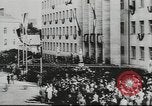
Monsignor Jozef Tiso present during the opening of the Palace of Justice in Presov, Slovakia.
Slovakian President Monsignor Jozef Tiso in Presov, Slovakia. Monsignor Jozef Tiso addresses a gathering during the opening of the Palace of Justice (Námestie legionárov 4, 080 01 Prešov, Slovakia). Officers and dignitaries seated during the ceremony. Soldiers and civilians present. Exteriors of the Palace of Justice. (World War II period).
Francisco Franco reviews Spanish Army maneuvers in Spain during World War 2
Spanish Head of State Regent of the Kingdom Francisco Franco in Spain during World War II. Francisco Franco reviews Spanish Army maneuvers. Francisco Franco arrives with other officers. He see as soldiers load a boat. The soldiers construct a pontoon bridge. They march in review.
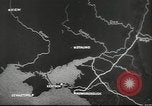
German commando operations in the Kuban Lakes region, Northwest Caucasus, World War Two
German commando troops attack Russian positions in the Kuban Lakes area near Russian Black Sea Port of Novorossiysk, Northwest Caucasus, during World War II. Map depicts the area of operations. German commando units in motor launches raid Russian positions. View of a bay from mountain. The commandos load in motor boats and move through marshes and lakes . The troops wade through water and move on land to attack Russian targets. They fire machine guns. Commandos returning to their base, where several are seen at a pier with their boat, as other boats arrive.
German and Romanian forces evacuate from Kuban Bridgehead, ahead of advancing Soviets, during World War 2
German and Romanian forces of the 17th Army, evacuate Kuban Bridgehead, at Taman, in Caucuses, and cross the Kerch Strait to Crimea, in World War Two. German and Romanian Officers study a map. S-mines aka 'Bouncing Betty' and Teller Mines are laid and barbed wire strung to impede the Russians. A convoy of trucks carries supplies. Some of local population evacuate along with the military. People carry their belongings in horse pulled carts. Many depart on railroad trains. Romanian troops set off charges that destroy sections of railroad behind them as they depart. Supplies are carried to ships at Port Kavkaz on the Russian shore of the Kerch Strait. Men roll drums in a dock area. Supplies are also transferred on the German-built aerial tramway, capable of transporting 1 thousand tons a day across the Kerch Strait.
CRITICALPAST.COM: About Us | Contact Us | FAQs - How to Order | License Agreement | My Account | My Lightboxes | Shopping Cart | Advanced Search | Featured Collections | Website Terms & Conditions | Privacy Policy ©2026 CriticalPast LLC.
License Agreement |
Terms & Conditions |
Privacy Policy
©2026 CriticalPast LLC.