


 Francais
 Deutsch
 Italiano
Refine Your Search
Tontouta New Caledonia 1943 stock footage and images
- Showing 97 to 102 of 10519 results more
more Hide
Hide
Close up of V-1 Argus pulse jet engine parts during World War 2.
Title card says “Geheime Kommandosache” (“secret commando operation” in English). “Erprobungsstelle der Luftwaffe Karlshagen” (“Test site of the Air Force Karlshagen” in English). “Flakzielgerät 76 Schnittautnahmen 14.10.1943” (“Anti-aircraft target device 76 cut recordings 10/14/1943” in English). Close up of V-1 glide bomb Argus pulse jet engine. Disassembly shows various components of the intake on the Argus engine, including the crucial spring controlled flap valve system, designed to close after each pulse of the engine.
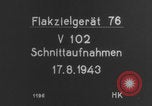
V-1 rocket launch from catapult ramp in Germany (WW2)
Title card says “Flakzielgerät 76 V 102 Schnittautnahmen 17.8.1943” (“Anti-aircraft target device 76 V 102 cut recordings 08/17/1943” in English). World War II V-1 glide bomb launches after Argus engine start. View of exit point of Walter catapult. Entire launch ramp shown as camera pans to surface of launch ramp.
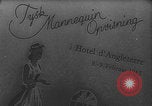
Models wear German-designed fashion in Copenhagen during World War 2
Women wearing German-designed fashion in Copenhagen, Denmark during World War II. A pamphlet in Danish reads “Tysk mannequinopvisning i Hotel d'Angleterre 8.-9. Februar 1943” (“German fashion show in Hotel d’Angleterre February 8-9, 1943” in English). A model smiles as she shows her silk dress. Three models in floral coats and dresses at the Hotel d’Angleterre (Kongens Nytorv 34, 1050 København, Denmark). Women in billowing elegant evening dresses. A woman preens before a mirror. Two women in evening dresses leaves together. Models in evening gowns walk in the catwalk. Spectators clapping.
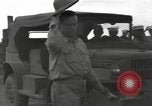
Bob Hope and his USO Troupe visit a U.S. Navy base on Mios Woendi island, Schouten Islands, Papua New Guinea, during World War II.
Bob Hope and members of his USO troupe ride on a PT boat during visit to entertain U.S. Navy personnel during World War 2. In opening scene, Bob Hope doffs his pith helmet as he strolls past the camera to climb aboard a PT boat (PT-331) of U.S. Navy Motor Torpedo Boat Squadron 21, where several naval officers greet him. Members of Hope's USO troupe, Patty Thomas, and Francis Langford, step from jeeps to board the PT boat. Next, the two are seen in the cockpit of the boat next to its captain, Lieutenant Kermit W. Montz, USNR, as the boat speeds along in the water. Among sailors occasionally glimpsed behind them is Radioman 1st Class bill Thielen. In change of scene, Bob Hope climbs out a hatch, holding onto his pith helmet to keep it from blowing off. The boat's number, 331 is clearly displayed on superstructure behind him. Various Navy sailors on deck. (Note: Squadron 21 received a Presidential Unit Citation for outstanding performance during the Huon Peninsula Campaign against Japanese forces from October 1943 to March 1944.)

The Renault Works plant at Billancourt after three aerial attacks by the Allied forces during World War II.
Results of air assaults by the British Royal and U.S. Eighth Air Forces over industrial areas in and around German-occupied Paris during Wolrd War II. The Renault Works plant at Billancourt after one aerial attack by the Royal Air Force (March 3, 1943) and two by the U.S. Eighth Air Force (April 4 and September 15, 1943). Workers clear the plant interiors. The damaged plant, collapsed roof, rubble and debris on the floor. Workers clear the debris. Damaged steel structures, pillars and walls. Buildings at the plant. Damaged walls, wrecked equipment and material. Allied officers and workers at the plant.

Dead body of Benito Mussolini lay on a street of the village Giulino di Mezzegra in Italy.
Italian partisans execute Mussolini. Body of Mussolini on a street of the village Giulino di Mezzegra in Italy. Italian soldiers near his body. Early pictures of Mussolini from 1938 to 1943. Mussolini and Adolf Hitler in 1943. Pictures of Mussolini some time before his death. (World War II period).
CRITICALPAST.COM: About Us | Contact Us | FAQs - How to Order | License Agreement | My Account | My Lightboxes | Shopping Cart | Advanced Search | Featured Collections | Website Terms & Conditions | Privacy Policy ©2026 CriticalPast LLC.
License Agreement |
Terms & Conditions |
Privacy Policy
©2026 CriticalPast LLC.