


 Francais
 Deutsch
 Italiano

Refine Your Search
Tontouta New Caledonia 1943 stock footage and images
- Showing 1141 to 1146 of 10542 results more
 Hide
Color Sound
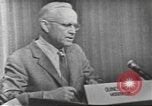
Vice President Nixon gives his closing statement during the fourth presidential election debate held in New York, U.S.
The fourth presidential election debate held between Democratic nominee Senator John F. Kennedy and Republican nominee U.S. Vice President Richard Nixon in New York, United States on 21st October 1960. ABC news correspondent Quincy Howe speaks during the debate and asks Vice President Richard Nixon to give his closing statement. Vice President Nixon opposes Senator Kennedy's statement that American is standing still. He says more houses and classrooms have been built, there has been a progress in civil rights and progress in field of slum clearance in Eisenhower's Administration which is more than in the previous administration. He says the United States should extend freedom to the world. He says that there were eleven dictators in Latin America in 1953 and now there are only 3 left. Nixon also talks about free government in Africa. He says that America will move ahead with the kind of leadership that we can provide in these years ahead. Correspondent Quincy speaks. He says that the opening statements by both candidates ran eight minutes each. The closing statements ran four minutes, thirty seconds. The order of speaking was reversed from their first joint appearance, when they followed the same procedure. A panel of newsmen questioned each candidate alternately. The first discussion dealt only with domestic policy. This one dealt only with foreign policy. As members of a new political generation, Vice President Nixon and Senator Kennedy have used new means of communication to pioneer a new type of political debate.

817th Army engineers build new emergency airfield, near Salerno, Italy during World War 2
U.S. Army 817th Army engineers build airfield within 24 hours near Salerno, Italy, in World War II. Members of the U.S. Army 817th Engineers Battalion are seen employing construction equipment to create a new emergency airfield near Salerno, Italy, during World War 2. A bulldozer uproots trees separating a tomato patch from a wheat field so both can be combined to create a larger space for an emergency airfield. A road grader passes a soldier seated in a piece of parked construction equipment, as it levels the ground. The operator in the parked equipment takes a drink from his canteen. Next, soldiers are seen wielding picks, and other hand tools to untangle clumps of earth and roots. Camera shows them next, working at the edge of the large cleared earthen airfield. They pause to wave to a P-38 lightning aircraft that has just landed at the new field. The P-38 passes on its landing roll, raising a cloud of dust. (Note: Moments after the end of the clip, this, first to land, P-38 had a fatal collision with a water truck, concealed in dust at the side of the runway.

Activities near the German news agency GmbH, DNB office at RKU in Ukraine.
Activities at a shoemaking establishment and the German news agency GmbH, DNB office at RKU in occupied Ukraine during World War 2. Exterior of a shoemaking establishment. An officer and a woman stand outside. The officer inspects a boot given him by the woman. Two officers clown around, one holding a hammer and another holding scissors. Another officer separates them. Sign on the building reads, "Schuhmacherei Roelof Pot." A painting of a boot is seen on the building. People stand near a cart. A man distributes bread from the cart. Some men work on a wooden structure. One man saws wood using a hand saw. A Dutch NOC officer (Nederlandse Oost Compagnie) inspects the construction. Men come out of a German news agency GmbH, DNB office at RKU building and discuss. A sign on the building reads, 'DNB Deutsches Nachrichtenbüro, DNB Dienststelle beim RKU."

U.S. Army Air Forces B-24 Liberators bombers fly from Guadalcanal to New Guinea during World War II.
U.S. Army Air Force planes are transferred from Guadalcanal, Solomon Islands to New Guinea during World War II. B-24 Liberator bomber being refueled in Guadalcanal. Formation of B-24s in flight over sea en route to New Guinea.

U.S. 8th Photo Recon Squadron preparing photos of Japanese positions in Rabaul, New Guinea, during World War II
U.S. 8th Photographic Reconnaissance Squadron, in Australia, preparing aerial photographs they took of Japanese positions in Rabaul, New Britain, Papua New Guinea, during World War 2. Rabaul prints being dried. A photo tech working on the prints. Another airman arrives and works with him. The prints are trimmed and sorted.

Staten Island Ferry approaches Manhattan; Statue of Liberty at night in New York City.
View of Manhattan Island and skyscraper buildings of New York City, as seen from New York harbor, from dusk to night. A passenger ferry of the Staten Island Ferry, a passenger ferry service operated by the New York City Department of Transportation, approaches the city. The Statue of Liberty. Views of skyscrapers of New York City lit up at night; the tallest being the twin towers of the World Trade Center.
CRITICALPAST.COM: About Us | Contact Us | FAQs - How to Order | License Agreement | My Account | My Lightboxes | Shopping Cart | Advanced Search | Featured Collections | Website Terms & Conditions | Privacy Policy ©2026 CriticalPast LLC.
License Agreement |
Terms & Conditions |
Privacy Policy
©2026 CriticalPast LLC.