


 Francais
 Deutsch
 Italiano
Refine Your Search
Tontouta New Caledonia 1943 stock footage and images
- Showing 13 to 18 of 10521 results more
more Hide
Hide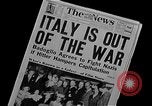
Allied pre-invasion base and activities in Scotland,1941. Allies in Algeria preparing for invasion of Sicily,1943
Activities of the Seabees in Scotland in 1941 and in Algeria in 1943, during World War II. News headlines in 1943 read : ' Italy is out of war' and '17 more Italian towns taken'. An animated map. The Clyde valley in Scotland showing a base built by the U.S. Navy Seabees, in 1941. Numerous quonset huts and vehicles are seen. View of the River Clyde, where 2400 feet of oceangoing dock are being assembled. A ship anchored at a harbor displaying U.S. flag. Allied troops board a landing ship with their belongings. An animated map tracing travel of Allied invasion forces from Scotland to Oran, Algeria, where Seabees are seen testing a floating causway that would be used for invasion of Sicily. Scuttled axis ships and other obstacles and damage that Seabees must repair in occupied ports. Allied ships and troops proceeding for invasion of Sicily. Allied warships bombarding Sicilian coast.
Destruction from Allied bombing at Lae airfield, New Guinea. B-25s fly bombing missions against Japanese targets in Wewak area.
Opening slate gives date as September 20, 1943. Scenes show devastation wrought by Allied bombing of the Japanese airfield at Lae, New Guinea. Most views are from the ground, as Allies occupy the field. Numerous Japanese aircraft are destroyed along with all the buildings and facilities. Next, is shown the view from inside a B-25 bomber, on September 27, 1943, as it flies in a 100 aircraft bombing mission to attack coastal facilities, ships, and airfields in the Wewak area, including the main air base at Wewak and its satellite fields at Boram, Dagua and But. Several B-25s are seen ahead in formation. View of the coastal area below as the camera plane (B-25) comes under fire by Japanese anti-aircraft guns. A pall of smoke hangs over the Wewak area from bombing by B-24s earlier. view from cockpit as the B-25 makes very low strafing and bombing attack against the Japanese satellite airbase at Boram. Another B-25 seen as it flies close to the ground. View to the rear shows small parachutes being released by the B-25, carrying single 100-lb fragmentation bombs and 23-pounders in clusters of three. The fragmentation bombs explode amongst palm trees sheltering Japanese aircraft. view out the back of the camera B-25 shows it continuing to fly, just over the tree tops, at very low altitude. Next, several B-25s are seen rejoined up in formation, ahead. Scene shifts to view from high altitude of bombs striking in the Wewak waterfront area. View from below of three B-25s in formation. Then view from cockpit of a B-25 flying low over the water strafing a ship. (Narrator says they dive low to skip-bomb a ship trying to escape.) Various views of the high hills at the waterfront. View from B-25 strafing Japanese aircraft on the ground at Dagua and Boram airfields. several B-25s in formation headed home. (World War II period).

Baseball players train in northern U.S. states during World War II, 1943
Newsreel clip entitled "Ball Players Train in North" shows major league baseball teams holding spring training in 1943. Teams were not allowed to travel south to Florida because of World War 2 travel restrictions. First part of clip shows men (presumably baseball players) riding in a horse and buggy along a tree-lined road. Giants seen running on field and meeting with manager and Hall of Fame outfielder Mel Ott. Players pose for camera, all wearing long sleeves. Closeup of Giants Hall of Fame pitcher Carl Hubbell. Giants players seen throwing at posters of Benito Mussolini, Adolf Hitler and Hideki Tojo -- Leaders of the Axis powers during the war. Players look at the posters after throwing; note patriotic war patch on Giant player's sleeve. Clip shifts to Washington Senators training camp the same year. Coach and renowned baseball clown Nick Altrock leads players in warmup drills. Players warm up in outfield, near what looks like a heating plant. Closeup of Senators pitcher Dutch Leonard throwing. Closeup of Senators owner Clark Griffith (in overcoat) talking with manager Ossie Bluege. Closeup of Bluege. Players marvel over of 7-foot player Richard Ahrens, who was signed by the Senators that spring as a possible publicity stunt; he never appeared in a minor or major league game. Washington players pretend to warm themselves up by small campfire on the field. Another shot of Altrock. (Note: There is no indication where these clips were taken but the Giants trained in Lakewood, New Jersey that spring and the Senators trained in College Park, Maryland. )

Four British working men and four American counterparts visit officials concerned with war production, in New York City and Washington DC (WW2)
A British film entitled, "People to People." Four British working men, visiting America, are seen in overcoats on the deck of a ship passing the Statue of Liberty in New York Harbor during World War II. They are accompanied by four American workers who were returning on the same ship, from a similar visit to England. Closeup of the eight men, named by the narrator, who calls them trade unionists on an exchange visit. Brief view of Chiang Kai-Shek, Franklin D. Roosevelt, and Winston Churchill at the Cairo Conference in 1943.Camera pans closeup over Roosevelt and Chiang Kai-Shek. Brief views of Roosevelt, Churchill, and Joseph Stalin at the Tehran Conference in 1943. Closeup of Roosevelt and Churchill, with Anthony Eden standing immediately behind them. Closeup of Stalin and Roosevelt, with U.S. Army Air Force Chief, General Henry H.(Hap) Arnold and British General Alan Brooke, Chief of the Imperial General Staff, conversing behind them. Scene shifts back to the men aboard the ship in New York harbor, with the New York City Manhattan skyline of buildings in the background. Next, the eight men are seen climbing steps to New York City Hall. Inside they are welcomed by New York City Mayor Fiorello LaGuardia. The group is then seen entering a building in Washington, DC, where they sit down at a table with Donald Nelson, Head of the U.S. War Production Board. In the Department of Labor building they meet William Hammatt Davis, Head of the War Labor Board, and also the Secretary of Labor, Frances Perkins. After that they are seen heading into the White House, where they are met by Mrs. Eleanor Roosevelt, who comes out of the White House to greet them on the porch. (Narrator says she later invited them inside for tea.) The men are next seen climbing the Capitol steps. Vice President Henry A. Wallace comes out to greet them and comments about industrial production not only during the war, but in the time of peace to follow.
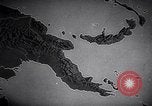
United States B-25 bombers, B-24 bombers, and P-38 fighters attack Japanese positions in Papua New Guinea.
August 1943: Animated map depicts Allied ground advances, 5th AAF air fleet stations, Japanese opposition base at Rabaul as well as Japanese positions and network in Papua New Guinea. Map depicting strategic Japanese positions of Wewak and Boram. 5th AAF soldiers decide to raid the two posts. 17 August 1943: USAAF B-25 Mitchell bombers and P-38 Lightning fighters attack the Japanese post of Wewak. Heavy bombardment by the American bombers. Smoke and explosion from the bombardment. Aerial view of the Japanese airplanes parked on the airstrip. 20 August 1943: USAAF B-24 Liberatoor bombers and P-38 Lightning fighters attack the Japanese position at Boram. Imperial Japanese Navy Air Service Mitsubishi Zeros attack the B-24s, P-38s intervene. Bombs dropped on the target. Smoke and explosion from the bombardment. (World War II period).
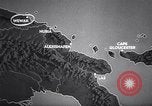
USAAF B-24 Liberator bombers drop 1000 lb demolition bombs over Nubia in World War II.
1943: An animated map depicts the strategic Japanese air and shipping base at Nubia in Papua New Guinea, during World War Two. 25 August 1943, Nubia: USAAF 5th Air Force B-24 Liberator bombers drop 1000 lb demolition bombs, from 16,000 feet, over Nubia. They target bivouac and supply areas. That afternoon, U.S. B-25s, flying low to the ground, make strafing attacks against the Japanese airfield at Nubia. United States soldiers unload jeeps, bulldozers, scrapers and other construction equipment in an abandoned Japanese airfield at Nadzab. U.S. 5th AAF constructing their air base. USAAF C-47s bring Australian infantrymen to the new base.
CRITICALPAST.COM: About Us | Contact Us | FAQs - How to Order | License Agreement | My Account | My Lightboxes | Shopping Cart | Advanced Search | Featured Collections | Website Terms & Conditions | Privacy Policy ©2026 CriticalPast LLC.
License Agreement |
Terms & Conditions |
Privacy Policy
©2026 CriticalPast LLC.