


 Francais
 Deutsch
 Italiano
Refine Your Search
Tontouta New Caledonia 1943 stock footage and images
- Showing 3877 to 3882 of 10521 results more
more Hide
Hide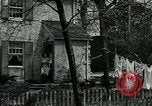
A woman helps new neighbor and women go shopping in United States.
Two neighbors in United States. Woman takes down washed clothes from clothesline in back of home. Taxi pulls up in front of a house. A man gets out with suitcase. Driver helps boy out with bicycle. A woman holds a baby. Taxi drives off. Moving van pulls up as family enters the house. A woman irons clothes and her daughter eats seated at table. Father pulls small boy out of barrel and spanks him. Neighbor watches time. She gets a basket and packs sandwiches and some fruits in basket. Her daughter takes it and gives it to the newly arrived family. New neighbor takes the basket, smiles and thanks neighbor for her helping hand. Two women meet to go shopping. Grocer waits for the women. Woman read the booklet 'Let freedom ring!' Other woman shows no interest in power takes. Two women greet a woman pushing a baby carriage. The woman with the carriage buys newspaper and stops in front of drugs store. Woman orders from druggist. She reads booklet of 'Let freedom ring!' and thinks about drug laws to protect her family against any harm to health. Drugs on shelf. Druggist packs item and gives it to her. She bumps into a woman who rubs her side as if hurt. Woman pushes the baby carriage on street. Sanitation truck comes. It washes the street. Mother with carriage stops at the U.S. post office. The U.S. flag on building of the post office. Woman and postmistress. Woman with carriage walks up to the Public Library. She sits on bench near entrance and is joined by a neighbor.
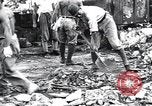
Reconstruction of Japan after WWII. New Constitution and implementation of democracy in Japan.
Reconstruction of Japan following World War II. New Constitution of Japan. Japanese military and other workers manually shovel debris and labor to rebuild their country which has been utterly destroyed by war. Document labeled 'The Constitution of Japan'. Japanese speak over loudspeakers and campaign in the first free elections in Japanese history. Women have the right to vote. Democracy brings civil liberty and women's rights. People listen to speaker at political rally or political campaign event in a Japanese city.
Mongolians celebrate their new year known as Tsam
Closeup of several people in a gathering, including children. One boy holds a Manchurian flag, and another holds that of Japan. All are bundled in winter clothes. A line of mounted horsemen are at the side of a road, with a large triangular banner held in their midst. village buildings seen across an expanse of snow and ice. People warmly dressed stand in the courtyard of a temple. . Some girls wear decorated muffs. A tall leader speaks with others. Children receive gifts. Music plays on a spring driven gramophone.Children stand holding presents. Officials stand behind large boxes and sacks of food and supplies. A man reaches into the pile and takes something that he gives to a child. Mongolians perform Tsam mask dance to celebrate beginning of the new year.
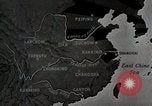
Chungking (Chongqing), new capital of China, is bombed by Japanese forces during Second Sino-Japanese war
The Republic of China establishes its wartime capital at Chungking (Chongqing), China during the Second Sino-Japanese War. Animated map depicts areas of Japanese occupation and highlights cities including Lanchow (Lanzhou), Chengtu (Chengdu), and Kunming. It highlights Chungking (Chongqing) as the new capital of Nationalist China. Generalissimo Chiang Kai-shek is seen leading a group of Chinese leaders as they walk through an arched gate in Chungking (Chongqing). A busy street with shops and apartment houses, in the commercial district. It is filled with pedestrians, cart traffic along the curbs, and automobiles in the road center. Boatmen on the Yangtze River are seen below long steep steps leading up to the streets above. Views of houses clustered along the cliffs, and workmen digging bomb shelters into the cliffs. View from inside a shelter being hollowed out of the rock. Back in the Japanese occupied area, a car brings a Japanese Air Force leader who addresses a large group of fliers at an airbase. Next, Japanese air crews are seen running to their airplanes from their camp on the airfield and taking off in their Mitsubishi G3M bombers, to attack Chungking (Chongqing). Nakajima Ki-27 airplanes take off from the field and join in large formations overhead. A formation of Chinese World War 1 era is seen inflight, ostensibly to engage incoming Japanese bombers. Japanese crew member in a bomber sees the Chinese fighters and gunners in the bombers get ready to fire on them. The Chinese fighter planes dive at the bombers but are intercepted by Nakajima Ki-27 airplanes flying cover. Aerial dogfights ensue with Chinese planes being shot down, and the bombers continuing their way. Air raid sirens sound in Chungking and people run to their shelters, including many school children. Views of bomber crews at their stations and then of bombs falling with the Yangtze River below. Bombs exploding along the riverfront and inland, along the cliffs. View of machinery operating, and Chinese workers occupied in underground factories in Chungking (Chongqing). Fires burning throughout the city, from the bombing, and Chinese fire fighters working to extinguish them.
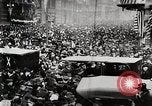
Crowd celebrates Armistice Day in New York City. U.S.State funeral for the unknown soldier of World War I
Crowd celebrating Armistice Day, November 11, 1918, in New York City. Many wave American flags. Dense crowd traps several vehicles. Different sequence shows the U.S. State funeral procession for the American Unknown Soldier of World War I, on November 21, 1921. Teams of white horses pull artillery caissons. Team of dark horses pull caisson bearing the coffin of the Unknown Soldier. It is covered with bunting and dark wreath. General of the Armies, John J. Pershing leads the Military officers who accompany the coffin. Following them is seen a large group of civilian officials, all in top hats.
U.S. planes bomb Japanese ships in south pacific,New Briton
U.S. planes bomb Japanese ships in south pacific near the tip of New Briton. Bomb blast on and near the ships. Aerial view of bomb blasts and Japanese ships below. (World War II period).
CRITICALPAST.COM: About Us | Contact Us | FAQs - How to Order | License Agreement | My Account | My Lightboxes | Shopping Cart | Advanced Search | Featured Collections | Website Terms & Conditions | Privacy Policy ©2026 CriticalPast LLC.
License Agreement |
Terms & Conditions |
Privacy Policy
©2026 CriticalPast LLC.