


 Francais
 Deutsch
 Italiano
Refine Your Search
Tontouta New Caledonia 1943 stock footage and images
- Showing 4561 to 4566 of 10521 results more
more Hide
Hide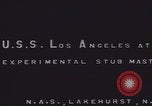
Ground personnel moving USS Los Angeles (ZR-3) airship across field in Lakehurst, New Jersey
Ground personnel moving the USS Los Angeles (ZR-3) rigid airship across a field. The words “U.S. Navy” is written on the dirigible. The airship from stern to bow is moored to mast. The crew is seen standing underneath the airship. The USS Los Angeles airship’s back shows one of the engines. Navy men in uniform moving the stern wheel of the dirigible. A group of Navy men push the dirigible’s stern wheel around the field. View of the handling gear and control car of the USS Los Angeles Zeppelin.
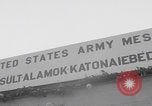
Hungaria refugee children celebrate Christmas at Camp Kilmer, New Jersey, United States
Sign reads “United States Army Mess” in English and Hungarian. Hungarian man, a refugee, receives a cup of coffee from a mess hall server. Hungarian sign reads “Vegyen Amennyitakap” (“Take as much as you can” in English). Christmas garlands decorate the mess hall. A girl is served with sausages and beans on her cafeteria tray. A Hungarian family sits together at a table in the mess hall at Camp Kilmer. A Hungarian couple eating. Girl eating with a spoon. Red Cross nurses host a Christmas party for Hungarian refugee children. A nurse gives out small Christmas tree models to children. A girl receives a Christmas tree paper model. A man wearing a Santa Claus mask and costume gives gifts to children. Hungarian refugee girls each receive a gift from Santa Claus. Children sing Hungarian Christmas carol “Mennyböl az Angyal” (“Angel from Heaven”).
Americans vote in the 1940 Presidential election.
Newsreel opening slate reads: "Roosevelt Re-elected." President Franklin D. Roosevelt is seen in the back seat of an open car, accompanied by his wife, Eleanor Roosevelt and The President's mother, Sara Ann Delano Roosevelt, as they arrive at the town Hall in Hyde Park, New York, to cast their ballots in the 1940 Presidential election. Inside the hall, the President signs a voter registration log and is then seen entering a voting booth. Closeup of him with his mother and wife smiling after casting their ballots. View shifts to the President's car with license plate number 101, as they drive away, with Secret Service agents riding the running boards. Scene changes to New York City, where uniformed policemen control a large crowd gathered around a car carrying Republican Presidential candidate, Wendell Wilkie. He acknowledges the crowd of fans and then enters a voting booth to cast his ballot. As he leaves the polling place he again acknowledges the cheers of his supporters. Another change of scene shows an unidentified politician exiting a polling place and waving to a crowd. This is followed by a view of former New York Governor, Al Smith, who supported Wendell Wilkie. He is seen on a street, waving his hat. His wife, Catherine Ann Dunn smith, stands behind him. Next, several people are seen lined up outside a polling place. Inside, New York Mayor Fiorello LaGuardia is seen signing a registry of voters. Camera focuses again on Al Smith and his wife. He has a stogie (cigar) in his mouth and she wears a corsage and picture of Wendell Wilkie. Several views of unidentified political figures casting ballots. A room filled with reporters and photographers where election returns are being tabulated on a large board. Signs identify the news organizations, such as United Press and Associated Press. A group of persons occupying desks in an area with sign reading :"Tabulators." Closer view of the large board where returns from various voting precincts are being recorded in real time (1940 election). This the Republican Party headquarters. One side of the board has a picture of Wendell Wilkie and the other of his running mate, Charles L. McNary. People napping in some corners of the room as the night progresses. Final scenes show crowds in New York City's Times Square, celebrating the re-election of Franklin D. Roosevelt. News in lights on the New York Times building first spell out: "Roosevelt Carries New York," followed by "Re election of President Roosevelt." Cheering crowd gathered outside the Roosevelt Springwood estate in Hyde Park, New York. The Roosevelt family gathered together in front of the family home. Closeup of the President waving to the crowd.
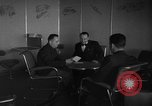
Captain Ernst Lehman is interviewed aboard zeppelin Hindenburg at Lakehurst Naval Air Station, New Jersey
Interiors of airship LZ 129 Hindenburg while moored at Lakehurst Naval Air Station. In the reading and writing room, the airship's Captain Ernst Lehman answers questions from an interviewer about their flight to Frankfurt, Germany and future flights planned for the Hindenburg. View of dining room with chairs and tables and open window. In a staged scene, two men look out the observation windows and talk of seeing America outside. A man walks up staircase from B-deck. A little girl is seated on a dining room chair at the observation windows. She smiles, gets up, and demonstrates that the chair is so light that she can pick it up with one hand.
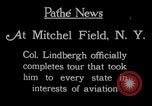
Colonel Lindbergh officially completes three month tour in his airplane 'Spirit of Saint Louis', at Mitchel Field, New York.
Officials and crowd assembled at Long Island's Mitchel Field to welcome Colonel Charles Augustus Lindbergh. Colonel Lindbergh's airplane 'Spirit of St Louis' pushed by men at airfield. Charles Lindbergh poses with an officer. Cameramen take pictures while Colonel Lindbergh gets into car.
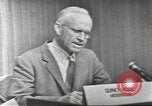
Vice President Nixon talks about Communist influence in the Western Hemisphere prior to presidential elections in the U.S.
The fourth presidential election debate held between Democratic nominee Senator John F. Kennedy and Republican nominee U.S. Vice President Richard Nixon in New York, United States on 21st October 1960. ABC news correspondent Quincy Howe speaks during the fourth Kennedy-Nixon presidential debate. He speaks that the candidates would answer and comment upon questions put by these four correspondents: Frank Singiser of Mutual News, John Edwards of ABC News, Walter Cronkite of CBS News and John Chancellor of NBC News. Frank Singiser puts the first question to Vice President Nixon. He asks Nixon the way he would handle Fidel Castro's regime and prevent establishment of Communist governments in the Western Hemisphere and why his policy is better for peace and security of the United States in the Western Hemisphere. Nixon answers that Senator Kennedy's policies and recommendations for the handling of Castro regime are dangerously irresponsible recommendations that he's made during the course of this campaign. Nixon speaks that what Senator Kennedy recommends is that the U.S. government should give help to exiles and to those within Cuba who oppose Castro regime, provided they are anti-Batista. Nixon says the United States have five treaties with Latin America, including the one setting up the Organization of American States in Bogota in 1948, in which the U.S. has agreed not to intervene in the internal affairs of any other American country. He further says that if the U.S. follows recommendations of Senator Kennedy then the country would probably be condemned in the United Nations and it would result in an open invitation to Soviet Premier Nikita Khrushchev to come into Latin America and to engage the U.S. in a civil war. He speaks about quarantining Cuban Prime Minister Fidel Castro by cutting off trade and diplomatic relations with Cuba.
CRITICALPAST.COM: About Us | Contact Us | FAQs - How to Order | License Agreement | My Account | My Lightboxes | Shopping Cart | Advanced Search | Featured Collections | Website Terms & Conditions | Privacy Policy ©2026 CriticalPast LLC.
License Agreement |
Terms & Conditions |
Privacy Policy
©2026 CriticalPast LLC.