


 Francais
 Deutsch
 Italiano
Refine Your Search
Tontouta New Caledonia 1943 stock footage and images
- Showing 4909 to 4914 of 10521 results more
more Hide
Hide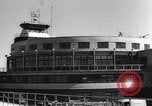
Military and civilian applications of radar and electronics
1946 Film about military and civilian applications of radar and electronics. View of the LaGuardia Airport Administration Building (passenger terminal) in New York, with control tower and various antennas on its roof. A TWA Constellation and DC-3 airplane on the airport ramp, as another aircraft is on the final approach to land. Commercial cargo vessels in New York harbor (Statue of Liberty barely seen in the misty background). A passenger railroad train speeding along the tracks. Radar returns shown on a plan position radar scope, tracking weather returns. Tropical storm hitting a seaside area. Scientists and technicians at work in a laboratory filled with electronic equipment. View of buildings at U.S. Army Signal Corps' Camp Evans, New Jersey. Sign above one entrance reads: "Evans Signal Laboratory." Inside the laboratory, images created by radar signals bounced off the moon are seen on a radar scope, during "Project Diana," on January 10, 1946. View of the Army's GB-4 radio controlled television glide bomb, suspended on a chain inside a building. It rotates around showing various views. Scene shifts to a launching track outdoors at a coastal facility, where a glide bomb takes off raising smoke as it accelerates along the launch path. Next, a GB-4 glide bomb is released from underneath a B-17 bomber in flight. It is seen flying away from the aircraft. Inside the aircraft, a crew member views its progress by means of television images received from a transmitter in the front of the bomb. Glimpse of the television images. View from the ground of the GB-4 bomb gliding to the ground and exploding. Views of a German V-2 rocket at Launch Complex 33, White Sands Proving Ground , New Mexico, where it was being tested by the U.S. Army Ordnance Department in 1946. Inside a control room, an Army technician gives the signal to launch, and the V-2 rocket fires and rises straight into the sky, with its fiery tail visible as it gains altitude. More views of scientists, engineers, and technicians inside a Signal Corps electronics laboratory. Soldiers being trained in radar technology, seated at an electronic array. An army staff sergeant technician working on radar components. A variety of different radar antennas rotating outdoors.
Hermann Wilhelm Goering represents Hitler at Heroes' memorial day ceremonies in 1938
The opening scene depicts Heldengedenktag (Heroes' memorial day) in Berlin, March 13,1938. It shows the spartan interior of the Neue Wache (New Guard) World War One memorial on Unter den Linden. A cross stands above masses of flowers and a flame burns next to it. A sentry stands outside the building. View of the equestrian statue of Frederick the Great, nearby in the center of Unter den Linden. Camera pans back across the front of the New Guard building showing soldiers in formation on either side. Accompanied by two officers, Hermann Goering in uniform, including steel helmet, walks behind soldiers as they carry a large floral wreath across the square and into the New Guard building. View from inside as they enter and place the wreath. Closeup of the wreath shows a ribbon with words: "Adolf Hitler." The two officers render a Nazi salute and Goering salutes with his Luftwaffe Field Marshal's baton. Throughout the sequence,the war song, "Ich hatt' einen Kameraden," is softly played as a slow dirge in the background. Scene shifts completely to a hall at night, in Vienna, Austria, as Goering gives a speech referring to Adolf Hitler. View of St. Stephen's cathedral and scenes from several days prior, as crowd of German people cheer in Heldenplatz about the Anschluss (annexation of Austria by Germany). Animated map showing the territorial annexation. Slate displaying the slogan: "Ein Volk; Ein Reich; Ein Fuhrer" (One people; one nation; one leader.) (Note: Regarding the New Guard, in Berlin: Since 1993, it has been the Central Memorial of the Federal Republic of Germany for the victims of war and tyranny. The eternal flame was replaced by a Four- times-enlarged copy of the bronze sculpture, "Mother with Dead Son,"by Kaethe Kollwitz, on a slab of black granite in the center of the room underneath the oculus. Her original small bronze made in 1937, resides in the Kaethe Kollwitz Museum in Charlottenburg.)
The City of Paris, France, before and after the Nazi invasion of 1940, and America preparing for World War II
Views of Paris in the late 1930s, prior to World War II. The Arc de Triomphe de l'Étoile (Arch of Triumph). The Tuileries gardens (Jardins des Tuileries) with bed of tulips in full bloom in foreground. The Eiffel Tower (la tour Eiffel). The fountain of River Commerce and Navigation at the Place de la Concord, Paris, with the Madeleine church (L'église de la Madeleine) directly behind, the Hotel de Crillon,barely seen at left, and its twin building, the French Naval Ministry, opposite, on the Rue Royale. People strolling and shopping on the Boulevard Haussmann. Awning of Les Deux Magots café and patrons seated at tables outside, in the Saint-Germain-des-Prés area of Paris. People relaxing in the Tuileries gardens, with Arc de Triomphe du Carrousel and Musée du Louvre in background. An artist at work, seated at a bench in the foreground. The west facade of Notre Dame Cathedral. Parisians looking at posters, reading in parks, visiting bookstores. Sign directing visitors to the Congres des Ecrivains (Congress of Writers) held at Maison de la Mutualité conference center at 24 Rue Saint-Victor, 5th arrondissement of Paris, France.in June, 1935. Several writers seated at a table with others standing around. Closeup of three. Closeup of British writer, Aldous Huxley, wearing eyeglasses. Two writers conversing. Scene shifts to Paris at night. Car traffic on streets of Paris at night. Illuminated sign at Moulin Rouge cinema theatre, topped with illuminated arms of a windmill. Lighted sign of nightclub, Le Rat Mort, in Place Pigalle. Interior of a Paris nightclub with sophisticated clientele. French entertainer musician playing a guitar. An official posting an announcement called "Counseil de Revision," calling for conscription (military draft recruitment) of citizens for military service. Parisians preparing defenses in the city, in front of the Eiffel Tower. Man deep in a trench preparing a shelter. Men carrying sandbags up a ladder to protect a national monument. Copy of the New York Times newspaper annnouncing the German attack on Poland. Copy of New York Daily News announcing fall of Holland. The New York World-Telegram paper announcing capitulation of France. German Panzer II tanks and motorcycle troops entering Paris. German infantry marching through the Arch of Triumph, on the Champs-Élysées. A Frenchman wiping his eyes as he watches the occupying troops. Hermann Goering with other officers riding in an open car along a Paris street. Closeup of Arch of Triumph. Adolf Hitler, accopanied by staff, looking at the Eiffel Tower. Nazi flag flying from the tower. Closeup of Hitler looking around. The U.S. Capitol building in Washington, DC. President Franklin D. Roosevelt, in Academic garb, at the University of Virginia commencement ceremony, in Memorial Gymnasium, on June 10, 1940. (FDR's son Franklin Jr. was among the graduates assembled, from the UVA Law School). Roosevelt expresses American sympathy and support for nations invaded by the Nazis. American street scene. Women preparing gifts intended for France. A poster showing a French soldier, entitled: "Le Paquet Au Front." American draftees in training at an army post in the U.S. Smoke billowing from American industrial facilities. Workers at an American shipyard. View of warships under construction at the yard. A Huge gun barrel being moved on special rail dollies, in a U.S. arms factory. U.S. Navy F4U Corsair Production Line during World War II. M3 Lee medium tanks being manufactured in U.S. factory. Closeup of finished one being transported via transverse crane. M4 Sherman tanks moving on flat rail cars. A speeding steam locomotive pulling freight cars. Martin PBM-5 Mariner in flight over an Atlantic convoy carrying war materiel to the United Kingdom. Sailor wearing headset, standing near depth charges at stern of a ship. British Naval Ensign flying from mast of a ship.
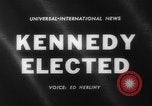
John F. Kennedy wins the Presidential election in the United States.
Presidential election of November 8, 1960. Voting for the 1960 Presidential election underway in United States. President Eisenhower arrives at a firehouse in Cumberland Township, Pennsylvania via helicopter to cast his vote. His wife, Mamie Eisenhower, also casts her vote. Senator John F. Kennedy and wife Jacqueline cast their votes at the Boston Public Library. Republican candidate Richard Nixon and wife Pat Nixon cast their votes in California. Republican Vice Presidential candidate Henry Cabot Lodge, Jr. votes. Senator Lyndon Johnson is also seen voting. Ballots are fed into a ballot box marked 'Town of Barnstable' Kenned Kennedy with his wife and daughter appear before the press at the Kennedy compound in Hyannis Port Massachusetts as he leads the race for the White House. News that Kennedy is pulling ahead in the race is seen on a scrolling text marquee aka 'The Zipper' mounted on New York Times building at One Times Square in New York. A reported watches wire reports printing from Associated Press machines. Richard Nixon at a public meeting accepts his defeat and assures his support for Kennedy. Votes being counted and Kennedy wins the election. A man at a newsstand views the front page of the New York Mirror newspaper with headline, 'EXTRA KENNEDY!' 'John F. Kennedy after winning the election. He addresses a public meeting at Hyannis, Massachusetts with his wife by his side, and other Kennedy family members present on stage, including Joseph P. Kennedy Sr, Rose Kennedy, Robert Kennedy, Edward Kennedy with Joan Bennett Kennedy, and the President-elect's sisters Patricia Kennedy Lawford, Jean Kennedy Smith, and Eunice Kennedy Shriver. John F. Kennedy accepts Nixon's greetings and talks about making a supreme effort to take America out of difficult times.
Indian PM, Indira Gandhi receives Uthant Peace award and addresses Foreign Policy Association in the United States.
Prime Minister Indira Gandhi of India visits United States for better understanding and friendship between the two countries. Street view of Carlyle Hotel (35 E 76th St, New York, NY 10021, United States) in New York City, and, inside, ceremony on August 1 where Indira Gandhi receives prestigious U Thant Peace award. Selection Committee Chairman presents speech. Indira Gandhi delivers a speech about culture, traditional values, and philosophy. Photographers take photos. Street view of Waldorf Astoria Hotel (301 Park Avenue Manhattan, New York City) in New York with traffic passing by. Inside, she addresses the Foreign Policy Association. She talks about the Green revolution, Balance of payment, Gross Domestic Product, and nuclear weapons. Association members seated at a table. Rajiv Gandhi, elder son of Indira Gandhi, is seen seated at table with association members.
Boeing workers celebrate; Nation's Capitol, Times Square and Statue of Liberty lighted to celebrate victory of Allies in Europe (VE Day) in World War 2
Americans celebrate the news of victory over Germany and prepare for continued war against Japan in World War II. Spirited Boeing employees celebrate news of victory over Germany in Seattle, Washington. They wheel out a giant B-29 bomber from an aircraft production hangar with a "On To Tokyo" sign on its side. The Boeing workers stand in a group and wave and cheer. The shining dome of the nation's capitol commands the most attention in Washington DC. All the lights ate turned on in Times Square in New York City and it blazes glory. People of the whole world get crazy with dancing, singing and parties in the streets and celebration drinks on V-E day (Victory in Europe). A man with a pretend Hitler mustache is hoisted in the air. The torch of the Statue of Liberty is lighted in New York.
CRITICALPAST.COM: About Us | Contact Us | FAQs - How to Order | License Agreement | My Account | My Lightboxes | Shopping Cart | Advanced Search | Featured Collections | Website Terms & Conditions | Privacy Policy ©2026 CriticalPast LLC.
License Agreement |
Terms & Conditions |
Privacy Policy
©2026 CriticalPast LLC.