


 Francais
 Deutsch
 Italiano
Refine Your Search
Tontouta New Caledonia 1943 stock footage and images
- Showing 4927 to 4932 of 10521 results more
more Hide
Hide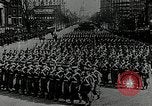
Early 20th century America footage; establishment and early circumstances of the U.S. Department of Labor
Film opens with view from a building overlooking President Woodrow Wilson's Inauguration Day parade along Pennsylvania Avenue, on March 4, 1913. A large contingent of U.S. Army West Point cadets march in forefront of the parade. Spectators line the sidewalks. Several stand atop buildings. Outgoing President, William Howard Taft is seen in his office signing a bill establishing the U.S. Department of Labor. Closeup of the bill and Taft signing it. Scenes of traffic and pedestrians in New York City. Some of the pedestrians appear to be wealthy class. Crowded early 20th century city streets filled with various horse drawn carriages together with bus traffic and early automobiles in chaotic confusion. A double decker bus with open top and sign "Fifth Avenue" and lower sign "To 22nd Street Only" operates in busy traffic on 5th Avenue beside horse drawn carriages and other motorized vehicles. Glimpses of women working in a factory; Men pouring molten metal into molds; Women punching time clocks as they leave a factory. Newly arrived immigrants at Ellis Island, New York City circa 1910 or during first 10 years of the 1900 decade. View of the Statue of Liberty. Women working in a textile factory. Men tapping a furnace in a steel plant. Pushcarts and peddlers at market lining the curb in a Jewish neighborhood of New York City (possibly lower east side). Brief view of pioneer Labor leader Samuel Gompers, founder of the American Federation of Labor. He hold a walking stick and doffs his hat. Sketches illustrating scenes of labor-related violence. Department of Labor sign being affixed to its location. A horse and wagon, representing the first assets of the new Department. A group of persons illustrative of the employees in the Department's Bureau of Labor Statistics.
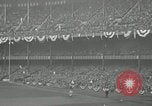
Montage of scenes reflecting life in the United States during the decade of the 1920s, following World War I
Baseball great, Babe Ruth starting to trot around the bases after hitting a home run. An inverted stunt biplane, N57323 with "EM Avery" readable on fuselage while flying inverted. A wing walker is strapped under the airplane (on top wing, now underneath). The airplane rolls over into upright position, trailing white smoke to be more easily seen by spectators on the ground. A 1920s jazz band comprised of African American musicians playing in a night club. A couple and then four women, dancing the Charleston. Point of view (POV) from moving car driving along Broadway in New York City at night, surrounded by neon light signs including some like the Winter Garden Theatre and the Rivoli Theatre. A flagpole sitter atop structure behind an RKO Keith's Advertising sign. Closeup of the man on his perch. A room full of women sewing garments in a factory. Wealthy, formal dressed couples at a city supper club, where an orchestra is playing. Exhausted couples clinging to one another on dance floor during a marathon dance contest. Gangsters firing a machine gun from window of a moving car. Charles A. Lindbergh steps past a policeman, to board his Ryan monoplane, "Spirit of St.Louis,"at Roosevelt field, Long Island, New York, on May 20, 1927. View of takeoff roll. Registration number "NX-211," visible atop the right wing. Manhattan ticker tape parade welcoming Lindbergh back to New York City, following his successful solo transatlantic flight. Charles Lindbergh speaking at a microphone. Traders on floor of the New York Stock Exchange during era of frantic stock market speculation. Money counted out at bank teller window. Labor strife at the gates of a Massey-Harris Company plant, with workers being hit with clubs and fleeing attacks by men hired by the company. Boy workers pose for a photograph While narrator mentions Child labor Act declared unconstitutional (1922). A girl worker. Boys employed as coal miners. Workers installing body panels on cars and working on engines in automobile production and assembly lines. Partially completed vehicles driving out of an automobile factory. Babe Ruth rounding third base and coming to home plate after hitting a home run in a baseball game.
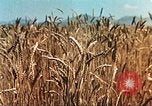
Montage of U.S. scenes covering various parts of the nation
Opening scene shows a wheat field in the United States. White hot molten metal collected in ladles as a furnace is tapped. Sandstone buttes the Navajo Nation's Monument Valley Park. Half Dome in Yosemite National Park. Michigan Avenue in Chicago, Illinois, as seen from a moving vehicle looking North from the Art Institute, with many skyscrapers of glass and steel. A white church in a suburban setting. The Japanese cherry trees in bloom along the Tidal Basin in Washington DC. A major river and an old fashioned stern wheeler River Boat cruising on it. A street scene in New Orleans, Louisiana. A roadway in Florida. A fishing village scene in New England. A formation of oil well pumps operating out West. Cowboys on horseback herding cattle in a wide open prairie view. View of the Statue of Liberty with dramatic sunset behind it. Two U.S. Marines conversing as they look at the Manhattan skyline in New York City. Aerial view of the skyscrapers on Manhattan Island. View of Times Square in Manhattan, with the Astor Hotel visible (It was razed in 1967). Police officer directing traffic at an intersection. Two Marines walking past the United Nations Building in Manhattan, New York City. View of the General Assembly Building and construction site of the The Dag Hammarskjöld Library Building being added in front of it. Camera pans upward showing Independence Hall in Philadelphia, Pennsylvania. Camera pans the U.S. Capitol building, followed by the Lincoln Memorial, the Jefferson Memorial, and the Washington Monument (viewed from steps of the Lincoln Memorial across the reflecting pool, in Washington, DC. A Marine color guard marches across the lawn in front of the United States Marine Corps War Memorial (Iwo Jima Memorial) in Arlington Ridge Park Virginia, as the Marine Band marches and plays. Closeup of the Memorial with American flag flying above it.
The United States Constitution created at the Philadelphia Convention in Philadelphia, Pennsylvania.
The history of the United States. 1783: Soldiers of the new republic after their victory in the American Revolutionary War. Soldiers on horseback meet new citizens. They watch as men carrying baggage walk away. A banner on a road separating two states reads 'New Hampshire Boundary'. A merchandiser demands money from two men to cross the border. Pictures of the land which farmers gave up because they could not pay back. Bankers inside a building. People on the streets. Delegates at the Philadelphia Convention in Pennsylvania. Pictures of people demanding new central government. Benjamin Franklin, one of the Founding Fathers of the US, walks supported by two men to the convention building. Several people stand around and watch. General George Washington, the elected President of the convention. He delivers a speech. He states the need for unity, a sound financial system, war debts to be paid, trade to be encouraged, national government to protect rights and perform functions. The delegates speak at the convention. The convention in progress. President George Washington with Benjamin Franklin and a few men at a final private conference during which they decide the government should have clearly defined substantial powers. The Preamble to the United States Constitution created on 17 September 1787, read out at the convention. Benjamin Franklin gets up with the help of two men. George Washington signs the constitution. Benjamin Franklin with George Washington. The carving on George Washington's chair. George Washington, the first President of the United States. People greeting the President. Alexander Hamilton, the Secretary of the Treasury, organizes a bank to receive taxes and import duties that pays off national debts.
2nd Sino-Japanese war, precursor to World War II in the Pacific. Pearl Harbor attack. Early phase of Pacific conflict between Japan and the U.S.
The film 'Sea power in the Pacific' showing Japanese dominance in China and at start of World War 2. Then it chronicles U.S. efforts to build Navy and fight back on sea and in the air. Opening scene shows Japanese Mitsubishi G3M (Type 96) bombers high overhead, and then closeup in formation. View from bomber of bomb bays open with bombs falling and view from ground of explosions and destruction. Overlay on film says: "China---1931." (This is not correct. The G3M bomber was not yet in service.) This film depicts Japanese attacks during second Sino-Japanese War, commencing 1937, Chinese civilians running to escape Japanese bombing of Singapore. Buildings destroyed and on fire. Next, Japanese troops, carrying the Rising Sun flag, are seen establishing a beachhead in an Amphibious assault. More scenes of Japanese infantry advancing through Singapore, ad it is being destroyed and burned. Soldiers charging along an alleyway, with pagoda in background. Next, Japanese soldiers are seen attacking Nanking, and committing atrocities and killing Chinese during the so-called "Rape of Nanking," in December, 1937. Chinese civilians being summarily shot and dumped into a large open grave after execution. Two Chinese prisoners with hands bound, being executed by rifle fire. Jubilant Japanese troops celebrating their victory. Map shows areas of China occupied during second Sino-Japanese war and the East Indies to the South. View of oil tanks; an open pit tin mine; a native cutting rubber tree bark to collect latex. Flags on map show regions of English, French, and Dutch colonial interest. It also shows Islands to the East, fortified by the Japanese. Cartoon shows Japanese soldier opposed by and American sailor (representing U.S. Sea Power). Next, famous images of the Japanese attack on Pearl Harbor, Hawaii, December 7, 1941, are shown, including the USS Arizona burning and sinking. Hawaii, Midway, Wake, and the Philippines Islands, are highlighted on a map and Japanese control of the Pacific is illustrated. Japanese soldiers are seen displaying a captured American flag. U.S. Lieutenant General Jonathan M. Wainwright is seen surrendering the garrison at Corregidor, on May 6, 1942. View of Japanese General Masahara Homma discussing surrender terms with Wainright. Map shows interlocking web of Japanese fortified bases in Pacific and need for seapower to oppose it. View of American shipyard with hundreds of workers, employed to build ships for the war effort, in World War 2. Views welding, metal fabrication, and other shipbuilding activity. A new ship going down the ways and a woman christening a new ship with splash from bottle of champagne. A new "Liberty Ship," the Richard Bassett, going down the ways at Bethlehem-Fairfield Shipyard Inc. Baltimore, Maryland. Closeup view as the stern of another ship enters the water upon launching. View of it from a distance. Shipyard workers knock supports from under what may be a landing craft, as it is launched. Japanese warships underway in the Pacific and firing their naval guns. Explosions on a shoreline from naval bombardment. Japanese infantry wading ashore during an amphibious assault. Map shows where Japanese forces attempt an amphibious assault on Southern New Guinea, thwarted by the U.S. Navy in the battle of the Coral Sea of May, 1942. In June, 1942, a Japanese attempt against Midway Island, was again checked by the U.S. Navy in the Battle of Midway. View of USS Wasp (CV-7) carrier deck filled with airplanes, including Grumman F4F Wildcats. A Douglas SBD Dauntless dive bomber being cleared for takeoff from the Wasp. Gun camera film showing Japanese airplanes being shot down by pursuing U.S. aircraft.
Harry S. Truman announces V-J day with Japan's acceptance of the terms of surrender, ending WWII; celebrations across America
Title card reads, "Peace, It's Wonderful." People celebrate as Japan accepts peace terms, ending World War 2. President Harry S. Truman of the United States announces Japan's acceptance of peace terms and the end of World War II. Reporters rush out to deliver news. Many scenes of American citizens, soldiers and sailors celebrating V-J Day in various cities of the United States. Crowds celebrate peace on V-J Day (Victory over Japan Day) in Washington DC, Chicago, San Francisco, and New York. Crowd outside White House waving. Woman holds newspaper with headline, "Japan Surrenders." A sailor dances with a girl. In San Francisco's Chinatown, firecrackers are lit up. In Seattle Washington, soldiers grab young women and kiss them. Aerial view of crowds celebrating the end of World War II at Times Square in Manhattan, New York City. Ticker tape falling in the air. Joyous, happy, and excited citizens cheer the end of World War 2. People waving newspapers with headline, "Japs Accept Terms." Spotlights illuminate nighttime crowds celebrating in New York City.
CRITICALPAST.COM: About Us | Contact Us | FAQs - How to Order | License Agreement | My Account | My Lightboxes | Shopping Cart | Advanced Search | Featured Collections | Website Terms & Conditions | Privacy Policy ©2026 CriticalPast LLC.
License Agreement |
Terms & Conditions |
Privacy Policy
©2026 CriticalPast LLC.