


 Francais
 Deutsch
 Italiano
Refine Your Search
Tontouta New Caledonia 1943 stock footage and images
- Showing 5023 to 5028 of 10521 results more
more Hide
Hide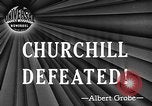
British Wartime General Election gives control to the Labor party in 1945
Opening slate of this film reads" Churchill Defeated." It goes on to show Winston Churchill attending his last meeting with wartime allied leaders at Podsdam, Germany in July, 1945. He shakes hands with Soviet Foreign Minister Vyacheslav Molotov. His replacement, Clement Attlee who is also there. View from above of Soviet leader, Joseph Stalin greeting the new British Prime Minister, Clement Attlee, who is accompanied by Foreign Secretary Anthony Eden and U.S. President Harry Truman, accompanied by Secretary of State James F. Byrnes. The wartime leaders gather around a large round table. Closeup of Marshal Stalin and Soviet Foreign Minister Molotov. Closeup of U.S. President Harry S. Truman at the conference table. View from above of the principals at the table. Film shifts to scenes of Major Attlee campaigning for votes. People in street listening to Ernest Bevin campaigning. Views of Winston Churchill being given a hearty farewell by a crowd, as he rides through on an open vehicle. Closeups of him he picks up a microphone to address the throng. Scene shifts to views of British voters casting their ballots. King George VI strolls with new Prime Minister Attlee and Winston Churchill. He poses with the new Prime Minister (Attlee) and Ernest Bevin on his right. At his left is Winston Churchill and Anthony Eden. Closeups of Clement Attlee.
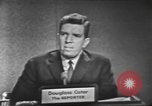
Kennedy and Nixon comment on nuclear disarmament before summit conference during a presidential election debate in the U.S.
The third Kennedy-Nixon Presidential Debate in the United States. Douglass Cater from Reporter magazine asks Democratic candidate Senator John F Kennedy about what sort of prolonged period does he envisage before there could be a summit conference and if he thinks that there could be any new initiatives on the grounds of nuclear disarmament during that period. Kennedy answers and talks about the need of strengthening of U.S. conventional forces and increasing missile production. On the question of nuclear weapon disarmament he states that the new administration should renew negotiations with the Soviet Union. He disagrees with the present administration's efforts regarding nuclear controls and general disarmament. He states that if he would get a chance he would make efforts to provide for control of nuclear weapons testing and begin general disarmament levels. Republican candidate U.S. Vice President Richard M Nixon mentions about his speech on this subject. He disagrees with Kennedy's statement that the administration is not making any effort because this is the highest level of operations in the whole State Department which is under the President himself. Roscoe Drummond from New York Herald Tribune asks Vice President Nixon about defending Quemoy and Matsu islands. Nixon answers and states that the U.S. should not deal with dictators and should not indicate which particular area it would defend. He gives the examples of the Korean War and World War II where the U.S. made a mistake. He says that Kennedy should change his position in this regard and not encourage the Chinese Communist and Soviet aggressors to react. Kennedy says that the treaty with the Republic of China excludes Quemoy and Matsu from the treaty area. He states that the treaty only includes defending of Formosa (Taiwan) and the Pescadores. He concludes that the U.S. should meet its commitments and raise war if the Chinese Communists attack the Pescadores and Formosa.
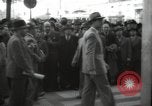
Crowd reading latest dispatches about African occupation outside newspaper offices in Lisbon, Portugal during World War II.
Crowd read news about African occupation in Lisbon, Portugal during World War II. Exterior of office of newspaper 'Seculo' shows crowd reading latest dispatches about African occupation. Exterior of office of newspaper 'Diario de Lisboa'. Newsboys around a door. News vendors rush down stairs with bundles of papers. News vendor's kiosk where papers of all countries are sold. Newsstand with foreign papers. First edition of Diario de Lisboa is sold at barber shop on the day of occupation of North Africa.
Mission and operations of the U.S. Army Service Forces during World War II
Film opens with an explosion at Pearl Harbor, Hawaii, December 7, 1941, during the Japanese attack in World War 2. The USS Arizona sinking. Newspaper headline reading "U.S. Declares War." Relief map globe of the world. Narrator speaks about accomplishments of the U.S. Army Service Forces since the Pearl Harbor attack. Glimpse of two M4 DV early Sherman tanks moving on a road. The famous Uncle Sam recruiting poster. Huge number of massed U.S. Army troops marching toward the camera lined 16 abreast. Army supply service personnel inspecting providers of all manner of supplies needed to feed, clothe, and equip the U.S. Army. Brief views of supply operations underway involving food and fuels. An Army truck and a P-38 lightning airplane (under wraps) being loaded aboard a ship. A warehouse stacked from floor to ceiling with military supplies. Forklifts moving in the aisles. Group of officers sitting around a table. Some wear shoulder patch of Army Service Forces on their uniforms. The processing of millions of volunteers and draftees for military service. Men in recruitment office being guided by staff. Lines of new recruits undergoing physical exams and then arriving in civilian clothes, with their baggage, at a training center. Barracks being constructed at a training camp or base in the United States. Camera pans across a large completed military camp. Soldiers forming up in front of barracks. Sign reads "Dispensary, Recruit Reception Center." Recruits lined up and receiving vaccinations against tropical and other diseases according to the regions to which they are being sent. An Army Sergeant assessing recruit qualifications for various military assignments. New recruits eating in a camp dining hall and also in a chow line at an outdoor field mess. Views of industrial workers picking up tools and assembling military equipment in war plants. A coal burning electric generating plant with 8 smoke stacks. A furnace with hot steel visible. An Army agent and an industrialist or business man signing contract documents. Glimpses of women war production workers placing items on a conveyer; guns being assembled by men in an armory; railroad train carrying freight across rugged U.S. territory; ocean-going ships ready for loading; cargo stacked up at ports; numerous 55 gallon drums ready for loading; rope slings of cargo being loaded for shipment; numerous army trucks ready for shipment to Allies, under "Lend Lease;" a nurse checking medical supplies for shipment; Many U.S. Army M3 tanks ready for shipment. Views of British forces engaged in the North African campaign, before the U.S. entry in World War 2. U.S. soldiers marching along a Camp road past a sign reading: "Headquarters, 725th Railway Operating Battalion" (Located in New Orleans). Rapid glimpses of various supplies, equipment, etc. being loaded for shipment abroad. Women war production workers in plants. Men in outdoor yards filling long lines of jerry cans. Close up views of clock hands moving, and gears of clock working. U.S. Army soldiers shooting automatic weapons (including tracer rounds) at a firing range.
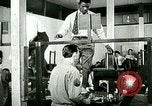
African American recruits in U.S. Army are issued uniforms and begin basic training in World War II
African American recruit sits in a chair with feet on a measuring device. A sergeant gives him a pair of shoes. But before he wears them the Sergeant tells him to stand, in the measuring device, holding two 20 pound weights. He then tells him to put on the shoes and go into the next room, where other African American recruits are lined up. They are instructed to remove all civilian clothes and begin dressing in army clothing. Next, completely dressed in their army uniforms, the recruits carrying duffel bags as they leave the snow-covered camp to board a train. Views of steam locomotives pulling trains in various places in the country. A convoy of army trucks carrying the new soldiers into a military base. The trucks park side-by-side in a line and the soldiers jump out with their gear to begin their basic training. A sergeant instructing the new soldiers on how to make a bed and other responsibilities. The new African American soldiers assembled in formation outside their barracks, on the snow, practicing close order drill, and making mistakes in the process. Next they are seen in a cross country march, carrying rifles. they take a 10-minute break. Soldiers in an infirmary, being visited by army doctors and African American nurses. Newly recruited soldiers being tended in an army dental clinic by African American dentists and hygienists. Soldiers shooting rifles on a firing range. Targets moving up and down on the range. Soldiers participating in sports, including football, baseball, boxing, and ping pong. A woman in the base library reading poetry aloud from a book entitled: "An Anthology of American African American Literature." African American members of the Women's Army Corps (WAC) are seen at another base, engaged in close order drill. Next these WACs are seen driving and riding in jeeps over rough terrain. A soldier shines his shoes, on Saturday night. African American soldiers and women dancing to music from an orchestra. The soldiers performing calisthenics in the open air. Rifles are held in some of the exercises. (World War II; WW II; World War 2; World War Two)
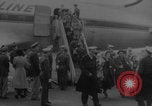
Hungarian refugees escaping from 1956 Hungarian Revolution arrive in Camp Kilmer; President Eisenhower during his second inaugural speech.
Hungarian refugees from the October 1956 Hungarian Revolution (also called Hungarian Uprising) disembark from an American Airlines plane after landing safely in the United States. Entrance to Camp Kilmer, New Jersey, where the Hungarian refugees were resettled. Hungarian refugees get off a bus. A Hungarian man holds his infant daughter with a pacifier. The camera moves to another Hungarian man, wearing a black hat. A Hungarian girl smiles, some of her front teeth missing. United States Army Sergeant Stuart Queen speaks to the camera. United States President Dwight D. Eisenhower speaks during his Second Inaugural Address at the East Portico of the United States Capitol in Washington DC. View of a radio tower. Radio tower view from the inside. View of the top of the Chrysler Building in New York City. Cars pass by modern apartment blocks with antennas on top of building. Television antenna on house roof. Man adjusts television as his wife watches from their couch in living room. A man and his wife, holding their baby, watches the inauguration speech of United States President Dwight D. Eisenhower on television from their family living room. Two women and a child watch United States President Dwight D. Eisenhower’s speech on television. Family of a woman and her children listen to Eisenhower’s speech from a radio in their living room. Bombing on a street in Budapest during the 1956 Hungarian Revolution. Men firing in Budapest. A tank fires in a park. Apartments getting devastated from firing. Hungarian man aims his gun and fires at a car. Men fire on a Budapest street. Doctor and paramedics carry an injured on a stretcher behind a tank. “Budapest is no longer merely the name of a city, henceforth it is a new and shining symbol of man’s yearning to be free”, said United States President Dwight D. Eisenhower from his second inaugural speech.
CRITICALPAST.COM: About Us | Contact Us | FAQs - How to Order | License Agreement | My Account | My Lightboxes | Shopping Cart | Advanced Search | Featured Collections | Website Terms & Conditions | Privacy Policy ©2026 CriticalPast LLC.
License Agreement |
Terms & Conditions |
Privacy Policy
©2026 CriticalPast LLC.