


 Francais
 Deutsch
 Italiano
Refine Your Search
Tontouta New Caledonia 1943 stock footage and images
- Showing 5059 to 5064 of 10521 results more
more Hide
Hide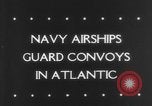
U.S. Navy Airships keep a vigil over a convoy in the Atlantic during World War II
U.S. Navy airships guard convoy in Atlantic in World War 2. Several K- type airships on ground at Lakehurst New Jersey. Bombs loaded aboard. Pilots get signal from control tower. The airships in flight. Airships keep a vigil. Navy airships patrol for German submarines. Coordination between Convoy Commander, escort vessels and planes. Bomb bay open and bombs dropping into ocean. . Convoy Vessels underway.

Dr. Wilhelm Frick is appointed Reich Protector of Bohemia and Moravia, and assumes his duties (WW2)
Dr. Wilhelm Frick, newly appointed Reich Protector of Bohemia and Moravia, inspects troops in a formal ceremony as he assumes his new duties during World War II. Seen with him is Karl Hermann Frank, the Reichminister for Bohemia and Moravia. Dr. Frick is seen greeting various officials and giving an address before a gathering in a large auditorium, where many attendees are dressed in traditional Bohemian or Moravian costume.
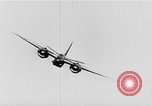
Instructional film on civilian precautions and first aid measures to be taken during a gas attack in the United States.
From a dramatized civilian protection film produced as a public service announcement or PSA by the Clorox Chemical company. Shows the precautions to be taken in case of a gas attack and the first aid measures to be used after gas exposure during World War 2. Aircraft in flight. Bomb wreckage during World War II including scenes from blitz firebombed areas in Europe or England, and scenes from China under attack by Japanese. Civilians fleeing in China as a Japanese attack begins. Back in the U.S., view of a new tank rolling into final assembly at a factory, and bullets being manufactured and poured into large containers in a munitions or ammunition factory. Narrator covers various precautions to be taken in case of a gas attack while at home, and actors depict: Closing the windows and other openings in the house. Woman seals kitchen exhaust fan. Man checks and closes fireplace flue in house. A man and woman move upstairs in the house to escape fumes. Air Warden sounds alert using a spinning handheld device, and asks people to stay indoors. Clothes affected by gas attack are left outside a house. Liquid gas removed from the skin by blotting with a tissue. Exposed skin cleaned and rinsed with bleaching solution. A baking soda solution containing water used to irrigate eyes. Man takes a shower and soaks himself up. Nose irrigated with baking soda solution. In case of unavailability of first aid one must take a bath. Woman takes a shower and rinses face and eyes. War scenes including a German Luftwaffe aircraft hit and diving toward ground. Wreckage of a German warplane. Views of a bottle of bleach, and baking soda solution, and a bar of soap used as cleaning tools in gas attack.
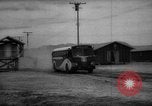
Japanese Americans at relocation center in United States during World War II.
Relocation of Nisei people in United States during World War 2. Japanese Americans arrive at the Manzanar relocation center (internment camp). Family members exit a bus. A young boy looking unsure as he observes the camp. New internees undergo medical examination. They participate in Americanization classes. They train themselves in self government. Block leaders are presented citations at a meeting. Japanese-American children internees are looked after in day care centers as men and women go to work. Young boys and girls seated at a table. Internees at Manzanar working in an experimental laboratory house for extracting rubber from guayule shrubs to increase rubber production during the war. Japanese American internees working in cultivating the guayule shrub. View of a project at the Parker camp where internees were working to irrigate desert land. View of sugar beet fields where internees could work. View of Manzanar war relocation center with mountains behind. War time propaganda narrator promotes the relocation centers as "setting a standard for the rest of the world in the treatment of people who may have loyalties to an enemy nation. We are protecting ourselves without violating the principles of Christian decency."
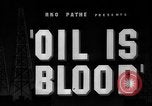
Production of petroleum at oil refineries and its transportation in United States, before and during World War II
Documentary titled, ' Oil Is Blood ' on production and transportation of petroleum and its by products in United States. Crude oil in a pit. Man takes samples from the pit. View of derricks at an oil drilling site. Derricks at sea. Exteriors of a building near the derricks. Service station attendants, pumping gas and cleaning the windshield, on a 1942 Lincoln Continental convertible, at a "Tydol Flying A" gas station. Scenes of busy highways and plenty of fuel give way to empty roads, closed gas stations, and restricted hours for obtaining fuel, as it is rationed during World War 2. Views of persons obtaining ration stamps and books. Various gasoline ration books including the "A" books (allowing the smallest amounts) and "B", "C", and other books allowing larger rations to more essential users. Oil rig "roughnecks" inserting new sections of pipe and proceeding to drill. Closeup of a "gusher" before it is capped. Men filling railroad tank cars with petroleum products. A long train of tank cars pulled by a steam locomotive. Animated map illustrates the ocean shipping lanes that formally served as means to transport fuel and oil, before the German U-Boat threat made them too dangerous for general use. Drums of fuel and oil being loaded aboard a ship to supply the Allies during the war. A convoy of ships heading to the war zone of North Africa.
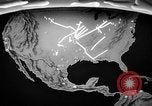
Laying of the Big Inch petroleum pipeline network between Texas and Illinois in the United States during World War 2.
A map shows pipeline network for the transportation of oil and its by-products in the United States, largely for the war effort during World War 2. Shows the laying of the Big Inch petroleum pipelines in Arkansas, Texas, and other locations. Tractors and explosives being used to clear the ground for laying the pipelines. Oil pipeline being laid across a river bed. A welder welds the joints. Pipelines being laid in trenches. Men operate valves to turn on the flow of oil in the new Big Inch pipeline. High octane aviation gas is filled in an aircraft at an airfield. Soldiers fill gas cans all lined up in a lot. An oil tanker in the background. Troops load gasoline jerrycans on trucks. B-17, B-26, and B-24 Bomber aircraft in refueling operations on various airfields. B-17 taking off and formation of aircraft in flight. Long lines of jerry cans being filled with gasoline by personnel near a railroad track. Close up view of gasoline dispensing nozzle in top of Jerry Can and a hand opening the next jerry can in line. Jerry cans loaded into trucks, transported, and unloaded by U.S. Army soldiers. Motor oil being poured into funnels for use in vehicles. Narrator declares, "Oil for freedom. American oil. The blood of the mechanized legion!" A formation of tanks and military vehicles move along a wide field. Narrator encourages sacrifice of American people giving up home comforts of goods and fuels made from oil so that they can be directed to the war effort.
CRITICALPAST.COM: About Us | Contact Us | FAQs - How to Order | License Agreement | My Account | My Lightboxes | Shopping Cart | Advanced Search | Featured Collections | Website Terms & Conditions | Privacy Policy ©2026 CriticalPast LLC.
License Agreement |
Terms & Conditions |
Privacy Policy
©2026 CriticalPast LLC.