


 Francais
 Deutsch
 Italiano
Refine Your Search
Tontouta New Caledonia 1943 stock footage and images
- Showing 5077 to 5082 of 10521 results more
more Hide
Hide
U.S. 13th Air Force B-24 Liberator bombers drop bombs over Japanese positions in Ballale during World War II.
U.S. Army Air Force aircraft attack enemy positions on Ballale Island, Papua, New Guinea. U.S. 13th Air Force B-24 Liberator bombers drop bombs over enemy positions on Ballale. Smoke billows up from the explosions.
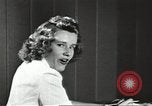
Trained women detect stolen ration stamps at the Office of Price Administration detection center in the United States.
Dramatizes the detection of counterfeit and stolen ration stamps by personnel trained in detection of illegal ration currency in the OPA (Office of Price Administration) detection center in the United States. A woman shows a bingo sheet with few stolen stamps detected by the serial numbers on them. The list shows time and place from where these stamps were stolen. Women detect more stamps from gum sheets. Shows the manner in which endorsement sign differs on each stamp. News in newspapers about the arrests of gas black marketers.
Men undergo various training activities after they join the United States Army.
Film titled 'Use of Training Films' on advantages and procedures of using U.S. Army training films. U.S. Army honor guard. Ground and elevated views of large number of United States Army soldiers marching in huge formation 12 or 14 abreast. Close up views of U.S. Army troops marching in formation. Men from various professions joining the U.S. army during World War II. New recruits in civilian clothes carrying suit cases stand in line at a Quartermaster to receive uniforms. They move in to barracks buildings. Training of men after they join army. A group of newly recruited soldiers making mistakes as they learn how to march and turn in formation. Service dress insignia of a U.S. army sergeant. Men fire rifles in prone position during a training. Men fire 155 mm howitzer. Men repair machine gun. Men are trained how to service a medium M3 tank. They are seen using wrenches to tighten nuts on the tank. Men learn to camouflage a piece of artillery and how to dig a foxhole. Soldiers practice bayonet drills. Soldiers seated in room being trained by means of training films.

People listen to the song 'God Bless America' sung by singer Kate Smith in the United States.
An American feature film 'This is The Army' depicts a performance by singer Kate Smith at the 21st anniversary of the armistice of World War I. Animated map shows Europe with fire in Poland. A man in the radio studio announces the name of Kate Smith on the stage, and noting the 21 anniversary of Armistice Day. A studio audience is present and applauds. Kate Smith introduces "God Bless America" as a new song, and then sings the song "God Bless America" with in-studio orchestra accompaniment. People watch the performance. An old man listens to the song, standing in front of his shop 'The Bugle Call.' He dusts a console radio with a feather duster and then goes inside and removes a bugle from a case labeled, ' Yip! Yip! Yaphank! 1918 ' At the Twardofsky business across the street, a man puts a small American flag into a basket as his father listens to the song on a small radio on the counter. People listen to the song in their houses and buildings. In a family living room: A couple seated in their living room listen to their console radio. A man, likely their son, seated at his desk listens to the song while studying. A woman looks at the photograph of a soldier, named Blake. Blake is then depicted listening to the same Kate Smith performance over a radio while stationed at Hickam Field in Hawaii. Characters Jerry Jones and Johnny Jones, played by actors George Murphy and Ronald Reagan are seen at the Jones and Jones production office. They listen to the radio. The character played by Ronald Reagan reads Variety Magazine.
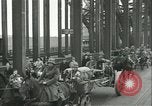
German and Japanese forces capture towns; Allied workers make ammunitions in factories (WW2)
German forces during remilitarization of the Rhineland: German Army supply wagons and German soldiers cross Hohenzollern Bridge in Cologne, Germany, to reoccupy Cologne and the Rhineland on March 7, 1936. Change of scene to Japan in late 1930s. Emperor Hirohito of Japan inspects troops on his white horse, Shirayuki. Japanese soldiers bow in front of the Imperial Palace in Tokyo. Japanese men holding banners. Japanese soldiers and cavalry advance. Japanese soldiers stand in formation and march on a street. Japanese Navy officers view a map or chart and discuss their plans and strategies for attack. Japanese soldiers fire artillery and other weapons in battle. Japanese war production worker in munitions plant making shells. Change of scene to American workers in war production factories in the United States making shells, bullets, and various munitions during World War 2. Elevated view of large American tank factory floor with many Army tanks being assembled. War production workers building Army trucks and new trucks being driven off of assembly line. Rows of U.S. Army tanks and artillery on the ground. U.S. Army soldiers board a troop transport ship. A submarine is spotted by a sailor. A hand presses a button to launch torpedoes to attack a ship. View through periscope as torpedo moves just below water surface toward target. View in open water of torpedo moving through water. Torpedo strikes a ship and explosion rocks ship. Formation of torpedo aircraft and dive bombers in flight over an area. Ships on fire with black clouds of smoke rising above. British navy sailors firing anti aircraft guns from a British ship. Sailors and officers aboard ships watch enemy airplanes through binoculars. U.S. Navy sailor manning a machine gun aboard ship watches the skies overhead.
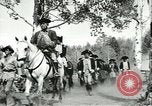
American forces prepare for war; ASF Lieutenant General Brehon B. Somervell addresses officials (WW2)
Continental Army cavalry riding horses and soldiers marching in an American Revolutionary War reenactment. Continental Army soldiers carrying the wounded on their backs under heavy rain. United States Army soldiers marching in New York City during World War II. Views of enormous numbers of U.S. Army soldiers marching in formation. Large columns of U.S. Army soldiers seen approaching camera position and from above. A soldier with an Army Service Forces (ASF) patch marching. Close up of the Army Service Forces (ASF) patch. Commanding General of the ASF Lieutenant General Brehon B. Somervell smiling. A notice detailing the War Department Reorganization effective March 9, 1942. Army Ground Forces commander Lieutenant General Lesley J. McNair. Army Air Forces Commander General Henry H. Arnold. General Somervell and Army Chief of Staff George C. Marshall. Soldiers advance towards a battlefront. Wounded are evacuated from the area. The soldiers stand in formation. Officials seated at a desk. General Somervell addresses them and speaks on the value of war material. A dead German soldier in tank. Dead bodies of Japanese soldiers scattered on the beach in the Pacific. Tires and scraps for use by the army. A newspaper advertisement reads “Your scrap will save some brave boy’s life!”. Ceiling prices listed in grocery store during wartime. Japanese planes bombing Malaya and Singapore. Burned houses after Japanese bombardment in Asia. A burning house in China. An oil tanker explodes and burns after being bombed at sea. Tanks advance towards the front. Generalissimo Chiang Kai-Shek and wife Soong Mei-Ling (Madame Chiang). An airplane in flight, bombarding a target area. Prisoners of war standing. Dead bodies lying on the ground. Destroyed area after an enemy attack. The soldiers and the tanks advance towards the battlefront. Barrage balloons in flight overhead. Allied flags on display such as the Soviet Union and England.
CRITICALPAST.COM: About Us | Contact Us | FAQs - How to Order | License Agreement | My Account | My Lightboxes | Shopping Cart | Advanced Search | Featured Collections | Website Terms & Conditions | Privacy Policy ©2026 CriticalPast LLC.
License Agreement |
Terms & Conditions |
Privacy Policy
©2026 CriticalPast LLC.