


 Francais
 Deutsch
 Italiano
Refine Your Search
Tontouta New Caledonia 1943 stock footage and images
- Showing 5095 to 5100 of 10521 results more
more Hide
Hide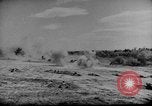
U.S. Army Quartermaster Corps prepare mortars, fire anti aircraft guns, and provide supplies during World War II.
Clip opens with brief World War I scene, circa 1917, of new American army recruits receiving army uniforms being issued by a U.S. Army Quartermaster. Clip then covers U.S. Army Quartermaster Corps' combat operations in various Theaters of Operations during World War II. Quartermaster Corps soldiers with rifles under the cover of a military truck during battle. Troops in trucks. An aircraft in low flight over a field. A U.S. Army truck. A Quartermaster fires an anti aircraft gun. Explosions occur and smoke rises. A British tank in a field. Soldiers beside a truck. Cans and barrels stacked on the ground. An enemy German tank in a field. Soldiers take cover. Quartermasters with guns in a trench. They come up the trench in prone positions. Dramatized battle scene with several Quartermaster corps casualties beside a wire fence. Soldiers prepare a mortar gun. An anti aircraft gun on an army truck. A soldier takes aim and fires a rifle during training. The Quartermaster flag hoisted on a pole. Actual footage shows aerial view of Bataan, and then ground views of groups of remaining U.S. Army soldiers around time of surrender of Bataan in April 1942. American soldier seen with their hands up and under guard of Japanese soldiers during Bataan surrender. Landing crafts arrive at a beach in North Africa. Supplies being offloaded at various battle fronts of World War 2. Soldiers and supplies off-loaded on the beach. Quartermasters seated on supplies boxes. Landing crafts arrive at a beach in the South West Pacific. Troops move across the beach. Troops disembark from landing crafts and move across a beach in Sicily, Italy. The Quartermasters unload boxes of supplies during various beach landings. They unload supplies and fire artillery on a beach head in Italy. Troops in trucks. A convoy of trucks loaded with supplies. Ammunition, ration and personnel in trucks move from Algeria to the front in Tunisia. Explosions occur and smoke rises. Trucks advance through smoke at night and in difficult conditions. Quartermaster General Major General E. B. Gregory speaks about the Quartermaster Corps. He says that the Quartermasters distribute goods to the army during training and combat. The movement of the Corps should be so regulated so as to deliver the goods at the right time in the right quantity.

People buy and read newspapers in London, England giving the story of the fall of Mussolini.
People read newspapers in London, England during World War II. People queue up to buy newspapers giving the story of the fall of Italian Prime Minister Benito Mussolini. A man reads newspaper headlines. A woman reads a newspaper. People sitting on benches in London Square read the news.
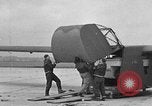
Weasel is carried aboard a glider and dropped by parachute from a plane in the United States.
Demonstration of the capabilities of the small snow vehicle, Weasel in the United States. Weasel is carried aboard a glider. Gilders take off. Weasel is dropped by parachute from a plane. It is ready to move for action as it lands. It travels over snow and rough terrain. Half track vehicle on snow covered land. Interior: Weasels are being improved. Weasel is driven on snow covered land with its new features like stable tracks and cargo body.

U.S. Navy Department develops ships and boats for amphibious assaults during World War II.
Film opens showing the U.S. Capitol building in Washington, DC. Next are views of the U.S. Navy and Munitions building on Constitution Avenue in Washington, DC (Sign on building reads: "Navy Department.") View of Senior Naval officers in a conference room in the building. Next scene shows a group of military planners discussing a three dimensional model of a Pacific island with landing ships and landing craft near the shore. A group of Army and Navy officers discuss documents as they stand in front of a huge wall map of the world. They walk together and point to the Mediterranean portion of the map. A large sign points toward "Naval Research Lab." Inside a Navy Commander and Lieutenant Commander confer over some maps with two civilians. Next, a room full of draftsmen (including a woman) are seen bent over drawing boards. Two engineers bend over an instrumented cutaway of a ship's hull. Senior military officers sit around a conference table. American and British flags are placed at the end of the room. Closeup of two British officer attendees. Civilian engineers and designers gather around a table. Workers at a shipyard gather on and around a Navy ship that displays a battery of four antiaircraft guns. Men in a foundry preparing to pour molten metal from a ladle into a mold. A milling machine taking a deep cut on the edge of a steel plate. A large engine being moved by an overhead conveyor in a factory. Men fabricating boats in a factory. View, from a moving platform, of men painting a newly manufactured Higgins boat (Landing Craft vehicle personnel, LCVP). A new Landing Ship Tank being launched at the Norfolk Navy Yard, Portsmouth, Virginia. USS LSTs 340 and 341 at their launchings in Portsmith.
Wounded Chinese soldiers are evacuated, treated and transferred to Ledo, Burma by L-4 airplanes.
Narrated News Reel footage. Wounded Chinese soldiers at a frontline hospital in Burma during World War II. Animated map shows Yupbang, Burma. U.S. Army General Joseph W. Stilwell watches Chinese casualties evacuated to a hospital near the frontline. Dr. Gordon S. Seagrave attends to the wounded Chinese soldiers in the field hospital. Burmese nurses with a wounded Chinese soldier. The American doctor and the Burmese nurses treat the casualties. A wounded Chinese soldier in a body cast. Chinese soldiers are transferred on stretchers and are loaded into a U.S. L-4 airplane flown by the 71st Liaison Squadron. An American pilot in the L-4 airplane. It takes off. 71st Liaison Squadron L-4 airplanes fly above cloud formation and land at an airstrip near Ledo. Wounded men are transferred from the airplanes to ambulances and taken to hospital. The airpanes take off.
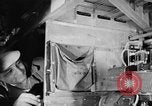
An electrical specialist checks regulators,igniter,alarm bell,motor during the B-24 aircraft inspection in the United States.
The 50-hours inspection of the ignition and electrical system of the USAAF B-24 Liberator heavy bomber aircraft at an airfield in the United States. The electrical specialist checks the regulators in the aircraft nose compartment. The specilaist checks starters and removes window strap for proper inspection. The specialist checks brush condition and inspects the heaters. He takes out screws and pulls out back casting and inspects the back plate for deformation of metals. The electrical specialist uses air hose to clean the oven. He checks and cleans the igniter using a brush. The specialist makes a similar inspection with the side heaters and cleans solenoid belt. He runs the motor and checks its functioning. He inspects the battery plug connection on the outside of the aircraft. He checks the A/C inverter. O perational check of alarm bell is done. He opens the fuse box to repair it, and with the help of a diagram he replaces the bad fuse with the new fuse. The aircraft in flight after completion of inspection.
CRITICALPAST.COM: About Us | Contact Us | FAQs - How to Order | License Agreement | My Account | My Lightboxes | Shopping Cart | Advanced Search | Featured Collections | Website Terms & Conditions | Privacy Policy ©2026 CriticalPast LLC.
License Agreement |
Terms & Conditions |
Privacy Policy
©2026 CriticalPast LLC.