


 Francais
 Deutsch
 Italiano
Refine Your Search
Tontouta New Caledonia 1943 stock footage and images
- Showing 5119 to 5124 of 10521 results more
more Hide
Hide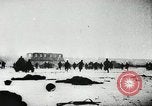
Soviet forces encircle German Army outside Stalingrad in November 1942; Soviet civilians celebrate Christmas 1942
Bombed out Soviet city seen in snow during World War 2. Map depicting U.S. and British forces landing and advancing in North Africa, and far North, the Soviet Army launching counteroffensive to push back the German Army advances in the Soviet Union. Animated map depicting Soviet forces pushing back on German forces and recapturing Schlusselburg, breaking the Axis ring around Leningrad. Map showing Russian forces bypassing German forces at Rzhev and recapturing Velikie Luki. Another Soviet advance was in the Voronezh area, pushing back German forces there and back over the Don River. Map shows Germans falling back from Grozny. Fresh reserve Soviet cavalry soldiers arriving on horseback from Siberia, riding horses on snow covered terrain. Views of reserve Soviet tanks and soldiers on foot arriving to assist at Stalingrad. Closeup views of reserve Soviet soldiers entering destroyed city of Stalingrad. Soviet Russian military officers Marshal Voronoff, Col. General Kosakoff, Lt. General Rakossovskvy, meeting to plan Operation Uranus strategy. Map depicts the result of their plans as two simultaneous attacks were launched; one encircling from the north of Stalingrad, counterclockwise, and the other from the South of Stalingrad, to perform a larger encircling around the encircled German forces. Footage (reenactment) shows Soviet soldiers from the north and south groups meeting on a snow covered field (in Kalach) as they complete the operation encircling the Germans in November 1942. The Soviet soldiers embrace and celebrate. Scenes of Soviet civilians celebrating Christmas in 1942. Civilians choosing a evergreen tree to serve as a Christmas tree. Soviet civilians riding in a truck on snow covered road. A Soviet child carrying a Christmas tree over his shoulder. Soviet children at an indoor Christmas celebration with dancing around a giant Christmas tree, an indoor slide, and a carousel. A small dog in a costume dances and twirls on its hind legs entertaining a group of smiling Russian children. Two Russian boys playing a game where each has to guess which hand is holding an item. The losing boy receives a finger flick against his nose by the winner. Carousel filled with children rotates around the Christmas tree. Scenes in Soviet ballistic and munitions factory as war production workers, both men and women, manufacture shells for the war effort. Young workers exchange greetings of Happy New Year as they work past midnight. Soviet soldier viewing war front through binoculars. Closeup view of wrist watch showing 12 o'clock midnight. A fellow Soviet soldier yells a new year greeting, followed by "Fire" as Soviet artillery open fire against German positions during night battle. Daytime views of snow covered battlefield show Soviet soldiers operating a long line of artillery as they blast German positions.
Various Federal Theatre presentations by the Works Progress Administration (WPA) in the United States.
Posters of various Federal Theatre presentations by the Works Progress Administration (WPA) in the United States during the Great Depression. Posters of dramatic theater productions like Macbeth, Battle Hymn, Jefferson Davis, Taking the Air and The Mikado, at various theatres in New York and New Jersey. A painted truck of the Portable Theatre. A puppet show at the "Theatre of the Magic Strings". Children lined up at the theater entrance with the marquee seen announcing "Marionettes" and the box office area. Children laugh during the show with the marionette puppets. A performance of the Gilbert and Sullivan popular operetta Pinafore with actors singing on stage the song "For He Is An Englishman". Actors seen on stage for Sinclair Lewis play 'It Can't Happen Here'. A presentation of the William Shakespeare play "Macbeth" presented by an all African American cast (also termed "Voodoo" Macbeth).
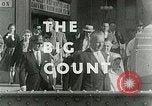
U.S. Census-1960 presented by Department of Commerce, Washington DC.
People watch results of U.S. Census,1960 presented on an electric population chart in the Department of Commerce,Washington DC, showing constant growth in population. The description about what various colors of the light stand for is given in the index, at the side of the chart. Professor Philip Hauser (Director,Population Research and Training Center, University of Chicago) makes a presentation of the census report. George Stone asks questions to him. View of men and women workers walking on a sidewalk in an urban area, bound to or from work and jobs. Construction of roads and highways shown in progress. A suburban neighborhood under construction with houses being built. In a classroom, a boy student solves a sum on the blackboard as the teacher stands next to him. Men at work on a construction site building a house. Cars at gasoline service station with sign "Sinclair". Gas station workers clean windshields and fuel cars. Traffic moves on a divided highway filled with 1950s cars and various automobiles. A train passes by on a platform of a metro or subway system. New office construction sites and new garden apartment (low rise apartments) are seen under construction.
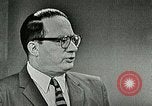
Philip Hauser briefs George Stone on U.S. census from 1820 to 1931 in USA; also some Wall Street depression scenes
George Stone and Dr Philip Hauser at the presentation of U.S. census around 1960. A slide of U.S. map appears on the screen. 1820 and population figures are marked on part of the map inhabited at that time. The reasons for the increase in the population are discussed by George Stone and Dr Philip Hauser. In the next slide census figures of 1830 appears. Concern for the handicapped lead to including of deaf, dumb and blind category in this census is shown. Dr Philip Hauser shows cartoons appearing in newspapers of that time to George Stone. In the next slide, census figures of 1850 and 7 classes of occupation of people are seen. A percentage representation of various occupations in the population is given in the next slide. The stress on accuracy of 1850 census is seen in the next slide. A comparison of number of occupations of males and females from 1840 to 1870 is shown in the next slide. Census of 1930 is mentioned in the next slide. 1931 is shown as a Special Unemployment Census. Newspaper headlines about stock market crash is seen. Around clip timecode 8:13 are images of Wall Street New York Stock Exchange floor near time of stock market crash. Wall Street region in New York City filled with people and views of lines or queues for homeless, unemployed, or food relief during the Great Depression.
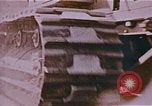
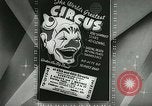
Movement of the circus from town to town, and the business of operating a circus
Taking down the tents and packing up a circus. Ringling Brothers Barnum and Bailey circus workers and local workers disassemble the tents and stages, load wagons and with help from elephants and bulldozers they pack up before heading to a new city. These scenes appear to be 1950s-196s. The circus train moving at speed. Following scenes appear to be early 1970s: Circus managers seated at a table planning a circus act. Scenes of the decorated performers in a real circus. Clowns performing. Circus managers viewing a potential new act involving trapeze,cycles, and acrobatic feats. Performers practicing without an audience.
African American Jesse Jackson introduced and interviewed by a press panel in the United States.
Jesse Jackson is interviewed in a press conference. Henry McGee, Newsweek Magazine; Patrick Borgan, London Times; and Judith Randal, New York Daily News comprise the interview board. Bill McCrory of Voice of America is the moderator. Jesse Jackson answers the Interview board over the moral authority of black Americans.
CRITICALPAST.COM: About Us | Contact Us | FAQs - How to Order | License Agreement | My Account | My Lightboxes | Shopping Cart | Advanced Search | Featured Collections | Website Terms & Conditions | Privacy Policy ©2026 CriticalPast LLC.
License Agreement |
Terms & Conditions |
Privacy Policy
©2026 CriticalPast LLC.