


 Francais
 Deutsch
 Italiano
Refine Your Search
Tontouta New Caledonia 1943 stock footage and images
- Showing 5197 to 5202 of 10520 results more
more Hide
Hide
Franklin D Roosevelt during his Presidential campaign in Boston, Massachusetts.
Franklin D Roosevelt's election campaign. A large crowd cheers at a public meeting during Roosevelt's election campaign in United States. A train pulls up at a station in New England. Roosevelt along with Alfred E Smith receives a warm welcome at the convention hall in Boston. Franklin D Roosevelt's election campaign. A large crowd cheers at a public meeting during Roosevelt's election campaign in United States. A train pulls up at a station in New England. Roosevelt along with Alfred E Smith receives a warm welcome at the convention hall in Boston.
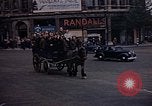
Victory in Europe: People celebrate in London, England as Germans surrender in World War II.
Germany surrenders in World War II. British soldiers and citizens loaded in a horse drawn carriage ride down a street in London and wave during celebrations on news of German surrender that day. A man selling the May 7, 1945 London newspaper "The Evening News" with headline "Germany Surrenders". A number of men and women buy newspapers from him. Allied soldiers in a jeep with American flag on it. They shake hands. Men and women march down a road with a British flag as they celebrate Allied victory in Europe during World War II. They are also rolling a statue on a cart. Happy British citizens celebrate VE Day.
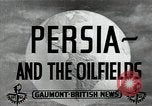
British newsreel detailing crude oil extraction and refinement efforts in Persia (present Iran) since the early 20th century
Newsreel titled, 'Persia and the Oil Fields." Narrator chronicles discovery of oil in Persia, benefits of oil to the local economy, and British involvement via the Great Oil Company (now British Petroleum). View of barren lands in Persia (now Abadan in Iran). Oil drillers at work in a refinery amidst the barren lands. Construction of oil refinery at Abadan. Oil revenue brings benefits to the people, as shown by new bridges, school buildings, teachers and young girl and boy students in classroom, and college students studying technical subjects. Professor instructs in front of a blackboard filled with mathematical formulas. Workers at metal shop machines applying new technical knowledge. Oil pipe lines laid across stretches of undeveloped land near Abadan, Iran. Crude oil bubbling from the ground. View of several British oil transport ships at a dock in the Persian Gulf, including "Umaria London", the "British Guardsman" and the "British Virtue." Narrator eludes to the then current difficulties in relations between Iran and Britain, due to the British oil embargo following nationalization of Iran's oil reserves by Mosaddegh.
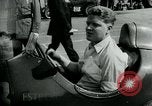
Japanese and French confer in Hanoi; war materiel supplies to China cutoff at Yunnan and Canton; British forces departing Shanhai
Clip opens with unrelated brief two second view of Frank Griswold, winner of 1940 New York World's Fair road race, waving from behind the wheel of his 1934 Alfa Romeo Tipo B after the race. Scene changes to views through the fertile countryside of French Indochina on a trip to Hanoi early in World War II. Narrator notes Hanoi is a principal supply hub for war materiel destined for General Chiang Kai-shek; supplies which the French have now interrupted at the request of Japanese authorities. A train arrives at station in Hanoi. People at the station. Views of downtown buildings of Hanoi and a market place. Street vendors selling foods and goods. A woman carrying a basket on her head. Rickshaw pullers at work behind several people seated at a street-side outdoor cafe. Narrator notes views are proceeding toward the central park where the residence of the head of the new government is located. Views of a couple in formal suit and dress strolling in the park. Major General Nishihara, head of the Japanese mission, is seen exiting a building following talks with the French Governor-General. Scene changes to Lao-Kai (or Lai Cai), a border station between French Indochina and China, where narrator says supply inspectors from Japan have traveled to examine the situation. View of the Yunnan railway with railroad tracks cut off by the French authorities, and guarded by local indigenous soldiers with conical hats (nón lá). Scene changes to the harbor at Canton China. Large ships anchored in harbor. Barrels or drums on the ground near docks, as narrator notes that large quantities of war supplies no lie idle and unusable on the port docks. Scene changes to Shanghai. A procession of forces from Great Britain on parade at a racecourse or stadium, and in the streets of the city, including uniformed bagpipers. Narrator notes it marks the end of British supremacy in China, with the first contingent of British troops departing Shanghai.
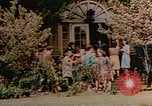
Idyllic scenes of American natural resources, lifestyle, and industry in the late 1940s
American teenagers walking in and out of a school or other institution. Movie set view of a immigrant family ostensibly on a ship deck looking outward. A view from the ground of the Empire State Building in New York City. People working on a farm and a red farm barn visible. Wide view of a river with forest on either side. Two people in a canoe paddling on a lake toward log cabin structures. Wide view of High Falls waterfall on Genesee River at Genesee Gorge in Rochester, New York, panning upward to show Williams, Hoyt and Company shoe factory building and buildings of downtown Rochester in more distant background. View looking upward at the Statue of Liberty. Scene with arms of people stretching out across a map of the United States and interlocking hands to represent unity across the nation. People walk towards the horizon.
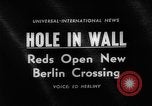
A barricade is raised at the site of the breach in the "Wall of Shame" in Berlin, Germany.
The Soviet controlled East German government opens a new Berlin Wall crossing. A fenced area in Berlin, Germany. A watch tower near the fenced area. The "Wall of Shame" in Berlin has been breached by the East German Red Regime. The new Berlin Wall opening is designed to provide a shorter route to the East Berlin Airport. Military officials in the area. A mason at the construction of a structure. Papers are checked by military officials and a barricade is raised to allow vehicles to pass through.
CRITICALPAST.COM: About Us | Contact Us | FAQs - How to Order | License Agreement | My Account | My Lightboxes | Shopping Cart | Advanced Search | Featured Collections | Website Terms & Conditions | Privacy Policy ©2026 CriticalPast LLC.
License Agreement |
Terms & Conditions |
Privacy Policy
©2026 CriticalPast LLC.