


 Francais
 Deutsch
 Italiano
Refine Your Search
Tontouta New Caledonia 1943 stock footage and images
- Showing 5449 to 5454 of 10520 results more
more Hide
Hide
American soldiers enter city of Leipzig, Germany, and take prisoners of war, during World War II.
American forces in Leipzig, Germany near the end of World War 2 in Europe. Landmarks include the heavily damaged New Town Hall, Burgplatz, and a church. At start of film, German civilians are seen running along railroad tracks, past war-damaged platform, to reach a train. Hungry German civilian men wrestle with a man on a sidewalk holding a large piece of meat. American soldiers walking across a city square in single file. Two Sherman tanks move across city square following the tracks of a tramway. The overhead electric wires for the tram are visible. More views of American soldiers walking and some in jeeps. A tilted view of the Reform Evangelist Church. Then camera straightens out and shows it properly. In front of the church, two American soldiers sit on a half-track with M45 Quadmount (Maxson) Anti-Aircraft guns installed on it. Back of the half-track has "660 AAA" stenciled on it. Many Jerry cans are held in racks along the sides of the half-track. Scene shifts to a formation of German prisoners of war with their hands over their heads. Close-up views of faces of German soldier prisoners of war. Camera pans across them, closeup. They carry all their personal gear, including bed rolls, but no weapons. View from behind them. Wider glimpse of the prisoners under guard. The severely damaged 1928 Kroch Building (Krochhochhaus) is seen in the background. Several German prisoners sit in a jeep, guarded by an American soldier with an M3 .45-caliber sub-machine gun ("grease gun"). At the end of the film, the bomb damaged 1905 New City Hall (Neues Rathaus) is seen in the background.
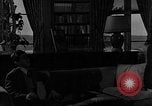
Toscanini and various other Italian scholars in the U.S. work to uphold democracy and reject fascism during World War 2.
Italian conductor Arturo Toscanini is seen in a room of his house, Wave Hill, in the Hudson Hill section of Riverdale in the Bronx, New York City. Toscanini is handed a record by teenage boy (possibly his grandson) and Toscanini plays the record on a console phonograph player. He walks up and down in the room as he listens to the music. Narrator discusses Toscanini's rejection of fascism. and then names various other Italians living in the U.S. who similarly reject fascism: Next shot shows Italian historian Gaetano Salvemini delivering a lecture to a class at Harvard University. Italian writer Giuseppe Antonio Borgese leads a small workshop class at the University of Chicago. Italian American press publishers of newspaper Il Nuovo Mondo (Giuseppe Lupus, Aurelio Natoli, and Carlo Emanuele Prato) are seen gathered at a desk in New York City. An Italian editor, Colonel Randolfo Pacciardi, works at a newspaper establishment. An Italian priest and patriot, Don Luigi Sturzo, reads a book. Another close-up view of Arturo Toscanini.
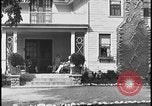
1928 film advertising Ford Motor cars
Opening scene shows women gathering for a bridge club party. They each drive to the party in their own cars and park in front of the house. While waiting for the last club member to arrive, they relax on the front porch of the hostess's home. They wear the fashions of the period, including Cloche hats, and some like flappers. The last woman to arrive drives a new Ford sedan, which attracts immediate attention from all the other women, who leave the porch and admire her car. Scene shifts to the next gathering of the bridge club, when all the womens' cars parked in front of the house, are new Fords.
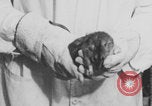
Rats being used for experimentation of animal behavior in crowded space by scientist
In a laboratory, a scientist places a rat in a small cage containing another rat. The latter attacks the new rat, after it felt threatened by its unfamiliar presence. The attack stops and the rat sniffs the newcomer. The new rat walks away. The rat attacks the newcomer again.
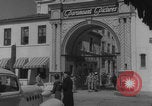
Film executives meeting in Los Angeles; Work Progress Administration staff and actors under WPA Federal Theater Project prepare and perform on stage
View of Paramount Pictures movie studio entrance. Hollywood film executives such as Paramount Picture’s Adolph Zukor in a meeting. View of Motion Picture Daily with news saying “Federal- NBC Units to Use Film Houses”. Two men buy theater tickets for a vaudeville show by the Federal Theater Project of the Great Depression organization called the Works Progress Administration (WPA). Works Progress Administration staff under the Federal Theater Project create props and stage design. A Works Progress Administration carpenter uses a Delta woodworking machinery. Works Progress Administration costume designer shows a design for a dress. Close up shot of Works Progress Administration costume designer. WPA technicians work on stage set design. A Works Progress Administration tailor measures a portly actor’s waistline. Seamstresses working in the costume department of the Federal Theater Project. Artist painting a background for a stage play. A seamstress adjusts a high slit dress of an actress. A milliner arranges a Fascinator, with tulle and pom-poms, on an actress’ head. Two actors and an actress practice a dance number together. Men and women dancers practice a dance. A pair of dancers perform a no-touch tango. Theater marquee saying, “Oh say can you sing WPA Music Comedy”. Newspaperman announcing show business news on newspaper. Orchestra plays inside a theater. Actors and actresses, in different period costumes, perform “Oh Say Can You Sing” as an ensemble after the curtains opened. View of faces of audience members as they clap and smile after watching the performance.
Scenes from WW1 include Woodrow Wilson, Franklin Roosevelt, troop deployment, munitions factory, ship building, WWI battle, and Armistice Day.
A title reading “1917”. An American ship sinks down in the Atlantic Ocean after it was torpedoed by a German U-Boat during World War I. United States President Woodrow Wilson signs the United States declaration of war on Germany. President Woodrow Wilson at work in his desk. A United States soldier blows a trumpet. United States soldiers crowd the deck of a ship sailing to Europe during WWI. The American Expeditionary Forces are waving as the ship sails away from the port. Franklin Roosevelt during World War I. American troops disembark from their ships after arriving in Europe. American women working in military supply factory. Women manufacture bullets using hand drills. A woman assembles munitions. Men building battleships at shipyard assembly line. Allied soldiers running in the battlefield to avoid being hit or bombed by the Germans. Bombs explode in the battlefield in Europe during World War I. Soldiers avoid bombs. A railway gun fires. An biplane falls in smoke after being hit. Explosion from tank in battlefield. Soldier rolls down to a trench. Explosion beside a rolling tank. A German soldier ducks in trench. An Allied soldier fires from a trench. A soldier behind him throws a grenade. Soldier with machine gun ducks from a trench. Tank rolls and fires in battlefield. Black explosion in battlefield. Soldiers run and avoid explosions. German soldiers fire a machine gun and throw grenades. Surrendered German prisoner soldiers march out as prisoners-of-war. American soldiers celebrate Armistice Day. View of the United States flag. Allied soldiers march in victory through ruined city. Americans celebrate Allied victory in World War I, filling with crowds in New York City. Americans hold banner saying, “Germany Surrenders”. Celebrating Americans in New York City, hold American flags and their hats triumphantly after Allied Victory in World War I.
CRITICALPAST.COM: About Us | Contact Us | FAQs - How to Order | License Agreement | My Account | My Lightboxes | Shopping Cart | Advanced Search | Featured Collections | Website Terms & Conditions | Privacy Policy ©2026 CriticalPast LLC.
License Agreement |
Terms & Conditions |
Privacy Policy
©2026 CriticalPast LLC.