


 Francais
 Deutsch
 Italiano
Refine Your Search
Tontouta New Caledonia 1943 stock footage and images
- Showing 5485 to 5490 of 10520 results more
more Hide
Hide
Unwanted immigrants in Communipaw are herded aboard the Ellis Island Boat to await passage back to Europe.
Early newsreel with narration showing round up and deportation activities for illegal immigrants and unwanted immigrants in America. The immigrants, including men, women, and children of the immigrants, are seen disembarking from a train at Communipaw, New Jersey and preparing for deportation out of the United States. The immigrants were gathered together from across the U.S. for numerous offenses, according to the narrator, including sneaking into the country illegally, committing crimes, or being Communist sympathizers, the 400 men, women and children are herded aboard the Ellis Island Boat to await deportation back to Europe. The Ellis Island Boat leaves the shore, pushed by a tugboat.
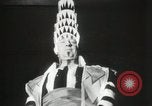
Architects dressed as buildings at Beaux Arts Ball.
Architects of important landmarks dressed as their designed buildings at Beaux- Arts Ball. They include, left to right, Leonard Schultze as the Waldorf-Astoria, William Van Alen as the Chrysler Building, Ely Jacques Kahn as the Squibb Building, Ralph Walker as the Wall Street Building, Arthur J.Arwine as a low pressure heating boiler, A. Stewart as the Fuller Building and Joseph Freelander as the Museum of the City of New York. They each wore a helmet-like construction of the building they had designed (23 January 1931).
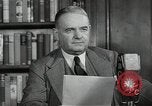
Colonel William Joseph Donovan gives a speech about danger emerged in Atlantic due to Hitler's policies
Colonel William Joseph Donovan gives a speech in New York. He holds papers in his hands. Books arranged in shelves behind him. He speaks about dangers in the Atlantic due to Hitler's policies.
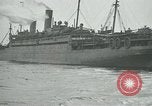
USS George Washington, departs from Hoboken for Paris Peace Conference at end of World War I
USS George Washington departs from Hoboken, New Jersey bound for the Paris Peace Conference at end of World War 1, with President Woodrow Wilson and his party on board. Smoke rises from stacks of the ship. Hoboken buildings and skyline in the background as seen from ship on the water. Silhouette of ship. A zeppelin airship (presumably of the U.S. Navy) in the sky over the port. It passes near the USS George Washington. A biplane aircraft in the sky passes by ship. A barge with stripes painted across entire exterior. Barge, airship and airplane in the sky seen. (World War I; World War 1; WWI; WW1)
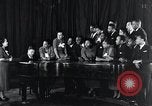
African American men and women sing spiritual song "Ezekiel Saw the Wheel"
Employment for African Americans provided by Works Progress Administration (WPA) Projects in New York, United States, during the Great Depression. African American men and women sing in a choir. Juanita Hall directs the song. A man plays piano. Men and women stand near piano and sing the gospel spiritual song ''Ezekiel Saw the Wheel". The Director conducts and sings along with the choir.
President Wilson votes in 1916 election. American soldiers cast ballots at army camp. British women work in industry to help during World War I
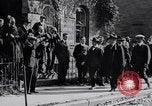
President Woodrow Wilson voting in the Presidential election on November 7, 1916, in Princeton, New Jersey. He is seen walking with an entourage, along the sidewalks of Chambers Street, past the entrance to G.A. Rule Real Estate offices, where men on the steps, remove their hats in acknowledgement and respect. The President and his party continue on to the old firehouse, that has been set up as a polling place. After greeting people there, President Wilson enters to vote. He comes out of the building after casting his ballot and doffs his hat to the camera and people in the vicinity. The scene shows American soldiers at an army camp casting their ballots in the election. They huddle around tables where there names are checked on voter lists and they receive ballots. One soldier is seen sealing his ballot before depositing it in a ballot box. Camera focuses on a ballot table with soldiers crowded around it. The final segment of the film contains completely unrelated footage of British women in the United Kingdom working in an industrial operation during World War 1. Some are seen at a railroad siding, clearing up scrap beside open rail cars. They use wooden wheel barrows with wooden wheels. Two women push a load of steel rail parts on a small flat rail car. In another location at the plant, women push a flat rail car loaded with lumber to a spot where several other women remove and stack it. Many steel railroad wheels are lined up in the background. The camera focuses on women pushing railroad axles, assembled with wheels, along tracks, toward a building in the rail yard. Two women touch-up paint on the side of a railroad car, as another woman (supervisor) watches. Back at the area of stacked lumber, two women fabricate something using a saw and hammer and nails on lumber placed atop wooden saw horses. Another woman wields a hammer in the background.
CRITICALPAST.COM: About Us | Contact Us | FAQs - How to Order | License Agreement | My Account | My Lightboxes | Shopping Cart | Advanced Search | Featured Collections | Website Terms & Conditions | Privacy Policy ©2026 CriticalPast LLC.
License Agreement |
Terms & Conditions |
Privacy Policy
©2026 CriticalPast LLC.