


 Francais
 Deutsch
 Italiano
Refine Your Search
US-Gliders- stock footage and images
- Showing 6025 to 6030 of 21999 results more
more Hide
Hide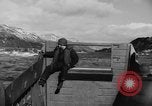
U.S. soldiers aboard LCMs (Landing Crafts, Mechanized) head for a beach in the Firth of Clyde, Scotland.
Maneuvers prior to D-Day landings in the Firth of Clyde, Scotland. A U.S. soldier sits on the stern of a landing craft underway. Many LCMs (Landing Crafts, Mechanized) underway. French LCMs underway. A French flag flying from the craft. The soldier sends a semaphore signal from an LCVP (Landing Craft, Vehicle, Personnel). The coastline of Scotland in the background. (World War II period).
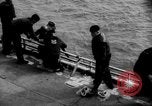
U.S. troops come on the deck of USS Bayfield (APA-33) in the Firth of Clyde, Scotland (WW2)
Maneuvers prior to D-Day landings in the Firth of Clyde, Scotland during World War II. U.S. troops come onto the deck of USS Bayfield (APA-33). An LCVP (Landing Craft, Vehicle, Mechanized) pulls alongside USS Bayfield. The troops come up a cargo net. USS Bayfield in a harbor. Amphibious crafts in the foreground.
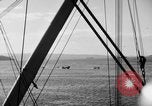
U.S. troops aboard USS Bayfield (APA-33) during pre-invasion maneuvers in the Firth of Clyde, Scotland (WW2)
Maneuvers prior to D-Day landings in the Firth of Clyde, Scotland during World War II. Landing crafts heading for a beach as seen from USS Bayfield (APA-33). U.S. troops come onto the deck of USS Bayfield. An LCVP (Landing Craft, Vehicle, Mechanized) alongside USS Bayfield. The deck of USS Bayfield showing troops. A boat crewman secures a line from an accommodation ladder. The troops walk up the ladder.
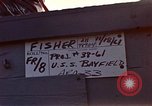
U.S. Marines in an LCVP (Landing Craft, Vehicle, Personnel) during amphibious exercises at White Beach, Okinawa, Japan
U.S. Marines in landing crafts head for White Beach in amphibious exercises at White Beach, Okinawa, japan, on 18 November 1961. Marines on LCVP (Landing Craft, Vehicle, Personnel) underway towards the beach area. The marines look out over the water from the landing craft. A cruiser ship in the far background. A wave of landing craft from the USS Bayfield (APA-33) head in for a beach assault. One of the marines crouches down on the landing craft. The marines wade ashore through the surf after disembarking from the landing craft. An LCM (Landing Craft, Mechanized) moves onto the beach. A Kaman HUK-1 helicopter flies over the beach to land for picking up the wounded. A large explosion occurrs inland on the beach area. Two HR2S1 Marine assault helicopters in flight over water from the beach area. Simulated atomic explosion occur over the assault beach. A landing craft on the beach area. An LCVP moves in from right.
U.S. Marines and LVTAs fire guns during amphibious assault exercises.
U.S. Marines fire machine guns during a beach assault training at White Beach, Okinawa, japan. The marines run parallel to the beach. A landing craft on the beach. A jeep moves from the landing craft onto the beach area. LVTAs (Landing Vehicles, Tracked, Armored) lined up on the beach. An LCM (Landing Craft, Mechanized) on the beach. An M50 Ontos tank in one of the landing craft. LVTAs fire from the beach. The marines disembark from an LCVP alongside USS Bayfield (APA-33). The marines climb up a cargo net to board USS Bayfield. Crew members of USS Bayfield pull in the cargo net to make it tighter for the marines. The crew rolls up the cargo net. A Marine 2nd Lieutenant on the deck of USS Bayfield.
U.S. Marines disembark from USS Bayfield (APA-33) during amphibious training exercise at White Beach, Okinawa, Japan.
U.S. Marines disembark from USS Bayfield (APA-33) during amphibious exercises in Okinawa, Japan. A crewman tends to the winch on the deck of USS Bayfield (APA-33). A I-JV telephone talker and a BM (Boatswain's Mate) on the deck of the ship. A crewman at the controls lowers down an LCVP (Landing Craft, Vehicle, Personnel) from the ship. Members of the crew handle lines. The BM gives a signal. The marines disembark from the ship onto the LCVP. The marines climb down cargo nets and onto the LCVP. The marines in LCVP head for the beach. USS Bayfield in the background. A coxswain in one of the landing craft.
CRITICALPAST.COM: About Us | Contact Us | FAQs - How to Order | License Agreement | My Account | My Lightboxes | Shopping Cart | Advanced Search | Featured Collections | Website Terms & Conditions | Privacy Policy ©2026 CriticalPast LLC.
License Agreement |
Terms & Conditions |
Privacy Policy
©2026 CriticalPast LLC.