


 Francais
 Deutsch
 Italiano
Refine Your Search
US-Gliders- stock footage and images
- Showing 661 to 666 of 21920 results more
more Hide
Hide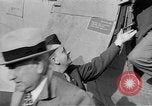
U.S. Army General Omar Nelson Bradley greets U.S. publishers and editors as they arrive in Reims, France.
U.S. publishers and editors visit Reims, France during World War II. The publishers and editors disembark from an aircraft. Aircraft parked at an airfield in the background. U.S. Army General Omar Nelson Bradley greets the visitors.
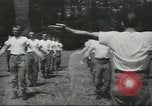
Headquarters Company U.S. Army drill during ongoing physical training serving the U.S. Army Military District of Washington
U.S. Army personnel assigned to the Military District of Washington DC undergo a physical training in Washington DC. At the U.S. Army Military District of Washington soldiers perform drills during ongoing physical training and maintenance. Soldiers stand in formation (this appears to be near grounds of the Pentagon in Arlington Virginia with George Washington Memorial Parkway in background) and their platoon Sergeant, Master Sergeant Queen, inspects them. Shown is the insignia of the unit: a sword across the Washington Monument.
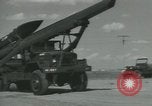
The U.S. Army conducts a number of test firings of tactical missiles for use in the field by Army troops
The U.S. Army test launches missiles in the United States. An Army Honest John missile is moved on its transporter launcher into position near some trees at an Army testing site. An army crew uses controls built into the launcher to raise it into a 45-degree launch angle. Closeup of soldier counting down to launch time and then signalling with his arm. Two hands are seen pushing down the plunger handle of an igniting control, and the missile launches in a burst of black smoke. It explodes in the distance raising a small mushroom cloud from its tactical nuclear warhead. A Little John, replacement is launched and disappears in distance. Next, an MGM-18 Lacrosse missile is seen on launch pad and then fired, leaving a trail of white smoke. View of it crashing onto the ground without any explosion.
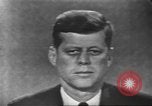
During an election debate in the US, John F Kennedy and Richard Nixon talk about the conduct, temperament, and speech of the U.S. President.
The third Kennedy-Nixon Presidential Debate in the United States. Charles Van Fremd from CBS News asks Democratic candidate Senator John F Kennedy whether he owed an apology to Vice President Nixon and the Republican Party, on behalf of Democrats, after former President Harry Truman "bluntly suggested where the Vice President and the Republican Party could go." Kennedy answers that President Harry S Truman has his methods of expressing things and he has been in politics for fifty years. He says that he could not tell President Truman to change his particular speaking manner, and perhaps only Mrs Truman could. Republican candidate Vice President Richard M Nixon says that U.S. President has an obligation not to lose his temper in public. He speaks of the importance of the standing of the office of the President, and how children all over America are influenced by the behavior and words of the President. He states that he is proud that President Eisenhower has restored dignity and good language to the conduct of U.S. Presidency. He implies that if he wins the election he would be the right kind of role model for children.

U.S. President Richard Nixon addresses people in the United States on withdrawal of remaining U.S. troops from Vietnam.
Television broadcast of U.S. President Richard Nixon's speech from the White House in Washington DC, United States on the withdrawal of remaining U.S. troops from Vietnam on 29th March 1973 during the Vietnam War. The White House. The Seal of the President of the United States. The President talks about that period of the Vietnam War when he joined the office and speaks about the program he initiated to end the war. He says American prisoners are on their way from Vietnam and people of South Vietnam are now free to choose their government. He says North Vietnam is not complying with few provisions of the Peace Agreement. He says that they should honor all those American soldiers who died during the Vietnam War. He refers to the difficult days of the war including the moratorium to end the war which was organized on October 15, 1969 when millions of Americans took day off from work and schools to participate in local demonstrations against the war. Nixon refers to the period of April 1971 when he ordered attacks on Communist bases in Cambodia. He talks about the period of May 1972 when he ordered air strikes in North Vietnam and the period of December 1972 when he ordered more air strikes.
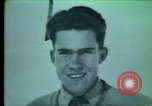
Prior to 1968 U.S. Presidential Election, Richard Nixon recounts his past when he was enlisted in the U.S. Navy.
Self-portrait of Richard Nixon aired during his 1968 presidential run against Hubert Humphrey and George Wallace in the United States. Pictures showing young Richard Nixon and his old home. An interviewer asks him about the period when he enlisted in the U.S. Navy. A 1945 picture of U.S. Navy Lieutenant Commander Richard Nixon. He speaks about his views about the problems the nation confronted in World War II.
CRITICALPAST.COM: About Us | Contact Us | FAQs - How to Order | License Agreement | My Account | My Lightboxes | Shopping Cart | Advanced Search | Featured Collections | Website Terms & Conditions | Privacy Policy ©2026 CriticalPast LLC.
License Agreement |
Terms & Conditions |
Privacy Policy
©2026 CriticalPast LLC.