


 Francais
 Deutsch
 Italiano
Refine Your Search
US-Gliders- stock footage and images
- Showing 6841 to 6846 of 21999 results more
more Hide
Hide
U.S. Sergeant Raymond Taylor is posthumously awarded with the Silver Star Medal in New York, United States.
A posthumous award ceremony for U.S. Sergeant Raymond Taylor in New York, United States. Commander of the First United States Army Withers A. Burress awards posthumous Silver Star Medal to the mother of Sergeant Raymond Taylor for his gallantry and action in the Korean War.
U.S. Air Force aircraft drop parachute food supplies over Japan following floods and volcanic eruptions.
Disasters in Japan. Rescue operations in Kyushu Island after being stricken by floods. Japanese people evacuating on Honshu Island following volcanic eruptions. Flooding in Honshu Island. U.S. Air Force aircraft drop parachute food supplies over Japan.

U.S. Senator from California Knowland praises the achievements of the ongoing session of the Congress in Washington DC.
U.S. Senator from California William F. Knowland speaks in Washington DC, United States. Senator Knowland highlights the achievements of the ongoing session of Congress which is about to adjourn. He praises the legislative body's record of accomplishments.
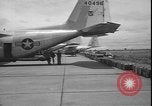
U.S. Air Force C-130 aircraft airlift freed hostages from Stanleyville, to Leopoldville, Republic of Congo
Crisis of Insurrection in Republic of Congo. A U.S. Air Force C-130 aircraft parked on a ramp. A B-26 aircraft taxiing behind it. Belgian troops with their gear rest in shade under wing of a C-130 aircraft. Ambulances drive to the tail of a C-130 that just arrived. The tail door of the aircraft opens and Belgian women and children (hostages freed from Stanleyville) come down the ramp. They are met and driven away. Another C-130 arrives and also discharges freed Belgian hostages.
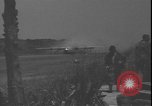
Freed hostages board a U.S. C- 13OE aircraft in Paulis, Republic of Congo
A U.S. Tactical Air Command C-13OE plane lands and raises considerable dust as it fully reverses all four engines to stop on the short dirt runway at Paulis, Republic of Congo, for evacuation to Leopoldville. Belgian soldiers direct the former hostages to board the aircraft. They do so carrying personal luggage. Several of the freed hostages appear to be clergymen.
Freed hostages board a U.S. Air Force C- 13OE aircraft in Paulis, Republic of Congo
View from cockpit of a U.S. Air Force C-130 aircraft through final approach and landing at Paulis airfield, Republic of Congo. On the ground, Belgian soldiers direct former hostages to board with their baggage via the rear door of the aircraft. View of the C-130 taking off from the airfield. Soon after, another C-130 lands, raising much dust as it reverses all four engines.
CRITICALPAST.COM: About Us | Contact Us | FAQs - How to Order | License Agreement | My Account | My Lightboxes | Shopping Cart | Advanced Search | Featured Collections | Website Terms & Conditions | Privacy Policy ©2026 CriticalPast LLC.
License Agreement |
Terms & Conditions |
Privacy Policy
©2026 CriticalPast LLC.