


 Francais
 Deutsch
 Italiano
Refine Your Search
US-Gliders- stock footage and images
- Showing 6883 to 6888 of 21999 results more
more Hide
Hide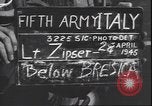
Special equipped vehicles of U.S. 1st Armored Engineer Assault Company in Bresica, Italy.
U.S. 1st Armored Engineer Assault Company in Bresica, Italy during World War II. Special equipped vehicles including Arks, Flails and Fascinette carriers move out of a camp area.
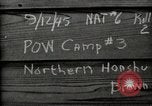
U.S. prisoners being interviewed at a Japanese prison camp in Honshu, Japan after World War II.
U.S. prisoners of war at a Japanese prison camp in northern Honshu, Japan after World War II. The prisoners being interviewed by an officer at the prison camp. The officer interviews prisoners and a medical officer as other prisoners look on. The prisoners speak into a microphone during the interview.
U.S. prisoners attend a prayer service at a Japanese prison camp in Honshu, Japan after World War II.
Japanese prison camp number 3 in northern Honshu, Japan after World War II. U.S. prisoners gathered around a tent for a religious service. A sign outside the tent reads ' Chapel'. A chaplain at the altar. Men on their knees as they offer prayers. Some of them read out from a holy book. The chaplain reads from a scripture. Men kneel down outside the tent. A soldier seated on a chair as another one whispers into his ears. Men with their heads bowed down. The priest speaks to the soldiers after the service.
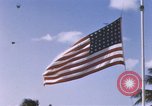
A man at a cemetery and the U.S. flag flies at half staff in the Philippines during World War II.
A cemetery in the Philippines during World War II. Close up view of the American flag as it flies at half mast. Coconut trees in the background. White crosses at the cemetery. A man kneels down in front of the crosses. The U.S. flag flutters in the background. A bell in the foreground.
U.S. Army officers address 6th Army soldiers before New Guinea landings in the South West Pacific during World War II.
The American campaign against the Japanese in the South West Pacific during World War II. A U.S. Army officer at a podium as he addresses soldiers. A large number of soldiers of 1st Cavalry Division seated as they listen to him before New Guinea landings. Another officer addresses the soldiers. The soldiers at a map as they are being briefed. The soldiers in combat gear as they prepare for the landings. A sign reads 'Headquarters of the Sixth Army entrance'. A man at a wireless receiver set as he wears headphones. A picture of a woman on the desk.
Two U.S. Army Air Forces P-51fighter planes crash in a residential area of Jacksonville, Florida.
Aftermath of an accident on July 20, 1944, when two U.S. Army Air Forces P-51C Mustang fighter planes,flying low in close formation, struck a palm tree and collided over the 2800 and 2900 blocks of Post Street, in between Willow Branch and Cherry Streets. The crash caused a three-alarm fire involving twelve houses, three apartments, and three garage apartments. Both pilots, one a Lee High School Graduate, died in the crash. The only other fatality was a person killed by an airplane engine that crashed into his residence. (Reportedly, the aircraft were buzzing the home where parents of one of the pilots lived, in the 2700 block of Post Street.) Firefighters extinguishing the fire. Smoking houses. Debris lying in the area. People gathered around the houses. A damaged house. A wrecked car. (World War II period).
CRITICALPAST.COM: About Us | Contact Us | FAQs - How to Order | License Agreement | My Account | My Lightboxes | Shopping Cart | Advanced Search | Featured Collections | Website Terms & Conditions | Privacy Policy ©2026 CriticalPast LLC.
License Agreement |
Terms & Conditions |
Privacy Policy
©2026 CriticalPast LLC.