


 Francais
 Deutsch
 Italiano
Refine Your Search
US-Gliders- stock footage and images
- Showing 7681 to 7686 of 21999 results more
more Hide
Hide
U.S. Vice President Richard Nixon serves as a gas station attendant, during campaign for March of Dimes in Washington DC.
U.S. Vice President Nixon is seen at an AMOCO gas station in Washington, DC, where a sign on the gas station reads: "March of Dimes. Nixon inserts hose to refuel a car and checks its oil level. Closeup of two young women in the car who are amused by the goings on. Photographers take pictures. The Vice President wipes the windshield of the car. A sign at the station reads: "Fill 'er up for Polio." A banner reads: "Join the March of Dimes." A little girl sits in a toy car at the station. Nixon walks over, carrying the fuel hose and smiles as he pretends to put gas into her toy car. She turns to look at him and holds up several fingers (possibly to indicate how many gallons she wants.)
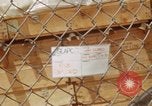
Units of the U.S. Army 101st Airborne Division defend Fire Support Base Ripcord,during the Vietnam war
Elements of the U.S. Army 101st Airborne Division defending Fire Support Base Ripcord in the A Shau Valley, South Vietnam, in the last major battle of the Vietnam War. View from Base Ripcord toward wooded hills from which the North Vietnamese 324B Division is laying siege. It is extremely windy causing canvas covers to flap. The camera is focused on a hilltop where enemy positions are located. Bombs explode there, dropped by U.S.aircraft (unseen). At times large clouds of white smoke rise from the site.
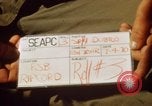
U.S. Army 319th Artillery supports 101st Airborne Division defending Fire Support Base Ripcord, in the Vietnam war
U.S. Army 319th Artillery attached to 101st Airborne Division strengthens defenses of Fire Support Base Ripcord to combat North Vietnam forces in the A Shau Valley, South Vietnam, during the Vietnam War. Opening scene shows Captain David F. Rich, Commander of Battery B, 2nd Battalion, 319th Artillery, conversing with Lieutenant Brennan, in very windy conditions atop the Fire Support Base. The carriage of a 105mm towed howitzer is seen in the foreground, with two shells set on it. View of howitzers and shells stacked atop the Base. The wind whipping aross the Base. African American soldier working on a howitzer. Another fighting the wind, as he carries canisters of propellant charges. He tosses them behind the sandbagged artillery position. Other soldiers join in moving gunpowder canisters. Closeup of two soldiers as the wind blows the hat off one.
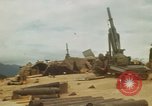
U.S. Army Battery B, 2nd Battalion, 319th Artillery, fire howitzers defending Fire Support Base Ripcord, in the Vietnam war
U.S. Fire Support Base Ripcord in the A Shau Valley, South Vietnam, under siege by North Vietnam Army forces during the Vietnam War. Several 105mm towed howitzers are positioned atop the base, with barrels at high elevations. Camera focuses on Gunners loading and firing one. The wind is blowing very hard, complicating their activity and causing the cameraman trouble too, as it buffets his camera. The camera views several guns operating in the battery. The Battery then level their guns to fire point blank at their targets. (They also increase their powder charge to 7, the maximum.) the resultant recoil strikes and injures SP/4 Bowing of a gun crew, who falls and is seen lying at the back of his gun. The crew calls for help and carries him to the ground. Cameraman stops filming briefly.. Next, a soldier is seen leaning over SP/4 Bowing, rendering aid.
Lyndon B Johnson and William C. Westmoreland review troops and decorate U.S. Army men at Cam Ranh Bay Air Base in Vietnam.
President of the United States Lyndon Baines Johnson visits Cam Ranh Bay Air Base in Vietnam during the Vietnam War. Troops in formation with all services color guard. President Johnson goes to a platform. Officials salute the President. He steps down from the platform with General William C Westmoreland. The President and General Westmoreland review troops in an open jeep (driven by John P. Ward of Fond du Lac, Wisconsin). Both then return to the platform. Troops march at the air base. President Johnson pins medals on U.S. military men.
Former U.S. President Wilson with wife Edith Wilson pay homage to a soldier at the Arlington National Cemetery in Virginia.
Former President of the United States Thomas Woodrow Wilson at the Arlington National Cemetery in Arlington, Virginia. People gathered at a ceremony. The coffin of a soldier carried over a horse drawn phaeton followed by officers. Former U.S. President Thomas Woodrow Wilson with wife Edith Bolling Galt Wilson in a horse drawn carriage on their way to the Arlington National Cemetery. Soldiers stand in formation. Former President Wilson with wife Edith Wilson arrives at the cemetery. Soldiers carry the coffin out of the horse drawn phaeton. A soldier plays a trumpet. Cars driven among a crowd.
CRITICALPAST.COM: About Us | Contact Us | FAQs - How to Order | License Agreement | My Account | My Lightboxes | Shopping Cart | Advanced Search | Featured Collections | Website Terms & Conditions | Privacy Policy ©2026 CriticalPast LLC.
License Agreement |
Terms & Conditions |
Privacy Policy
©2026 CriticalPast LLC.