


 Francais
 Deutsch
 Italiano
Refine Your Search
US-Gliders- stock footage and images
- Showing 7783 to 7788 of 21999 results more
more Hide
Hide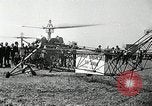
U.S. fighter aircraft designer Igor Sikorsky sets a record for hovering in air for 1½ hours in a VS-300 in Connecticut.
Designer of U.S. fighter aircraft Igor Sikorsky sets a new record for hovering in air for 1:32 in Vought-Sikorsky VS-300 helicopter in Stratford, Connecticut. People stand around the VS-300. A three-blade rotor rotates. VS-300 raises up from the group. The VS-300 hovering in the air. The VS-300 lowers down on the ground. People cheer and wave to Sikorsky for setting a record. People stand around Igor Sikorsky. A man approaches Sikorsky to congratulate him.
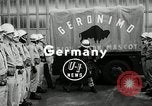
U.S. troops greet a buffalo calf as he arrives to join the 510th Tank Battalion as mascot in Germany.
The U.S. 510th Tank Battalion, of the 10th Cavalry Regiment, in Germany. The unit's roots go back to 1866 (Buffalo Soldiers). Troops lined up for a fun ceremony welcoming their 100 pound baby Buffalo mascot, from Allentown, Pennsylvania. An Army truck with canvas cover sits as backdrop. The canvas is painted with their buffalo unit insignia and the word "Geronimo." A Lieutenant Colonel and a noncom bring the calf forward and it drinks from a container held by the Colonel, who then places large "dog tags"around the calf's neck. The tags read " Allen T. Geronimo" and give its serial number as 12345678, and key dates as 1954. Unit band then plays.
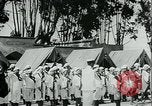
The U.S. marines and officers salute as the United States flag is hoisted in Almeda, California during World War I.
Junior U.S. Marines are being trained in Almeda, California during World War I. The marines stand in formation. Tents in the background. The marines and officers salute as the United States flag is hoisted. The flag flatters in wind.
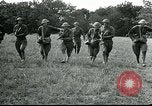
Army soldiers in training at a base in the U.S. during World War I
U.S. soldiers training in the United States during World War 1. Several soldiers run across a field, towards the camera. Two of them carry light machine guns. A bugler leads a group of soldiers towards a mess tent where they are served food,into their mess kits. They eat standing, at long tables. Army Post Brass band marches and plays. Horses and mules in a corral at Army post.
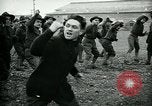
Featherweight Boxing Champion, Johnny Kilbane trains U.S. soldiers at Camp Sherman, during World War I.
U.S. Army Lieutenant Johnny Kilbane, World Featherweight Champion, is seen leading soldiers in a boxing drill, at Camp Sherman, Chillicothe, Ohio, during World War 1.
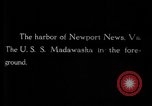
U.S. troops with their supplies depart for World War I duty on USS America and USS Madawaska at harbor in Newport News, Virginia.
American Army forces heading to France during World War 1. U.S. Army troops embark from Newport News, Virginia for France in 1918 during World War I. View of the Newport News harbor. USS Madawaska in the foreground. Other ships in the background. The troops with their supplies embark on USS America. They walk up a gangplank. The troops on the deck of USS America. The troops climb on the mast.
CRITICALPAST.COM: About Us | Contact Us | FAQs - How to Order | License Agreement | My Account | My Lightboxes | Shopping Cart | Advanced Search | Featured Collections | Website Terms & Conditions | Privacy Policy ©2026 CriticalPast LLC.
License Agreement |
Terms & Conditions |
Privacy Policy
©2026 CriticalPast LLC.