


 Francais
 Deutsch
 Italiano
Refine Your Search
US-Gliders- stock footage and images
- Showing 7819 to 7824 of 21999 results more
more Hide
Hide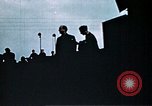
U.S. 351st Bomb Group airmen watch Bob Hope in USO show at their base, RAF Station Polebrook, in World War II
Bob Hope on a USO tour, entertaining airmen of the U.S. 351st Bombardment Group at their base, RAF Station Polebrook, England, during World War 2. He and Jack Pepper are seen tap dancing and clowning for the audience of servicemen. Sweeping view of the audience.
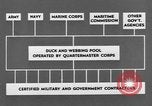
U.S. Army Quartermaster Corps' service areas and procedure of procurement of materials in the United States.
The United States Army Quartermaster Corps in the United States. A diagram showing the functions of the Quartermaster Corps. The service areas of the Quartermaster Corps are the army, the navy, the Marine Corps, the Maritime Commission and other government agencies. Members of the Headquarters Army Service squad and Quartermaster Corps officers seated around a table during a meeting discuss consolidation of procurement of items common to all military services. The U.S. flag behind the officer at the head of the table. Several women in a depot testing materials. Women during the packaging of materials. View of soldiers, paratroopers, jungle troops, mountain troops and amphibious troops who are all served by the Quartermaster Corps. (World War II period).

The U.S. Army Quartermaster Corps store procured supplies and enlisted men are trained in quartermaster operations (WW2)
The United States Army Quartermaster Corps in the United States during World War II. A diagrammatic comparison of army manpower of 8,000,000 in December 1943 as against 1,750,000 in December 1941. A diagrammatic representation of huge increase in volume of obligated procurement in 1942 as against 1941. Men wheeling carts of supplies at a store. Men carrying supplies coming down a gangway from a ship onto a dock. Soldiers with guns standing on the dock. Soldiers moving through a wooded area. Men carrying the procured materials for storing. Officers watching the men. Two soldiers wearing their uniforms. People and vehicles moving on a city street. A signboard on a building reads 'Office of the Quartermaster General War Department'. The headquarters building in view. A map of the U.S. showing locations of different procuring offices across the nation. Men and women working in an office at the headquarters. Petroleum, Subsistence and Textile sections at the headquarters. Officers working in the headquarters. Men getting into a truck. Enlisted men being trained in various quartermaster operations at a training center.
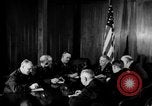
U.S. Army Quartermaster Corps' plan for procurement of materials for military services in the United States (WW2)
The United States Army Quartermaster Corps in the United States. Members of the Headquarters Army Service squad and Quartermaster Corps officers seated around a table during a meeting discuss the procurement plan of items for the military services in World War II. A signboard over the Quartermaster Headquarters building reads 'Office of the Quartermaster General War Department'. A map of the United States shows locations of procurement offices across the nation where authority is given to field officers for procurement. A field officer with a military personnel signing a contract for a fixed amount for the procurement of materials. A map shows the authority given in the procurement of materials which helps in speedy and efficient procurement. A simplified contract form which is used when the prices are known and when the total purchase does not exceed 500 thousand dollars. A purchasing officer hands over the contract to a staff to be sent to a manufacturer or a dealer. The manufacturer in his office signing the contract. Workers at the Quartermaster Headquarters at work.
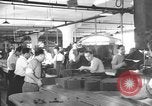
Small war plants' participation in U.S. Army Quartermaster Corps supply program in the United States (WW2)
United States Army Quartermaster Corps supply program in the United States. Workers at small war plants during production of different materials and military uniform parts in World War II. Two officers looking at a sample fur cap. U.S. military personnel with Quartermaster Corps officers seated around a table discuss procurement of materials in association with small war plants. A diagrammatic representation of the increase in the number of purchase transactions and the volume of dollar purchases as a result of the small war plant participation in the Quartermaster Corps supply program for the period of November 1942-43. War produciton workers at the war plants.
U.S. Army 77th Division soldiers fire artillery in the Ryukyu Islands during the Ryukyu Campaign of World War II.
U.S. Army 77th Infantry Division in the Ryukyu Islands during the Ryukyu campaign of World War II. A vessel underway at sea en route to the Ryukyu Islands. Soldiers on landing crafts underway at sea. LVTs (Landing Vehicle Tracked) heading towards a beach. Soldiers unload from the LVTs onto the beach. 305th and 306th Infantry Regiment troops advance inland from the beach. A small building. Two soldiers holding guns in prone position on the side of a road. The soldiers fire the guns. The troops load and fire 81mm mortars. The soldiers standing behind shut their ears. The troops load a 155mm howitzer. The howitzer is fired from beneath a camouflage net. One of the soldiers shuts his ears. Several soldiers on a field and LVTs parked in view. Men of the 304th Field Artillery Battalion remove shells from cartons.
CRITICALPAST.COM: About Us | Contact Us | FAQs - How to Order | License Agreement | My Account | My Lightboxes | Shopping Cart | Advanced Search | Featured Collections | Website Terms & Conditions | Privacy Policy ©2026 CriticalPast LLC.
License Agreement |
Terms & Conditions |
Privacy Policy
©2026 CriticalPast LLC.