


 Francais
 Deutsch
 Italiano
Refine Your Search
US-Gliders- stock footage and images
- Showing 7855 to 7860 of 22001 results more
more Hide
Hide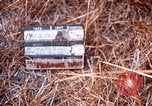
U.S. Army soldiers rest and then advance across a field in South Vietnam during the Vietnam War.
U.S. soldiers of the 2nd Battalion, 503rd Airborne Infantry Regiment, 173rd Airborne Brigade in South Vietnam during Operation Big Spring of the Vietnam War. Soldiers seated in a field with weapons. They rest and talk amongst themselves. A soldier pets a dog. He holds the leash of the dog. Other soldiers stand nearby. A soldier reads a newspaper. A soldier looks at photographs in his wallet. One of them smokes. The soldiers pick up their backpacks and begin to advance across the field. View of soldiers crossing field, approaching camera. Soldiers wearing backpacks and carrying their weapons move through a thick brush area while on patrol.
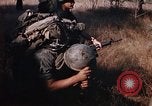
U.S. soldiers advance along a jungle and dig shallow shelters in South Vietnam.
U.S. soldiers of the 2nd Battalion, 503rd Airborne Infantry Regiment, 173rd Airborne Brigade in South Vietnam during Operation Big Spring of the Vietnam War. Soldiers advance along a jungle. Trees in the foreground. Two soldiers talk. They dig shallow shelters in the jungle. They load and fire an 81 mm mortar.
Origin of the U.S. Census and its development and refinement over time.
(Animated cartoons for majority of clip; actual office and early computer scenes near end of clip.) Accompanying narration about the origins of the United States census and establishment of the permanent Census office in 1902. Animation and cartoons illustrate the manner in which the census was taken over its history. A cartoon illustration of census worker, Henry Hollerith, developer of the punch card method of data recording and manipulation. (The 88 column punch cards shown in use in 1950, bear his name.) Equipment illustrated include: punch card sorting machinery; and early digital computer. Actual Images of 1970 era early computer and tape machines and related electronic computer keyboards. A worker mounting a tape on a machine in an office.
U.S. exports, imports and domestic commerce by land sea and air. Census Bureau reports on American industry
New cars being offloaded from a ship at a port. Seaman and dock workers watching over railing of freighter, The "Chesire" with home port of Liverpool England. Closeup of the ship, Tara Maru, with home port Osaka, Japan. A Greek freighter in port. Passengers in rapid transit train traveling beside super highway of many lanes in the United States. View of car and truck traffic on busy highway. A Boeing 727-100 airliner and other passenger aircraft around runways and on tarmac at a civilian airport. Glimpse of various late 1960s and early 1970s cars and trucks on crowded section of highway during heavy traffic. People boarding a bus. Logs, steel tubes, and bulk cargoes being moved. A truck full of lumber. Cargo being loaded on an airplane. A cargo ship passing under the Golden Gate Bridge in San Francisco California. Bureau of Census workers compiling data using early computers, with views of keyboards and tape drives. Bureau reports being placed in envelopes and mailed. Factory workers carrying lunch boxes. Men in business suits carrying brief cases. Entry gate of a prison, with view of permiter fencing and guard tower visible. View upward from inside the prison wall, with barbed wire atop the fence. A court building.
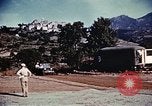
General John Kenneth Cannon and U.S. Army General Jacob Loucks Devers meet in Corsica, France during World War II.
United States Army Air Forces General John Kenneth Cannon in Corsica, France during World War II. General Cannon in a field. Officers seated in a jeep arrive near him. U.S. Army General Jacob "Jake" Loucks Devers dismounts and greets him. Generals Cannon and Devers talk. They walk into a house. Exterior of a Corsican town. General's trailer and a camouflage net.
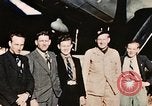
U.S. airmen who escaped internment in Switzerland pose at Annecy airfield, France, during World War II
American fliers who escaped internment in Switzerland, pose in front of a C-47 aircraft at Annecy Airfield in World War 2. They wear clothes provided by sympathetic civilians, and kid about the way they fit. They are accompanied by a Free-French Commandant (equivalent to U.S. rank of Major) who wears rank insignia on shoulders of his uniform and the Cross of Lorraine and rank insignia on his black beret.
CRITICALPAST.COM: About Us | Contact Us | FAQs - How to Order | License Agreement | My Account | My Lightboxes | Shopping Cart | Advanced Search | Featured Collections | Website Terms & Conditions | Privacy Policy ©2026 CriticalPast LLC.
License Agreement |
Terms & Conditions |
Privacy Policy
©2026 CriticalPast LLC.